



Introduction
On January 1, 2027, the CPT 2027 maternity care changes replace the global obstetric package with service-level reporting for antepartum care, labor management, delivery and postpartum care. For practices used to billing one global code after delivery, this is a major operational shift.
The coding structure is final, but payment policy is not uniform. In the CY 2027 Medicare Physician Fee Schedule proposed rule, CMS sought comment on 15 HCPCS G-codes that would keep a global-style payment pathway for Medicare. Some commercial payers are also holding back: in August 2026, Cigna stated that it is not changing its current maternity billing guidance at this time. State Medicaid programs may publish their own instructions.
OB/GYN practices now have two questions to answer: how CPT requires services to be reported and how each payer will process and pay them. This guide covers the confirmed coding rules, what is still pending, how to handle pregnancies that span the change and how to prevent early denials.
2027 Maternity Coding Changes at a Glance
The AMA approved 12 new codes, 6 revised codes and 17 deleted codes for maternity care. The changes replace the legacy global package with separate reporting across four phases of care.
How Global Maternity Billing Worked Through 2026
Under the legacy model, one global code covered routine antepartum visits, admission for labor, the delivery and routine postpartum care. The practice billed once, usually after delivery. Separate delivery-only and antepartum-only codes were used mainly when a patient transferred care.
Legacy global code | Service |
|---|---|
59400 | Routine obstetric care, vaginal delivery |
59510 | Routine obstetric care, cesarean delivery |
59610 | Routine obstetric care, vaginal delivery after previous cesarean (VBAC) |
59618 | Routine obstetric care, attempted VBAC ending in cesarean delivery |
What Changes on January 1, 2027
Phase of care | Through December 31, 2026 | Beginning January 1, 2027 |
|---|---|---|
Antepartum | Routine care included in global or antepartum-only codes | Report the appropriate E/M service for each encounter |
Labor management | Generally included in the delivery or global code | Report initial or subsequent day labor management at the straightforward or complex level |
Delivery | Delivery-only and global codes by method | Report the new vaginal or cesarean delivery code |
Postpartum | Routine care included in global or delivery-plus-postpartum codes | Report E/M services by setting after the delivery date; routine same-day care stays in the delivery code |
The deleted codes are 59050, 59400, 59409, 59410, 59425, 59426, 59430, 59510, 59514, 59515, 59525, 59610, 59612, 59614, 59618, 59620 and 59622. Use the licensed CPT 2027 code set, or the AMA's maternity care codes and guidelines, for complete descriptors and parenthetical instructions.
Why the Maternity Code Structure Is Changing
According to the AMA, pregnancy care is now routinely delivered by multiple, sometimes unaffiliated care teams. The new structure lets each clinician report the care they actually provide and gives payers visibility into real-world care delivery, with the goal of better transparency, data quality and measurement. It supports encounter-level reporting across office, hospital, birthing center, home and telemedicine settings.
What Is Final and What Is Still Pending?
Separating confirmed CPT rules from payer decisions prevents premature EHR changes and inaccurate reimbursement forecasts.
Topic | Status as of September 24, 2026 | Practice action |
|---|---|---|
CPT maternity restructure | Final for dates of service on or after January 1, 2027 | Load the 2027 code set and update charge capture |
New, revised and deleted codes | Published by the AMA; minor editorial refinements may still occur | Confirm final language in the CPT 2027 Professional Edition |
Medicare values for the new CPT codes | Proposed | Model proposed values; wait for the final rule before locking fee schedules |
15 Medicare maternity G-codes | CMS requested comment on a global-style alternative | Do not treat as final; watch the CY 2027 PFS final rule |
Commercial payers | Payer-specific; some, such as Cigna, are keeping current guidance for now | Get written 2027 billing, modifier, bundling and fee-schedule instructions |
Medicaid | State-specific | Monitor each state program and managed care plan |
NCCI and proprietary edits | Not fully available for 2027 | Test claim combinations as edit files are published |
CMS published the CY 2027 PFS proposed rule on July 16, 2026 and the comment period closed September 14. ACOG has publicly responded to the proposed G-codes. Until the final rule is out, treat the G-code pathway and proposed values as planning inputs, not billing instructions.
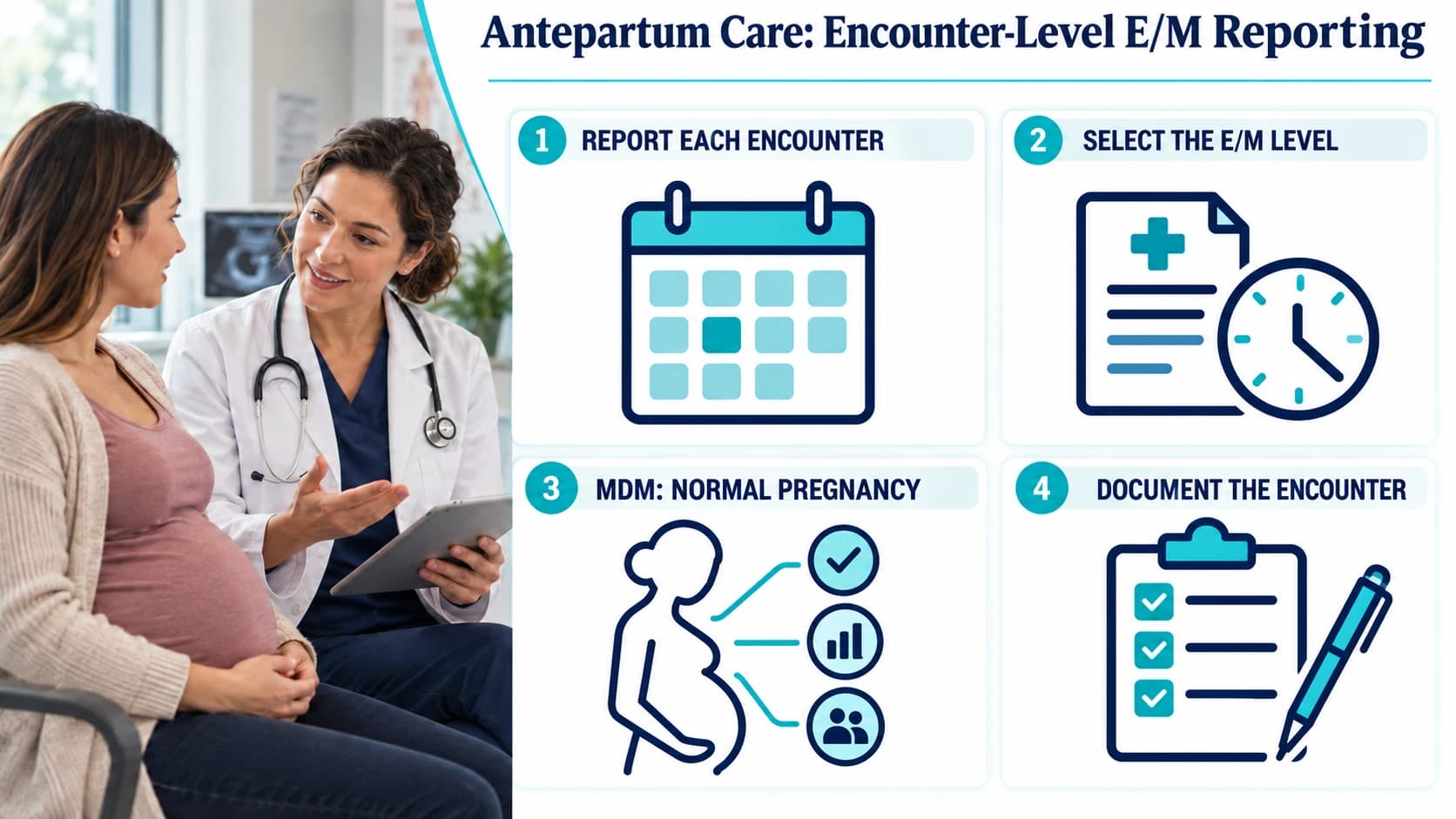
Antepartum Care Uses Encounter-Level E/M Reporting
Starting January 1, 2027, antepartum care is reported per encounter with the E/M service that matches where the patient was seen, such as office, hospital, or telehealth. Office visits use 99202 to 99205 for new patients or 99211 to 99215 for established patients. Telemedicine encounters may use 98000 to 98015 and other settings use their own hospital, observation, home, emergency department, or critical care codes.
A first prenatal appointment is not automatically a new-patient visit. Apply the standard definition: whether the patient received a professional service from the same clinician, or another clinician of the same specialty and subspecialty in the same group, within the past three years.
Select the E/M Level From the Record
Choose the level using medical decision making (MDM) or total time on the date of the encounter. When time is used, it must meet or exceed the code's threshold, for example 20 minutes for 99213. Do not assign a level from the pregnancy diagnosis, visit label, or a preset prenatal schedule.
One point matters for MDM: the AMA antepartum FAQ states that a normal pregnancy is not an acute, uncomplicated illness. For MDM, it fits the moderate problem category of a chronic illness with exacerbation, progression, or side effects of treatment. Count comorbidities only when they are actually addressed at the encounter.
Documentation should show:
- The conditions or pregnancy-related problems addressed
- The data reviewed and analyzed
- The management risk and decisions made
- Total physician or qualified health care professional time, when time supports the code
- A medically appropriate history and exam, an assessment and plan and an authenticated record
Clinical staff time does not count toward physician or qualified health care professional time for office E/M selection. Templates should prompt for the facts that support the service without pushing every visit to the same level.
Match Telemedicine Reporting to the Payer
CPT recognizes telemedicine as a setting for antepartum care, but the correct code family, modifier, place of service, coverage and payment still depend on the payer. Before submitting a virtual prenatal claim, check the payer's eligible services, audio-video or audio-only rules, patient location requirements, modifier instructions (such as modifier 95) and place-of-service policy.
Keep Coding Rules Separate From Visit Frequency Policy
CPT does not cap the number of billable antepartum encounters. ACOG supports tailored prenatal care based on each patient's medical, social and structural needs. Payers may still apply medical necessity, frequency, or prior authorization edits, so document why each visit occurred and keep the care plan on file for payer review.
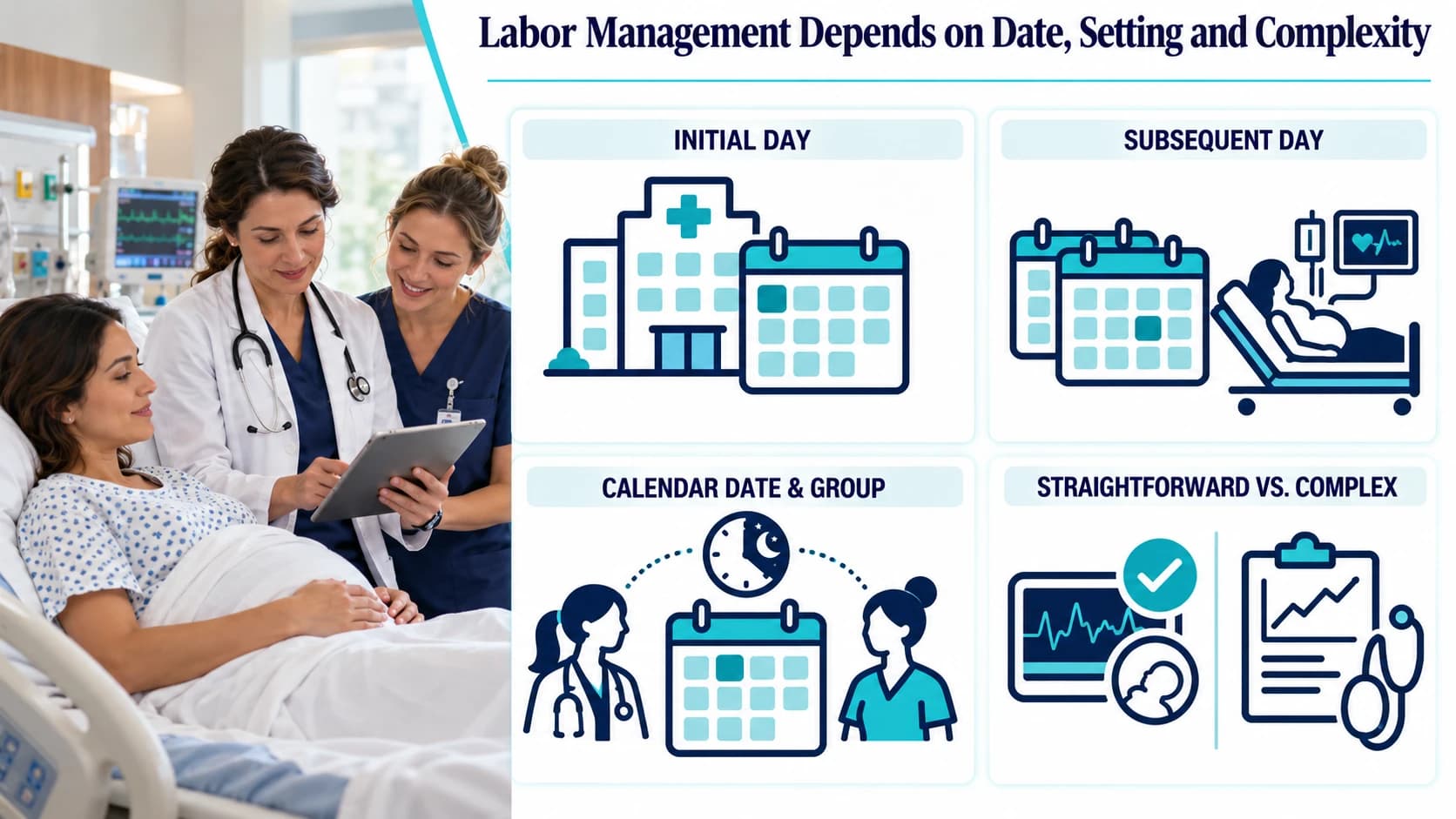
Labor Management Depends on Date, Setting and Complexity
Four new codes describe labor management in a facility such as a hospital or birthing center.
Code | Service |
|---|---|
59080 | Initial day labor management, straightforward |
59081 | Initial day labor management, complex |
59082 | Subsequent day labor management, straightforward |
59083 | Subsequent day labor management, complex |
Labor management includes interim examinations, review and interpretation of physiologic data and induction or augmentation activities described in the CPT guidelines. These are not reported separately.
Apply the Calendar Date and Group Rules
The same clinician, or clinicians in the same group and specialty, report one labor management service per calendar date at the highest supported level. Never report both straightforward and complex labor management for the same date.
The initial day is the first calendar date of the facility admission when labor management starts. Subsequent day codes apply to later dates, including the delivery date when labor management is performed. A continuous service that crosses midnight is reported once, on one of the two dates.
Straightforward Labor Must Meet Every Criterion
Straightforward labor management requires all of the following: singleton vertex presentation, routine maternal and fetal monitoring, no fetal monitoring finding that requires clinician intervention, normal progression or routine induction or augmentation, stable medical conditions that need no added management and no prior cesarean.
If any criterion is not met, the service is complex. Examples include multiple gestation, non-vertex presentation, a prior cesarean, a fetal heart rate abnormality that changes management, preeclampsia, or another maternal condition that needs added management. Length of labor alone does not make it complex unless prolonged labor is diagnosed.
Know When Labor Management Is Not Reported
A scheduled cesarean performed before labor begins does not support a labor management code. A patient evaluated for false labor and discharged without delivering is reported with the E/M service for that setting.
An office or emergency department E/M service earlier the same day may be reported separately when the patient is later admitted for labor management, typically with modifier 25. Labor management and delivery are also separately reportable on the same date, but check NCCI edits and payer bundling rules before submitting.
Delivery Care Uses New Procedure Codes
The new delivery codes cover the delivery event and routine postpartum care on the same calendar date. Vaginal delivery codes include delivery of the placenta and repair of first- or second-degree lacerations by the delivering clinician or their group. Cesarean codes include incision, delivery, placenta and closure.
Code | Service |
|---|---|
59431 | Vaginal delivery, with or without episiotomy |
59432 | Vaginal delivery, with or without episiotomy, after previous cesarean delivery |
59502 | Cesarean delivery, primary |
59503 | Cesarean delivery, repeat |
59504 | Subtotal or total hysterectomy at the same encounter as cesarean delivery |
59433 | Third-degree episiotomy or laceration repair |
59434 | Fourth-degree episiotomy or laceration repair |
59623 | Uterine tamponade for postpartum hemorrhage (for example, balloon, catheter, vacuum, or packing) |
Distinguish Planned Cesarean From Labor Followed by Cesarean
When a planned cesarean happens before labor begins, do not report labor management. When labor or induction occurs and an unplanned cesarean follows, labor management may be reported with the cesarean code.
Use the primary cesarean code when the patient has never had a cesarean. Use the repeat code when she has, including an unsuccessful trial of labor after cesarean that ends in a repeat cesarean.
Apply the Repair, Hysterectomy and Multiple Gestation Rules
- Repairs: First- and second-degree repairs are included in the vaginal delivery code. Third- and fourth-degree repairs (59433, 59434) are separately reportable regardless of who reports the delivery.
- Cesarean hysterectomy: 59504 is separately reportable by the same or a different physician. When the same physician performs both procedures, append modifier 51.
- Multiple gestation: Report labor management once per date regardless of the number of fetuses. Report one cesarean code regardless of how many fetuses are delivered by cesarean and one vaginal delivery code per fetus delivered vaginally. A mixed vaginal and cesarean delivery reports both codes, with modifier 51 on the secondary procedure. Confirm payer processing before submission.
Postpartum Care Is Reported by Setting
Under the AMA postpartum guidance, the patient's location and the calendar date decide which E/M family applies.
Postpartum service | 2027 reporting |
|---|---|
Routine care on the delivery date | Included in the vaginal or cesarean delivery code |
Inpatient care after the delivery date | Subsequent hospital inpatient or observation care (99231 to 99233) for each date |
Hospital discharge | Discharge day management (99238, 99239) |
Outpatient follow-up | Office E/M (99202 to 99215) or telemedicine (98000 to 98015), based on what was provided and by whom |
Critical postpartum management | Critical care codes when their requirements are met |
Do not automatically append modifier 25 to same-day delivery care. Routine postpartum work on the delivery date is included and any separately reported E/M service must be significant and separately identifiable. For follow-up visits, code what was done and who did it: a nurse-only visit may support 99211 and a "routine postpartum" label does not set a physician E/M level.
Pregnancies Spanning 2026 and 2027 Need Split Reporting
Use the code set in effect on the date of service. Do not start billing every 2026 prenatal visit separately just because the patient will deliver in 2027. For routine antepartum care completed in 2026, the AMA transition guidance recommends:
Routine 2026 antepartum encounters | Reporting method |
|---|---|
One to three | Report each encounter with the appropriate E/M code |
Four to six | Report 59425 at the conclusion of the last 2026 encounter |
Seven or more | Report 59426 at the conclusion of the last 2026 encounter |
Nonroutine encounters are not counted and are reported separately when supported. You can bill 2026 antepartum care at the end of 2026 or in early 2027; you do not need to wait for delivery.
Common Transition Scenarios
- Care starts in 2026, delivery in 2027. Apply the visit-count method to routine 2026 antepartum care. Report services on or after January 1, 2027 under the new structure: E/M per visit, 59080 to 59083 for labor, the new delivery code and E/M for postpartum care.
- Delivery in 2026, postpartum care in 2027. Report the delivery with the applicable 2026 code, such as 59400. AMA guidance states that postpartum services on or after January 1, 2027 may be reported with the appropriate E/M code. Confirm the payer's transition policy and contract first, since the 2026 global payment included routine postpartum care.
- Patient transfers between practices. Reconcile dates, clinicians, routine visit counts, nonroutine services and claims already submitted to avoid both missed charges and duplicate billing.
Create a transition work queue for every pregnancy with a due date near January 1. Track the payer, expected delivery date, 2026 routine visit count, prior claims, planned billing method and payer confirmation status.

Build a Payer and System Readiness Plan
The change affects coding, payment, patient estimates, contracting and data flow. Assign an owner and due date to each workstream.
Workstream | Required action | Evidence of readiness |
|---|---|---|
Code library and charge master | Load 59080 to 59083, 59431 to 59434, 59502 to 59504 and 59623; end-date deleted codes for new dates of service | A test patient shows the correct 2027 charge options |
Clinical documentation | Update antepartum, labor, delivery and postpartum templates | Mock records support the code without coder guesswork |
Payer policy | Get written rules on CPT adoption, G-codes, modifiers, edits and timely filing | A payer matrix lists the source, date and contact confirmation |
Fee schedules and contracts | Load final 2027 rates and review contract language tied to deleted codes | System rates match each payer's 2027 schedule |
Claim edits | Build date-of-service, setting, same-day and code-pair checks | Test claims pass or trigger the intended warning |
Patient estimates | Replace global-package assumptions with payer-specific estimates | Estimates explain that services may be billed separately |
Staff training | Run role-based scenarios for clinicians, coders, billers and financial counselors | Staff complete transition, labor, delivery and postpartum cases |
Monitoring | Track rejections, denials, underpayments and payer variance by code | A weekly dashboard shows payer, edit, owner and resolution |
Do not permanently delete legacy codes from your system. You will still need them for late claims, corrections and services dated before January 1, 2027. End-date them for new dates of service and keep controlled access for prior-period billing.
Prevent Transition-Related Denials
Early denials will show both internal setup gaps and payer implementation differences. Categorize denials by the actual fix needed, not in one general coding queue.
Risk | Why the claim fails | Preventive control |
|---|---|---|
Deleted code on a 2027 date | Charge master or favorites list still shows a legacy code | Add date-of-service validation; remove deleted codes from 2027 selection |
Wrong antepartum E/M level | Level assigned from visit type instead of the record | Audit MDM or time support before submission |
Wrong patient status | First prenatal visit billed as new patient automatically | Apply the standard new versus established definition |
Duplicate labor management | Straightforward and complex both billed for one date | Allow only the highest supported level per date and group |
Labor code for false labor or planned cesarean | Workflow triggers labor management without qualifying labor | Require labor or induction status and delivery outcome |
Routine same-day postpartum E/M | Included delivery-date work billed separately | Suppress routine same-day charges; review true exceptions |
Laceration repair unbundled | First- or second-degree repair billed separately | Capture repair degree and who performed the delivery |
Multiple gestation unit error | Labor or cesarean codes multiplied by fetus count | Apply the labor, vaginal and cesarean unit rules |
Payer-specific edit or modifier denial | Claim follows CPT but not the payer's rule | Route by payer matrix and keep the source used |
Transition duplicate or omission | 2026 visit-count billing not reconciled with 2027 visits | Keep a pregnancy-level ledger across dates, clinicians and claims |
Review remittances weekly in January and February 2027. Separate clearinghouse rejections, coding denials, authorization issues, medical necessity denials, bundling edits and underpayments and confirm whether each issue is internal or a payer setup problem before changing claim rules. A structured denial management process and specialty-trained medical coding review make this far easier during the first quarter.
Payer Edits to Monitor
- NCCI: CMS will publish NCCI edits for the 2027 codes. Review each quarterly update for new bundling restrictions.
- Commercial proprietary edits: Many plans use their own claim editing systems that can differ from Medicare NCCI.
- State Medicaid: Programs vary widely and may limit antepartum visits or require prior authorization for certain services.
Frequently Asked Questions
When do the 2027 maternity CPT changes take effect?
January 1, 2027. Use 2026 rules for services through December 31, 2026 and 2027 rules for services on or after January 1, subject to payer-specific instructions.
Can we start billing every prenatal visit separately in 2026?
No. For routine 2026 antepartum care, use individual E/M codes for one to three encounters, 59425 for four to six, or 59426 for seven or more, per the AMA transition guidance.
Can labor management and delivery be reported on the same date?
Yes, when both are performed and documented. A payer may require a modifier or apply edits, so confirm the payer's rule first.
Is labor management reported for a planned cesarean?
No, not when the cesarean is scheduled and labor has not begun. When labor or induction comes before an unplanned cesarean, both services may be reportable.
How is postpartum care reported after the delivery date?
Use the E/M family for the setting: subsequent hospital or observation care for inpatient days, discharge day management at discharge and office or telemedicine codes for follow-up. Routine care on the delivery date is included in the delivery code.
Are the proposed Medicare maternity G-codes final?
No. CMS requested comment on 15 G-codes in the CY 2027 proposed rule. Wait for the final rule before treating that pathway as adopted.
Will every payer reimburse the new codes the same way?
No. CPT sets reporting rules, while each payer controls coverage, edits, modifiers and rates. Cigna, for example, has said it is keeping its current maternity billing guidance for now. Keep a dated payer matrix and get written confirmation when a policy is unclear.
Can midwives and family physicians use the new maternity codes?
CPT codes are generally not limited by provider type. Who can bill depends on state scope of practice and each payer's credentialing rules.
Prepare Your 2027 Maternity Billing Workflow
The coding change is close enough to configure and test, even though some payment decisions are still open. Start with the work that does not depend on the CMS final rule: identify transition pregnancies, revise documentation templates, load the new codes, build a payer matrix, test claim scenarios and train each team by role.
Dastify Solutions supports OB/GYN practices with OB/GYN billing services, coding review and denial follow-up through transitions like this one. Schedule a consultation to review your 2027 maternity workflow, payer readiness and denial monitoring plan.
Review your 2027 maternity workflow, payer readiness and denial monitoring plan
Educational disclaimer: This article is general educational information, not medical, legal, compliance, payer-contract, or patient-specific coding advice. CPT reporting does not determine coverage or payment. Use the current licensed CPT code set and verify each claim against the documentation, date and setting of service, patient plan, provider contract and current payer policy.
Primary Sources: AMA CPT 2027 Maternity Care Services | AMA CPT 2027 FAQs | CMS Proposed 2027 Physician Fee Schedule | ACOG Clinical Guidance | CMS E/M Services