




Introduction
Effective January 1, 2026, Medicare allows HCPCS add-on code G2211 to be reported with eligible home or residence E/M visits. The eligible base codes are 99341, 99342, 99344, 99345, and 99347–99350. This expansion allows practitioners who provide qualifying longitudinal care in a patient’s home or residence to report G2211 when the visit and practitioner-patient relationship meet CMS requirements.
The change creates an additional payment opportunity for qualifying home-based primary and specialty care. It also extends the existing G2211 and Modifier 25 policy to eligible home and residence visits. Practices should update claim edits, documentation guidance, and staff training before reporting the code because payment depends on the base E/M code, the nature of the ongoing care relationship, and any same-day service billed with Modifier 25.
This is the 2026 home and residence E/M code matrix, the documentation that supports ongoing care, the decision tree for Modifier 25, and the code stacking rules for AWV, CCM, and TCM.
The 2026 Home and Residence E/M Code Matrix
According to MM14315, beginning January 1, 2026, G2211 may be reported with the following home or residence E/M base codes when all applicable requirements are met.
99341 – Home or residence visit, new patient, straightforward MDM
99342 – Home or residence visit, new patient, low MDM
99344 – Home or residence visit, new patient, moderate MDM
99345 – Home or residence visit, new patient, high MDM
99347 – Home or residence visit, established patient, straightforward MDM
99348 – Home or residence visit, established patient, low MDM
99349 – Home or residence visit, established patient, moderate MDM
99350 – Home or residence visit, established patient, high MDM
Select the underlying home or residence E/M code using the current CPT rules for medical decision-making or total time. G2211 does not change the level of the base E/M service and should not be used to justify a higher E/M code.
The absence of 99343 and 99346 from the 2026 eligible-code list is not a new 2026 deletion. CPT 99343 was deleted as part of the 2023 E/M revisions, while 99346 is not included in the current home or residence E/M code family. Practices that already implemented the 2023 revisions should not need to rebuild their home-visit code list for this reason. The required 2026 change is to add G2211 eligibility to the eight approved base codes.
How Medicare Calculates G2211 Payment
CMS established two Physician Fee Schedule conversion factors for 2026:
- $33.5675 for qualifying APM participants
- $33.4009 for physicians and practitioners who are not qualifying APM participants
G2211 does not have one national payment amount that applies to every claim. Payment depends on the applicable conversion factor, the code’s RVUs, geographic adjustments, and whether the service is paid at the facility or non-facility rate. Use the CMS Physician Fee Schedule Look-Up Tool or the applicable MAC fee schedule to estimate payment for a specific locality.
Payment Calculation Example:
G2211 carries roughly 0.47 total RVUs. Using the non-QP conversion factor ($33.4009), the national average allowed amount is approximately $15.70 per qualifying visit before locality adjustments, sequestration, and patient cost-sharing.
What “Longitudinal Care” Means for G2211
G2211 reflects visit complexity arising from an ongoing practitioner-patient relationship. It may be appropriate when the practitioner serves as the continuing focal point for the patient’s healthcare needs or provides ongoing care for a single serious or complex condition.
CMS has not established a minimum number of visits, a required relationship length, or a G2211-specific documentation phrase. The code can apply to a new or established patient when the record supports the practitioner’s responsibility for ongoing care. It is generally not appropriate for discrete, routine, or time-limited treatment when the practitioner does not assume continuing responsibility for the patient’s care.
What the Medical Record Should Support
CMS has not created separate documentation requirements for G2211. The medical record should nevertheless support the medical necessity of the underlying E/M visit and the nature of the practitioner-patient relationship.
Relevant support may appear in the diagnoses, assessment, plan of care, care-coordination activity, previous claims history, or the practitioner’s stated plan to provide continuing care. CMS does not require a special phrase or separate template. Prior encounters do not have to be copied into every note. Avoid adding a standalone statement such as “G2211 billed” when the remainder of the record does not support an ongoing relationship.
The Modifier 25 Trap
As per the MLN Matters MM13473 and the CMS FAQ for G2211, the basic rule is that G2211 can’t be billed if the base E/M is reported with Modifier 25 on the same day. That’s the default.
An exception applies when the same practitioner reports the eligible base E/M service with Modifier 25 on the same date as an Annual Wellness Visit, vaccine administration, or another CMS-recognized Medicare Part B preventive service. CMS extended this policy to eligible home and residence E/M visits beginning January 1, 2026. Direct your billing team to CMS’s current preventive-services list rather than assuming every USPSTF recommendation qualifies; for example, glaucoma screening is expressly excluded from this exception.
The Modifier 25 Decision Tree – A Flowchart To Help You Avoid The Trap
Run this at claim scrub, not at final posting.
1. Is Modifier 25 on the base E/M? If the answer is no, continue evaluating the base code, medical necessity, and longitudinal-care criteria. (Absence of Modifier 25 removes one payment barrier, but does not guarantee eligibility on its own.)
2. If so, is the same-day companion service a CMS-recognized Medicare Part B preventive service (such as AWV G0438/G0439 or an eligible vaccine administration code on the CMS list)? If that’s the case, G2211 is eligible.
3. If the companion is a minor procedure or some other non-preventive service, G2211 won’t pay out on that DOS.
Automatically applied Modifier 25 edits on non-preventive services remain a common cause of unexpected G2211 rejections. Review your EHR templates and claim scrubbers to ensure Modifier 25 is not appended by default when no qualifying preventive service is billed.

Stacking G2211 With AWV, CCM & TCM
G2211 With AWV G0438/G0439
You can bill an AWV and a medically necessary E/M on the same day, as long as the E/M is separate from the AWV and you apply Modifier 25 to it. There’s a specific exception in the G2211 FAQ – G2211 will still pay when the E/M has Modifier 25 because it is being provided with a Medicare-covered preventive service, such as the Annual Wellness Visit.
Report the AWV first, followed by the separately identifiable E/M service with Modifier 25 and then G2211.
G2211 With CCM
Chronic Care Management is a time-based service that gets billed by the month. G2211 attaches to a covered E/M on a given date of service (DOS), not to the time spent with the CCM. So – if you’ve got a patient who had a home E/M during a particular month, and the continuity criteria are met, then you can bill G2211 on that line separately.
For all things stacking, take a look at our chronic care management code stacking guide.
G2211 and TCM
Do not attach G2211 to CPT 99495 or 99496. G2211 must be reported with an eligible office/outpatient or home/residence E/M base code. The required TCM face-to-face visit is included in the TCM service and is not separately reported with a home or residence E/M code.
Commercial Payer Alignment
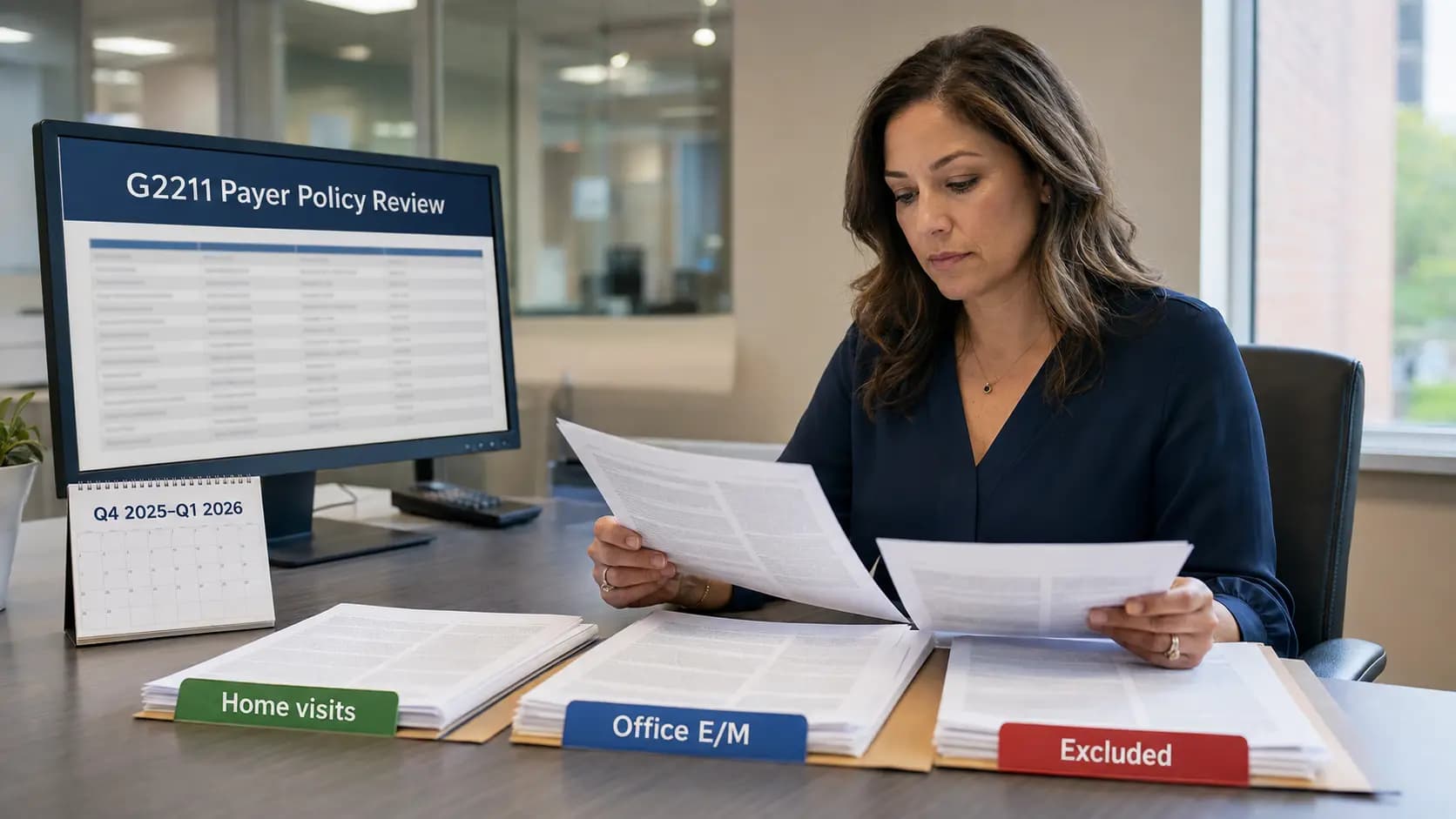
Commercial-payer coverage varies. Verify each payer’s current policy and contract before reporting G2211. Some of the big national plans are following what Medicare does, including the expansion to home visits; others exclude G2211 entirely; and then there are others that just cover office-based E/M adds. Check the payer bulletins that came out in Q4 2025 and Q1 2026 for each of your contracted plans. Don’t just assume they’ll always follow Medicare.
Common Billing and Audit Risks
Risk 1: Modifier 25 reported without a qualifying preventive service.
Confirm that the same-day service appears on CMS’s qualifying preventive-services list. If it does, review the claim for coding or processing errors. If it does not, determine whether a corrected claim is appropriate under the payer’s rules and update the claim edit that allowed the incompatible combination.
Risk 2: Lack of documented continuity.
This is a post-payment audit risk rather than a front-end denial. Ensure clinical notes and claims history collectively support an ongoing practitioner-patient relationship.
Risk 3: Ineligible base codes or non-covered settings.
Attaching G2211 to non-eligible base codes (like hospital, ED, or TCM codes) will trigger immediate denials. In RHC and FQHC settings, G2211 is bundled into the overall rate and is not paid separately.
Additional Payment Considerations
Patient cost-sharing: The usual Medicare Part B deductible and coinsurance apply to G2211. Practices should account for this when discussing patient responsibility.
RHCs and FQHCs: G2211 is bundled into the Rural Health Clinic all-inclusive rate and the Federally Qualified Health Center prospective payment rate. Medicare does not make a separate G2211 payment to an RHC or FQHC.
Frequently Asked Questions
Can you bill G2211 with 99343 or 99346 in 2026?
No. CPT 99343 was deleted effective January 1, 2023, and 99346 is not a current home or residence E/M code. Select the appropriate current code based on the documented MDM or total time (99341, 99342, 99344, 99345, 99347, 99348, 99349, or 99350); do not automatically substitute another code.
Does G2211 pay when the E/M has a Modifier 25 for a same-day AWV?
Yes. The CMS G2211 FAQ says G2211 still pays when the base E/M has a Modifier 25 – because the E/M was provided with a Medicare-covered preventive service like the Annual Wellness Visit.
What documentation does G2211 need?
CMS does not require a special phrase or separate G2211 template. The existing record and claims history should collectively support the medically necessary E/M visit and the qualifying practitioner-patient relationship. Prior encounters do not need to be copied into every note.
What are the 2026 Medicare conversion factors?
Why might clean G2211 claims be delayed or denied in early 2026?
CMS made the policy effective January 1, 2026, but CR 14447 gives contractors an implementation date of October 5, 2026 for system edits and preventive bypass criteria. Consult your MAC regarding claims processed before this date rather than assuming an error.
Disclaimer: This article is provided for general educational and informational purposes only and does not constitute medical, legal, coding, billing, compliance, or reimbursement advice. Medicare and commercial payer policies, fee schedules, coding requirements, and local Medicare Administrative Contractor guidance may change and can vary by payer and jurisdiction. Providers remain responsible for verifying current requirements, medical necessity, documentation, code selection, modifier use, and coverage before submitting claims. References to payment or eligibility do not guarantee reimbursement. Consult current CMS publications, your MAC, applicable payer policies, and a qualified coding or compliance professional for guidance specific to your practice.