



Introduction
For more than thirty years, obstetricians documented routine prenatal visits knowing the exact code on the superbill barely mattered. Whether an interval check took eight minutes or twenty-five, the entire pregnancy disappeared into a single global maternity code billed months down the road.
That billing safety net disappears on January 1, 2027.
Under the AMA CPT 2027 maternity restructuring guidance, the traditional bundled global OB codes are being deleted. In their place, antepartum care will be reported per encounter with the evaluation and management code appropriate to the setting and service provided.
The change creates more granular reporting for practices managing routine and high-risk pregnancies, but it does not guarantee higher payment. CPT establishes how services are reported; each commercial payer, Medicaid program, Medicare policy and provider contract determines coverage, claim edits, fee schedules, cost sharing and payment.
The operational risk is significant. Every prenatal encounter must independently support the reported diagnosis, E/M family and level. Bare-bones templates, unsupported code defaults and payer rules that have not been updated for 2027 can lead to downcoding, delayed payment, denials or recoupment.
Here is the operational framework your practice needs to select, document and bill antepartum E/M services accurately under CPT 2027.
The New Baseline: How E/M Rules Apply to Prenatal Care
Under the CPT 2027 framework, antepartum visits do not receive a new pregnancy-specific E/M code family. Report the E/M service that matches the patient’s location and the work performed. Office and other outpatient encounters may use CPT 99202 through 99205 for new patients and CPT 99211 through 99215 for established patients. Hospital, observation and telemedicine encounters use the applicable E/M family for those settings.
New Versus Established Is Not Based on the Pregnancy
An initial prenatal visit is not automatically a new-patient visit. Under CMS E/M guidance, a patient is generally new only when the patient has not received a professional service from the physician or another physician or qualified health care professional of the same specialty and subspecialty in the same group during the previous three years. Verify group and specialty history before assigning 99202 through 99205.
Many physicians still carry documentation habits from the 1990s, assuming that writing a lengthy review of systems or counting physical exam bullets justifies a higher billing tier. That approach is outdated. For office and other outpatient visits, code selection is based on one of two pathways:
- The level of medical decision making documented during the encounter.
- The total qualifying physician or other qualified health care professional time on the date of the encounter.
The note must include a medically appropriate history and examination when performed, but the number of history or examination elements does not determine the office or outpatient E/M level.
Medical Decision Making for Antepartum Visits
Medical decision making measures the clinical cognitive effort required to assess and manage the patient during that specific encounter. To establish an MDM level, the encounter must meet or exceed the required thresholds in at least two of three elements:
- Number and complexity of problems addressed: the pregnancy and any maternal or fetal conditions evaluated or managed during the encounter.
- Amount and complexity of data reviewed and analyzed: qualifying tests, documents, independent interpretations and discussions with external professionals.
- Risk of complications and morbidity or mortality of patient management: the management decisions made during the encounter, including prescription drug management when applicable.
The Pregnancy Specific MDM Rule Practices Must Understand
AMA antepartum guidance states that normal pregnancy may be treated as a problem addressed for E/M reporting and that pregnancy best fits the moderate problems category because the condition of the patient or fetus may not be stable. This affects only the problems-addressed element. It does not automatically make every prenatal visit a moderate-level E/M service. The final MDM level still requires two of the three elements to meet or exceed the same level.
Comorbidities such as hypertension, obesity, advanced maternal age or gestational diabetes do not raise the E/M level merely because they appear on the problem list. They count when they are addressed and when their presence changes the data reviewed, risk assessment or management performed during that encounter.
MDM element | What to document | Important limitation |
|---|---|---|
Problems addressed | Pregnancy status plus each maternal or fetal condition evaluated or managed that day. | Do not count an inactive condition that did not affect the encounter. |
Data reviewed and analyzed | Identify qualifying tests, external notes, independent interpretations and professional discussions. | Ordering or reviewing one routine test does not automatically establish a particular data level. Apply the full current E/M data rules. |
Management risk | Document the management decision and why it was appropriate for the patient’s condition. | Prescription management may support moderate risk, but risk alone does not establish moderate MDM. |
Applying MDM to Routine and Complex Obstetric Visits
In an uncomplicated pregnancy, a routine interval visit may still result in a lower-level established-patient E/M code when the data and management-risk elements remain minimal or low. Do not label pregnancy itself as a self-limited or minor problem. Apply all three MDM elements to the work performed during that encounter.
Gestational diabetes management: Reviewing glucose values, assessing the effect on the pregnancy and changing treatment may support moderate MDM when at least two elements reach the moderate level. Prescription drug management can support moderate risk, but prescribing insulin by itself does not automatically establish CPT 99214.
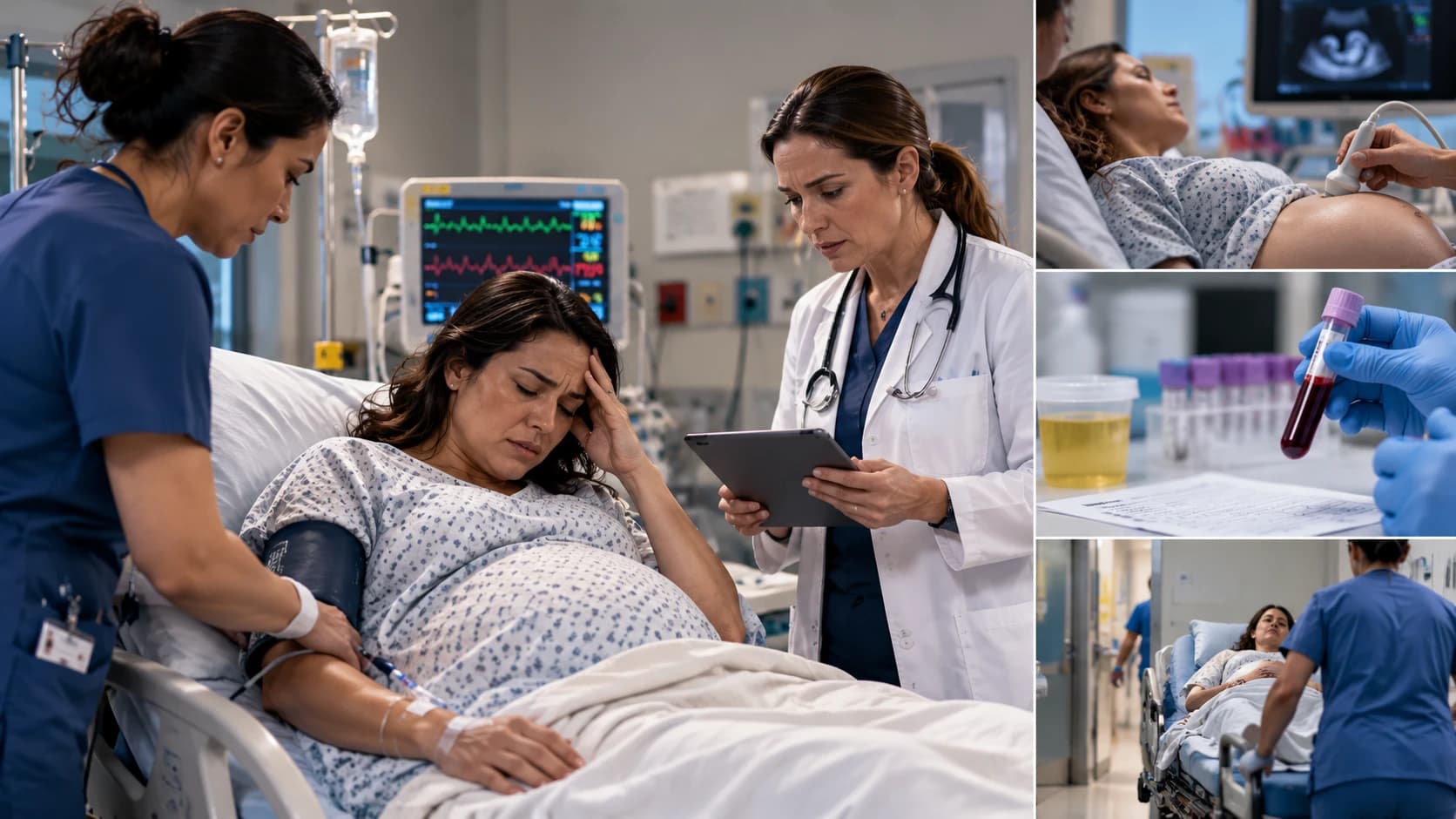
Urgent preeclampsia evaluation: A third-trimester patient with severe-range blood pressure, neurologic symptoms and abnormal laboratory findings may support high-complexity MDM when the documented problems and management risk meet the high threshold, such as a condition posing a threat to life or bodily function and a decision regarding emergency hospitalization. Code the actual work and decisions documented, not the diagnosis label alone.

Time Based Coding for Prenatal Encounters
When counseling, record review or care coordination makes total time the clearest representation of the encounter, the clinician may select the office or outpatient E/M level using time. Choose the method that accurately describes the service; do not select time or MDM solely because one produces higher payment.
Total time includes qualifying time personally spent by the billing physician or other qualified health care professional on the calendar date of the encounter. It includes both face-to-face and qualifying non-face-to-face work performed that day.
What Counts Toward Total Time
- Reviewing prior obstetric records, ultrasound reports and laboratory results before the encounter.
- Obtaining or reviewing a separately obtained history and conducting the medically appropriate examination or evaluation.
- Counseling and educating the patient, family or caregiver.
- Documenting clinical information and updating the treatment plan in the health record.
- Ordering medications, laboratory work, non-stress tests or biophysical profiles.
- Referring to and communicating with other health care professionals when that work is not separately reported.
- Independently interpreting results and communicating them when the interpretation is not separately reported.
What Does Not Count
- Time spent by nurses, medical assistants, phlebotomists or other clinical staff.
- Travel time between clinic locations or hospital facilities.
- Work performed on a different calendar date, including later portal messages or result review.
- Time spent performing a separately reported procedure or service, including an ultrasound or separately billed test interpretation.
- Overlapping time when more than one physician or qualified health care professional works with the patient at the same time.
Document the exact total time, such as “Total physician time on the date of service was 34 minutes,” and describe the qualifying work when useful. CPT requires total time; start and stop times are not generally required for these office E/M services, although a payer may request additional detail.
CPT code | Patient status | Total time |
|---|---|---|
99202 | New | 15–29 minutes |
99203 | New | 30–44 minutes |
99204 | New | 45–59 minutes |
99205 | New | 60–74 minutes |
99211 | Established | Minimal service; no time threshold |
99212 | Established | 10–19 minutes |
99213 | Established | 20–29 minutes |
99214 | Established | 30–39 minutes |
99215 | Established | 40–54 minutes |
When total time exceeds the maximum for 99205 or 99215, review the applicable prolonged-service code and payer policy. CPT and Medicare do not always use the same prolonged-service code or time threshold.
Diagnosis Coding Must Match the Encounter
Per-encounter reporting makes diagnosis selection more visible on every claim. Link the E/M service to the condition or supervision addressed that day and apply the FY 2027 ICD-10-CM Official Guidelines:
- For a routine outpatient prenatal visit with no complication, report the appropriate Z34 category code as the first-listed diagnosis.
- Do not report a Z34 supervision code together with an O00–O9A Chapter 15 pregnancy code.
- When a pregnancy complication is evaluated or managed, report the applicable O code with the required trimester and fetus detail.
- Add a Z3A code for weeks of gestation when appropriate under the official guidelines.
- Use the 2027 ICD-10-CM code set for dates of service beginning October 1, 2026 and verify annual code changes rather than carrying forward a prior-year code list.
- Consider HCPCS modifier TH to identify obstetrical treatment or prenatal or postpartum services when the payer requires or accepts it.
For example, O36.5930 describes maternal care for other known or suspected poor fetal growth in the third trimester when the fetus designation is not applicable or unspecified. Select the most specific supported code and required fetus identifier rather than using this example as a default for every fetal-growth-restriction encounter.
Documenting Frequent Visits and Medical Necessity
Under the traditional model, clinics often followed a standard calendar: monthly visits through 28 weeks, biweekly visits through 36 weeks and weekly visits until birth.
ACOG Clinical Consensus No. 8 supports tailoring visit frequency and monitoring the patient’s medical and social needs rather than relying on one rigid schedule. Tailoring does not mean that every patient should receive fewer visits or that clinical judgment is replaced by a billing rule.
With encounter-based billing, each claim should be supported by the work and medical necessity documented for that date. When a patient requires unusually frequent visits for oligohydramnios, fetal growth restriction, hypertension or another condition, the record should explain the purpose and result of each encounter.
Documentation Elements for Frequent Encounters
- Specific diagnosis: Report the condition actively monitored or managed, with trimester and fetus detail when required.
- Objective interval findings: Record the relevant changes or stability in blood pressure, symptoms, fetal testing, Doppler findings, laboratory results or other monitored measures.
- Frequency rationale: Explain why the selected follow-up interval is appropriate for the documented risk and care plan.
- Assessment and plan: Record the management decision resulting from the encounter. A medically appropriate decision to continue the current plan can support the service; a treatment change is not required at every visit.
Protect Your OB/GYN Revenue Throughout the 2027 Coding Restructure
Moving from bundled global maternity billing to per-visit E/M claims requires updated charge masters, coder retraining, and aggressive denial prevention. Dastify Solutions delivers dedicated specialty billing and revenue cycle management for OB/GYN practices nationwide.
Telehealth Prenatal Visits
Telehealth is part of the 2027 antepartum framework, but coding and coverage depend on the communication method, patient location, payer and plan. Do not apply one modifier and place-of-service combination to every payer.
- Synchronous audio-video: CPT telemedicine guidance includes E/M codes 98000–98007. Some payers may instead direct practices to report an office E/M code with a telehealth modifier. Follow the payer’s current policy.
- Synchronous audio-only: CPT includes codes 98008–98015 for new and established patient audio-only E/M services. Confirm that the payer recognizes and pays these codes; do not use the deleted physician telephone codes 99441–99443.
- Place of service: CMS telehealth guidance directs Medicare professional claims to POS 02 when the patient is not at home and POS 10 when the patient is at home. Commercial and Medicaid policies may differ.
- Modifiers: Modifier 95 is not a universal requirement for every professional telehealth claim. Confirm the payer’s instructions for modifier 95, modifier 93, or other telehealth indicators.
- Clinical suitability: Use telehealth only when the modality supports the services the patient requires; arrange in-person care when examination, testing or treatment cannot be completed remotely.
Transition Billing for Pregnancies Spanning 2026 and 2027
Pregnancies with antepartum care in both calendar years require the AMA split reporting approach. Apply the code set and guidelines in effect for each date of service and confirm any additional payer transition instructions.
Antepartum Services Performed in 2026
- One to three routine antepartum visits in 2026: Report each encounter with the appropriate E/M code.
- Four to six routine antepartum visits in 2026: Report CPT 59425 when the service has concluded, using the last included encounter date unless the payer requires a date span.
- Seven or more routine antepartum visits in 2026: Report CPT 59426 when the service has concluded, subject to payer reporting instructions. Non-routine encounters are not included in these routine visit counts and may be separately reported when supported. Practices do not need to wait for delivery to bill the completed 2026 antepartum-only service.
Antepartum and Delivery Services Performed in 2027
Beginning January 1, 2027, report each antepartum encounter with the E/M code appropriate to the setting and service. Report labor management and delivery using the new 2027 code structure. A delivery that occurred in 2026 may still be reported with the applicable 2026 global code even when postpartum care continues into 2027; eligible 2027 postpartum encounters may then be reported with the appropriate E/M code.
Five Antepartum Billing Errors to Prevent
- Defaulting every established prenatal encounter to 99213. Each encounter must be leveled from its documented MDM or total time; a standing code default cannot replace code selection.
- Treating one MDM element as the entire code level. A diagnosis, prescription decision or test order does not independently establish the final MDM level because two of three elements are required.
- Counting clinic time instead of physician or QHP time. Staff time and time spent on separately reported services cannot be added to the reporting professional’s E/M total.
- Automatically bundling a same-day office visit into labor management. Under the official 2027 CPT maternity guidelines, an E/M at an initial site such as an office or emergency department may be separately reported when significant and separately identifiable; modifier 25 may be added when applicable.
- Automatically adding modifier 25 whenever an ultrasound or other procedure occurs. Under CMS NCCI modifier 25 guidance, modifier 25 belongs on the E/M only when the E/M is significant and separately identifiable from the work inherent in the procedure.
Preclaim Quality Checklist for 2027 Antepartum Encounters
- Select the E/M family from the actual care setting, then verify new or established status and the supported level.
- Document all three MDM elements or the exact total physician or QHP time on the date of service.
- Report the diagnosis that reflects routine supervision or the complication actually addressed, including trimester, gestational week and fetus detail when applicable.
- Apply modifier 25 only when the documentation supports a significant, separately identifiable E/M service.
- Match telehealth codes, POS and modifiers to the payer, modality and patient location.
- Split 2026 and 2027 antepartum services using the AMA transition rules and any additional payer instructions.
- Confirm that contracts, fee schedules, clearinghouse edits, EHR templates and chargemaster entries recognize the deleted and replacement codes.
- Track maternity denials by payer, CARC and RARC and correct payer-specific configuration problems before they affect a larger claim volume.
Prepare Your OB/GYN Revenue Cycle for 2027
Moving from global maternity billing to encounter-level reporting requires more than adding codes to a chargemaster. Practices should validate payer readiness, update documentation templates, educate clinicians and coders, test common claim combinations, review patient cost-estimate workflows and monitor denials after implementation.
Dastify Solutions provides specialty billing and revenue cycle support for OB/GYN practices preparing for the 2027 maternity coding transition. Contact our team to review your workflow, payer configuration and denial-prevention plan.
Frequently Asked Questions
Can a Certified Nurse Midwife or Nurse Practitioner bill antepartum E/M services?
Yes, when the professional is qualified to report the service, acting within state scope-of-practice requirements and properly enrolled or credentialed with the payer. Payment is payer-specific. Under Medicare payment guidance, nurse practitioner services are generally paid at 85% of the physician fee-schedule amount, while qualified certified nurse-midwife services have been paid based on 100% of the physician fee-schedule amount since January 1, 2011. Commercial and Medicaid payment rules vary.
How is a nurse only blood pressure check or injection reported?
A medically necessary nurse-only blood-pressure recheck may support CPT 99211 when the code’s requirements and the payer’s supervision rules are met. Do not automatically bill 99211 for a visit whose only service is an injection. Under Medicare drug-administration policy, 99211 is not separately payable with therapeutic or diagnostic drug administration; report the applicable drug and administration service and verify payer-specific rules.
What if a payer rejects a standalone antepartum E/M claim as bundled?
Verify the date of service, patient status, E/M level, diagnosis linkage, modifier and the payer’s 2027 maternity policy. Review the CARC and RARC on the remittance advice, confirm that the contract and fee schedule have been updated and appeal when the claim follows CPT and the payer’s published requirements. Do not assume the CPT change alone guarantees payment under every contract.
Are 2027 payment amounts final?
Not yet at the time of this review. CMS issued the CY 2027 Medicare Physician Fee Schedule proposed rule in July 2026 and the final rule is expected in early November. Practices should recheck final Medicare policy and each Medicaid and commercial payer’s implementation guidance before January 1, 2027.