






Introduction
A claim can be delayed before submission because of incomplete patient information, inactive coverage, missing authorization or a coding issue. It can also be denied after adjudication because the payer determines that the service is not covered, not supported by the documentation or subject to another payment rule.
In a national survey of hospitals, health systems and post-acute providers, Premier reported that initial denial rates remained near 15%. The same report found that many denials were later overturned, but only after additional administrative work. Results vary by payer, specialty and care setting, so every practice should track its own rejection rate, denial rate and cost to resolve each claim.
This guide explains what medical billing services include, how the revenue cycle works, what different service models cost and how to evaluate a billing partner. It is written for practice leaders who need a practical basis for comparing an internal billing team with an outsourced or hybrid model.
What is Medical Billing?
Medical billing is the process of translating healthcare services into claims submitted to insurers and following up to ensure payment.
Each claim represents a patient’s visit, including their diagnosis, the care provided, and the procedures performed, all translated into standardized codes that insurers recognize.
Effective billing depends on a clear understanding of:
- ICD-10, CPT, and HCPCS coding systems
- Payer-specific rules and documentation requirements
- HIPAA and CMS compliance standards
Diagnosis and procedure codes must be supported by the provider’s documentation and submitted under the applicable payer rules. An unsupported diagnosis, missing modifier or incomplete claim field may cause a rejection, denial or payment delay. Accurate billing reduces avoidable rework, but it does not guarantee payment; coverage, medical necessity, authorization requirements and contract terms also affect the payer’s decision.
Medical Billing vs Medical Coding
These terms are often used together but they are not the same thing. Here is a simple way to think about it.
Coding converts the clinical note into standard codes. Billing takes those codes and turns them into claims, then follows up until the money is posted. If a coder assigns CPT 99213 for an office visit and ICD-10 E11.9 for Type 2 diabetes, the biller uses those codes to create the claim, submit it, and handle appeals if needed. An error at either step can slow or stop payment.
Medical Billing vs Coding Functions
Function | Coding | Billing |
|---|---|---|
Purpose | Convert services into standardized codes | Create claims and track payment |
Responsibility | Certified coders | Billers or billing specialists |
Outcome | Accuracy in documentation | Timely reimbursement |
Medical Billing Process Steps: The Complete Revenue Cycle Explained
The medical billing process, often called the revenue cycle, is a multi-step journey that starts before the patient sees the doctor and ends long after they have left. Each step is crucial for ensuring claim accuracy and prompt payment.
The 7 Steps of the Medical Billing Cycle
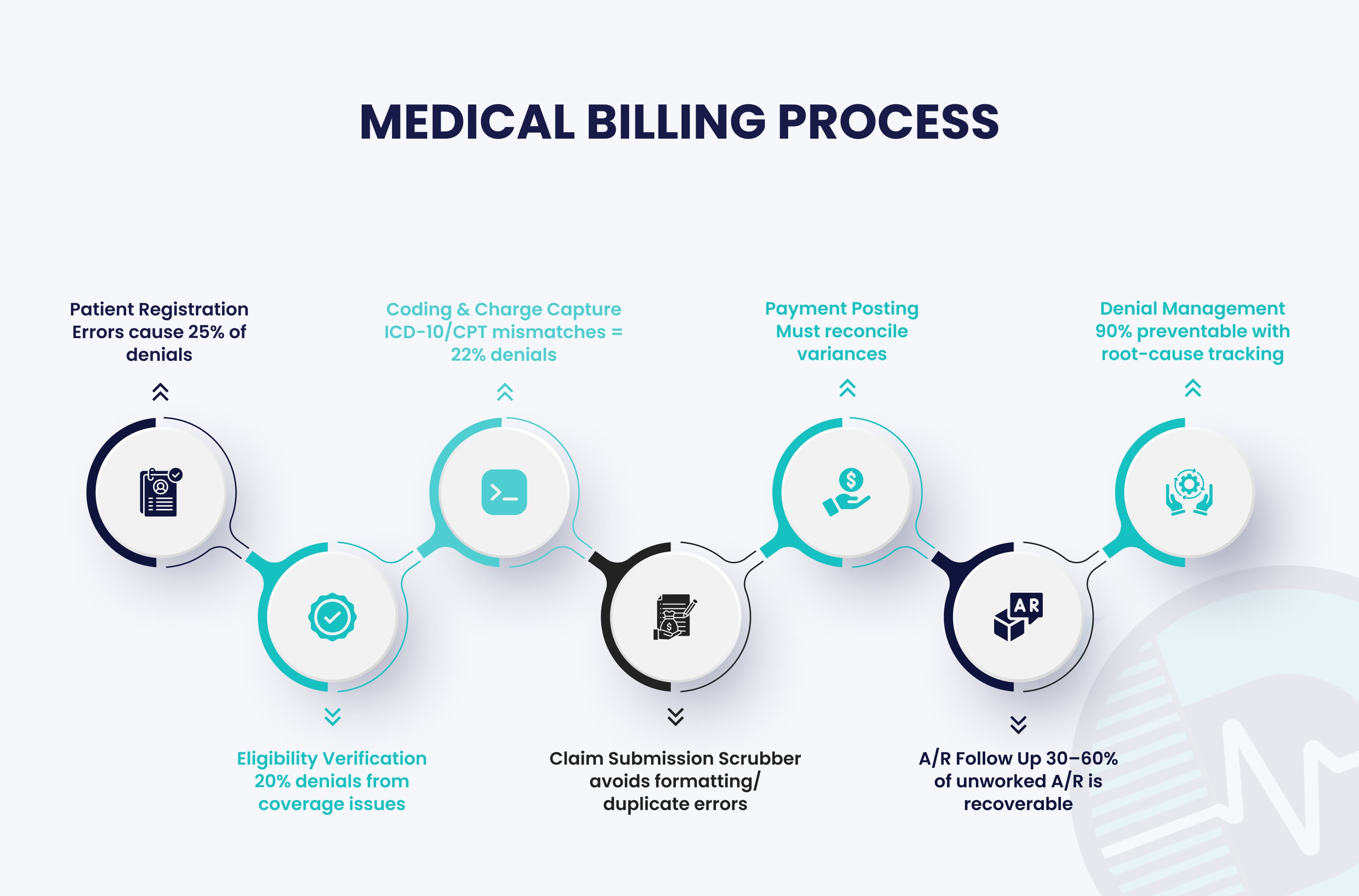
Stage | Purpose |
|---|---|
1. Scheduling and registration | Collect patient demographics, guarantor details and insurance information before the encounter. |
2. Eligibility and benefits verification | Confirm active coverage, plan benefits, patient responsibility and payer-specific requirements. An eligibility response does not guarantee payment. |
3. Prior authorization and referrals | Determine whether the planned service requires authorization or a referral and retain the payer response with the encounter record. |
4. Clinical documentation and charge capture | Document the service and capture all reportable charges promptly. |
5. Coding and claim preparation | Assign supported ICD-10-CM, CPT or HCPCS codes and review claim data for completeness and payer edits. |
6. Submission and acknowledgement | Submit the claim through the clearinghouse or payer channel and work any front-end rejection before the filing limit. |
7. Adjudication and remittance | Review the payer’s payment decision, adjustments and responsibility codes on the ERA or paper remittance. |
8. Payment posting and variance review | Post payments and adjustments, reconcile deposits and investigate possible underpayments against contract terms. |
9. Denial, A/R and patient balance follow-up | Correct or appeal eligible denials, follow unresolved balances and send accurate patient statements after payer responsibility is confirmed. |
CMS lists the adopted standards for electronic healthcare transactions, including eligibility, claims, claim status and remittance advice.
Average Time Spent per Step
Each phase in the billing process takes time, and even small delays can slow down payments. Knowing how long each step usually takes helps a practice see where things get stuck and where improvements will have the biggest impact.
| Avg Time Required |
|---|---|
Pre-Authorization | 5–15 minutes per patient |
Registration & Verification | 5–10 minutes |
Coding & Charge Capture | 10–20 minutes |
Claim Submission | 1–2 minutes |
Payer Adjudication | 15–30 days |
Payment Posting | 3–5 minutes |
A/R Follow-Up | Weekly–monthly |
Patient Billing | 5–10 minutes per account |
According to the Medical Group Management Association, inefficient billing processes raise administrative costs by more than ten percent and push the payment cycle a number of weeks further back. Simple changes such as automation of verification, close tracking of claims, and set follow-up routines can significantly speed up reimbursements.
Maximize Collections With Expert Billers
What Is a Clean Claim Rate?
A clean claim contains the information required for the payer to process it without requesting additional information from the provider. Medicare describes a clean claim as one that does not require the Medicare Administrative Contractor to investigate or develop information outside its operation before payment.
Clean claim rate is usually calculated by dividing claims accepted on first submission by total claims submitted during the same period. Before comparing results, confirm that the practice and the billing company use the same definition. Some organizations exclude corrected claims, payer outages or encounters held before submission, which can make two reported rates look comparable when they are not.
Use clean claim rate with first-pass resolution rate, rejection rate, initial denial rate, days in A/R and net collection rate. No single measure provides a complete view of billing performance. Practices falling below this threshold are typically losing revenue to front-end errors in coding, documentation or eligibility verification.
What is Prior Authorization in Medical Billing?
Prior authorization (PA) is a payer requirement that certain services be approved before they are delivered. Without PA when required, the claim is automatically denied regardless of medical necessity. Services commonly requiring prior authorization include specialty medications and biologics, elective surgical procedures, advanced imaging (MRI, CT, PET) and inpatient admissions.
Under CMS-0057-F, affected payers must respond to expedited prior authorization requests for medical items and services within 72 hours and to standard requests within seven calendar days, unless the patient’s condition requires a faster decision. The rule applies to specified Medicare Advantage, Medicaid and CHIP payers and excludes drug requests. CMS states that the decision-timeframe requirements do not apply to Qualified Health Plan issuers on the federally facilitated exchanges. Program-specific extensions may apply, so staff should confirm the rule and the payer’s current procedure before relying on a deadline.
Types of Medical Billing Services
Medical billing companies may manage the full revenue cycle or a defined part of it. A practice should confirm the exact scope before comparing fees.
Full-service Revenue Cycle Management: eligibility, authorization support, charge entry, claim submission, payment posting, denial management, A/R follow-up, patient billing and reporting.
Claims Submission and Scrubbing: preparation, validation, clearinghouse submission and front-end rejection work.
Medical Coding: code assignment or coding review based on the provider’s documentation and applicable coding rules.
Denial Management and Appeals: denial classification, root-cause analysis, correction, appeal preparation and deadline tracking.
A/R Recovery: focused work on unpaid or underpaid balances, often by payer, age or dollar threshold.
Eligibility and Prior Authorization Support: benefit checks, authorization submissions and status follow-up before service.
Payment Posting and Reconciliation: ERA and EOB posting, adjustment review, deposit reconciliation and underpayment identification.
Credentialing and Payer Enrollment: provider application, revalidation and enrollment status work. This service is related to billing but is not part of every billing agreement.
Patient Billing Support: statements, payment questions, payment plans and balance follow-up after payer adjudication.
Medical Billing Delivery Models
A practice can perform these services internally, assign all of them to a billing company or use a hybrid model. The best structure depends on claim volume, specialty, payer mix, staffing, technology and the level of control the practice wants to retain.
Feature | In-House Billing | Outsourced Billing | Hybrid Billing |
|---|---|---|---|
Control | Staff and processes are fully managed internally | Managed by external experts via a service agreement | Shared control. Internal team handles front-end; experts handle backend |
Cost | High fixed costs from salaries, software, and training | Variable fee, often a percentage of collections | Moderate blend of fixed and variable costs |
Expertise | Limited to knowledge of the in-house team | Access to certified specialists familiar with payer rules | Leverages both internal and external knowledge |
Scalability | Difficult and expensive to scale | Scales quickly with practice volume | Moderately scalable |
Technology | Requires investment and ongoing maintenance | Advanced software and analytics included | Mix of internal and vendor-provided tools |
Best For | Large practices with dedicated resources | Practices seeking efficiency and cost reduction | Organizations wanting a tailored approach |
Why Outsource Medical Billing: Cost, Performance and Efficiency Comparison
Every healthcare practice invests time and money to get paid for the care it provides. But when billing is managed entirely in-house, that investment often grows faster than the return. Salaries, software subscriptions, ongoing coder training, compliance audits and IT maintenance add up quickly. Claim volumes fluctuate, denials rise and fall, payer rules change and staff availability varies.
Outsourcing changes the equation. Instead of carrying fixed costs, you pay for measurable performance. External billing specialists already have certified teams, advanced RCM software and established compliance systems. You access all of that instantly without building or maintaining it yourself.
When Outsourcing Medical Billing May Help
Outsourcing can give a practice access to trained billing staff, coverage during absences, payer follow-up capacity and reporting tools without building each function internally. It may be appropriate when denials are not worked consistently, A/R is aging, staff turnover is disrupting follow-up or the practice lacks specialty-specific billing support.
Outsourcing is not automatically the lower-cost or lower-risk option. A poor fit can create communication delays, weak accountability, patient-service problems or difficulty recovering data when the contract ends. Practices with a stable internal team and strong results may prefer to keep billing in-house or outsource only a defined function such as coding audits, denial work or old A/R.
Common Medical Billing Pricing Models
Percentage of collections: the fee is based on an agreed definition of collections. Confirm whether refunds, capitation, patient payments and old A/R are included.
Per-claim fee: useful when claim volume is predictable, but denial work, appeals and patient statements may be priced separately.
Flat monthly fee: provides predictable expense, although the agreement should address material changes in volume or scope.
Hourly or project fee: often used for audits, credentialing, temporary coverage or A/R recovery.
Hybrid fee: combines a base charge with volume, collection or performance terms.
Compare the total scope, not only the headline rate. Ask whether the price includes coding review, clearinghouse fees, denial appeals, patient statements, credentialing, reports, software access, implementation, old A/R and termination support. Confirm the fee basis in writing and test it against at least three months of the practice’s actual collections and claim volume.
Cost of Inefficient Billing
Every claim error, missing document, or late submission chips away at a healthcare provider’s revenue. Billing inefficiencies are not just administrative setbacks; they directly affect profitability, compliance risk, and cash flow stability.
All these numbers show that billing inefficiency isn’t just about errors. It also means missing out on chances to grow revenue and keep your finances stable over time.
Key Challenges in Medical Billing
Each denied claim or delayed payment affects more than just the numbers. It leads to workflow problems, overworked staff, and lost time, all of which can hurt patient care and revenue.
To understand where these inefficiencies begin, it helps to look at the most common challenges that disrupt billing operations.
Challenge | Operational Impact | Effective Solution |
|---|---|---|
High Denial Rates | Each denied claim requires rework, slowing down payments and increasing administrative costs. | Automate claim scrubbing and track denial trends to address recurring issues. |
Staff Turnover | High turnover disrupts workflows and increases training costs, leading to inconsistency in claim handling. | Standardize processes and use automation to reduce dependency on manual tasks. |
Regulatory Complexity | Frequent updates to HIPAA and CMS guidelines make compliance management difficult. | Conduct quarterly audits and staff training to stay aligned with regulations. |
Manual Workflows | Paper-based or fragmented systems increase error rates and slow reimbursement cycles. | Integrate EHR and RCM tools for faster, more accurate data transfer. |
Evolving Payer Requirements | Constant changes in payer policies lead to confusion and inconsistent reimbursement. | Use payer portals and automated eligibility verification for real-time updates. |
Underpayments and Contract Variance | Claims may be paid below the contracted amount without being denied. | Compare remittance data with contract terms and route material variances for follow-up. |
Patient Balance Errors | Incorrect responsibility or unclear statements can delay collections and create patient complaints. | Confirm payer adjudication before billing the patient and provide a documented process for questions and corrections. |
How to Read Claim Adjustments and Denials
A payer uses the remittance advice to explain how a claim or service line was adjudicated. The message may include a group code, a Claim Adjustment Reason Code and a Remittance Advice Remark Code. The group code identifies financial responsibility, the CARC describes the adjustment and the RARC may provide the detail needed to determine the next step.
For example, CARC 16 means the claim or service lacks information or contains a submission error. It must be read with the accompanying remark code to identify what is missing or invalid. A billing team should not assign a root cause or submit a corrected claim from the CARC alone.
Use the payer’s remittance, portal, contract and applicable coverage policy to decide whether to correct, appeal, transfer responsibility or write off an adjustment. Record the final root cause in a consistent category so the practice can identify recurring problems by payer, provider, location and service.
Rejection Versus Denial
A rejection usually occurs before adjudication because the claim fails a submission or data requirement. A denial occurs after the payer adjudicates the claim and does not allow payment for all or part of it. Work rejections promptly so they do not become timely-filing problems, and work denials according to the payer’s correction and appeal rules.
Most claim denials start with front-end errors. Fixing the first few minutes of your billing workflow can save weeks of downstream rework.
Addressing these issues at the front end of the billing process is far more cost-effective than resolving them later. While no system can eliminate denials entirely, the right mix of automation, process design, and expert oversight like the approach used by Dastify Solutions, can significantly reduce their frequency and financial impact.
How to Read an ERA, Remittance Advice or EOB
Providers generally use an Electronic Remittance Advice or a Standard Paper Remittance to review claim adjudication and payment. An Explanation of Benefits is usually written for the patient and is not a bill. Each document serves a different audience, although both explain how the payer processed the claim.
For provider follow-up, review the allowed amount, paid amount, adjustment amount, patient responsibility, group code, CARC, RARC and any provider-level balance adjustment. Reconcile the remittance with the related payment and compare material payment variances with the payer contract.
Set an internal review schedule that leaves enough time to correct rejections, appeal eligible denials and address underpayments before the payer’s deadline. Do not use one 48-hour standard for every payer or workflow unless it is an internal service requirement.
HIPAA Responsibilities in Medical Billing
A medical billing company that creates, receives, maintains or transmits protected health information on behalf of a covered provider is generally a business associate. Before the billing company handles PHI, the parties must have a written business associate agreement that defines the permitted work and requires appropriate protection of the information.
The agreement is only one part of due diligence. A practice should review how the billing company controls access, trains its workforce, assesses security risk, manages subcontractors, reports incidents, maintains backups and returns or destroys data when the relationship ends. The review should cover administrative, physical and technical safeguards for electronic PHI.
A private HIPAA training certificate or compliance certificate may show that an assessment or course took place, but it is not government approval and does not replace the organization’s legal duties. HHS states that it does not endorse or recognize private Security Rule certifications.
HIPAA civil monetary penalties depend on the facts and are adjusted over time. Link readers to current HHS enforcement information instead of placing a fixed penalty range in an evergreen article.
Medical Billing Technology Trends: AI, Automation and Predictive Analytics
Medical billing is becoming smarter and more connected. The focus is moving from just processing claims to using systems that spot problems early, keep providers updated, and help patients better understand their costs.
|
|
|
|---|---|---|
Modern billing platforms can now spot likely denials before a claim is sent. By analyzing past data and payer behavior, they help staff correct problems early. The 2024 CAQH Index identifies substantial provider savings opportunities from moving administrative transactions to fully electronic workflows. Its estimates include $11.5 billion for eligibility and benefit verification, $2.4 billion for claim submission and $2.2 billion for claim-status inquiries. These estimates address transaction automation broadly; they should not be presented as savings produced by predictive denial tools alone. | Instead of waiting weeks for claim updates, practices are beginning to use dashboards that show revenue flow and claim status in real time. This visibility allows administrators to act quickly, track performance, and plan resources with confidence. | Patients now expect clarity. Digital billing portals, upfront cost estimates, and easier payment options are becoming standard. These tools build trust and reduce confusion about what patients owe and why. |
|
|
|---|---|
Cloud billing platforms are replacing disconnected software. When billing tools work directly with electronic health records, information moves smoothly from visit to payment, cutting down on errors and delays. | Payer and regulatory requirements change frequently. Technology can distribute edits, flag missing information and document workflow steps, but it does not make a practice compliant by itself. Updated rules should be reviewed, tested and monitored by qualified staff before they are applied to live claims. |
Any use of automation or artificial intelligence should have a defined owner, access controls, validation rules, exception handling and human review. Practices should ask vendors what data is used, whether PHI is shared with subprocessors, how model output is checked and how errors are corrected.
A Documented Dastify Client Result
n Dastify’s published case study of Vital Behavioral Care LLC, the practice’s A/R days decreased from 52 to 28, its denial rate decreased from 35% to 15%, and its clean claim rate increased from 85% to 98%. The case study explains the client setting, the billing changes and the measured results. Performance will vary by specialty, payer mix, starting condition, claim volume and implementation quality.
Practices considering Dastify can review the full case study and request a billing audit based on their own claims, denials and A/R data.
How to Choose a Medical Billing Company
A billing company should be evaluated on scope, operating discipline, security and accountability. A low fee has little value if important work is excluded, reports are unclear or the practice cannot recover its data when the relationship ends.
1. Confirm Specialty and Payer Experience
Ask which specialties, payer types and claim volumes the billing team handles today. Request examples that match your practice as closely as possible. General billing experience does not replace knowledge of specialty documentation, modifiers, authorization patterns and payer policies.
2. Define the Work in Writing
List every responsibility assigned to the practice and the billing company. Cover eligibility, authorization, coding, charge entry, claim submission, rejection work, payment posting, denial appeals, A/R follow-up, patient statements, credit balances, refunds, reporting and credentialing. State what is excluded and how additional work will be priced.
3. Agree on Performance Measures
Define each metric before setting a target. At minimum, review claim-submission turnaround, clean claim rate, rejection rate, initial denial rate, denial-resolution time, days in A/R, A/R over 90 days, net collection rate, underpayment recovery and response time. The agreement should identify the data source, calculation method, reporting period and exclusions for every measure.
4. Review Security and Compliance
Require a business associate agreement before PHI is shared. Ask about access controls, workforce training, security-risk assessments, encryption, backup and recovery, incident response, subcontractors and data location. If the company presents an independent security assessment, confirm its period, scope and any exceptions.
5. Test Technology and Reporting
Confirm whether the company works inside your current EHR and practice-management system or requires a separate platform. Review a sample dashboard and monthly report. Ask how clearinghouse rejections, payer messages, notes, attachments and appeals will remain visible to the practice.
6. Plan the Transition
A written implementation plan should cover system access, payer and clearinghouse setup, data transfer, opening A/R, staff training, patient communication, reporting and escalation. Assign an owner and due date to each task. Define when the billing company becomes responsible for new claims and who works balances created before that date.
Questions to Ask Before Signing
- Which services are included in the quoted fee, and which services cost extra?
- Who performs coding, and what credentials or specialty training does that team hold?
- How do you separate a rejection from a denial, and how do you calculate each rate?
- What are your claim-submission, rejection-response and denial-follow-up standards?
- How will we see claim status, notes, remittance data and appeal activity?
- Who is our daily contact, and what is the escalation path for urgent issues?
- Which staff members and subcontractors can access our PHI, and from where?
- Will you sign our BAA or provide one for legal review before access is granted?
- How do you identify underpayments and compare payments with contract terms?
- What happens to open claims, reports and data when the agreement ends?
- Can you provide a current client reference or case study from a similar practice?
- What information do you need from us to meet the agreed performance standards?
Contract Terms to Review
- Fee definition, invoicing method, minimums and excluded services
- Initial term, renewal, termination notice and early-termination charges
- Ownership and return of data, documents, payer correspondence and work notes
- Responsibility for old A/R and claims submitted before or after transition
- Service levels, reporting dates, escalation and remedies for repeated failure
- Use of subcontractors and responsibility for their work and security
- Professional liability, cyber insurance and breach responsibilities
- Transition assistance and continued access after termination
Warning Signs
- A performance guarantee without a baseline, calculation method or exclusions
- A refusal to sign a BAA before receiving PHI
- No access to claim notes, reports or supporting data
- A low headline fee with denial work, patient billing or clearinghouse costs excluded
- No named implementation lead or written transition plan
- No clear process for returning data and unfinished work at termination
Conclusion
Medical billing affects cash flow, staff workload, compliance and the patient’s financial experience. The right operating model is the one that gives the practice reliable claim handling, clear accountability and access to its own data at a sustainable cost.
Before selecting a billing company, define the work, confirm how performance will be measured, review security controls and test the proposed workflow against your specialty and payer mix. Compare vendors on documented scope and results, not on the headline rate alone.
Dastify supports medical billing workflows across multiple specialties. Practices can review Dastify’s services, pricing and case studies before requesting an audit based on their own revenue-cycle data.
Outsource Your Billing. Focus on Patient Care
Frequently Asked Questions
What are the steps in the medical billing process?
The process starts with patient registration and insurance verification, followed by coding, claim submission, payer review, payment posting, and denial follow-up. Each step ensures that providers are reimbursed accurately and on time.
What is the difference between medical billing and coding?
Coding turns medical procedures and diagnoses into standardized codes like ICD-10 and CPT. Billing uses those codes to create claims, submit them to insurers, and follow up until payment is received.
Why is accurate medical billing important?
Accurate billing prevents denials, reduces delays, and keeps revenue consistent. It also helps practices stay compliant with HIPAA and CMS rules while protecting patient data.
How does RCM improve healthcare finances?
Revenue Cycle Management (RCM) connects every financial step from scheduling to payment. Strong RCM systems reduce claim rework, shorten A/R days, and improve cash flow and collection rates.
How much do medical billing services cost?
Medical billing may be priced as a percentage of collections, a per-claim fee, a flat monthly fee, a project rate or a hybrid arrangement. Compare the full scope as well as the rate. Ask whether coding, clearinghouse charges, denial appeals, patient statements, credentialing, reporting, implementation and termination support are included.
What should a medical billing agreement include?
The agreement should define the services, fee basis, performance measures, reporting, data ownership, security duties, subcontractor use, escalation process, termination terms and transition assistance. It should also state which tasks remain the practice’s responsibility.
How can a practice verify a billing company’s results?
Ask for metric definitions, reporting periods, starting values and documented results from a comparable client. Confirm that the practice will have access to claim-level data and can reproduce the reported measures from its EHR, practice-management system, clearinghouse or remittance files.
What are the latest trends in medical billing technology?
Automation, predictive analytics, cloud-based billing, and AI-driven denial prevention are transforming billing accuracy and speed. Integrated EHR and RCM systems also give providers real-time visibility into their revenue.
Disclaimer
This article is provided for general educational purposes and is not legal, coding, billing, compliance or reimbursement advice. Payer contracts, coverage policies, coding requirements and government rules change and may vary by program and jurisdiction. Verify current requirements with the applicable payer, CMS, HHS and qualified coding, billing, compliance or legal professionals before acting on a specific claim or contract. Payment is not guaranteed.