


Legal Disclaimer (Informational Only)
This article is for educational purposes only and does not constitute legal advice. For legal interpretation of the Texas Prompt Pay Law (TPPA), ERISA applicability, appeal rights, or enforcement, consult a licensed healthcare attorney or compliance specialist.
These slow-paying and underpaying practices have been adopted by many insurance companies, resulting in significant revenue loss for physicians. But now that the tables have finally turned for physicians, insurance companies can no longer drag their feet.
In this blog, we’re breaking down the Texas Prompt Pay Law and showing you how filing your claims on time can keep more dollars in your pocket, not the payer’s.
Most Texas practices lose meaningful revenue each year to delayed TPPA payments, improper clean-claim submission, or not following payment-clock rules. This guide gives you the exact timelines, exclusions, and checklists you need to stay compliant and protect cash flow.
Say Goodbye to Financial Burden: History of Texas Prompt Pay Law
They say, “A penny saved is a penny earned.” That’s precisely what the Texas Prompt Pay Law (TPPA) is designed to protect. Enacted in 2003, the TPPA set strict timelines for insurance companies to reimburse healthcare providers and established clear penalty caps for delayed payments.
For years, insurance companies and Texas authorities went back and forth over how far the TPPA could apply, particularly for plans governed by federal ERISA law.
The Fifth Circuit finally put the debate to rest: ERISA determines whether a claim is valid, but the Texas Department of Insurance (TDI) decides how quickly valid claims must be paid.
This matters because most TPPA appeal failures happen when practices confuse ERISA timelines with TDI-governed deadlines.
That’s a big win for Texas physicians, who no longer have to face endless delays or uncertainty around reimbursements. Today, if payers miss the deadlines, healthcare facilities have the right to take legal action and finally get what they’re owed. Furthermore, the Texas Prompt Pay Law (TPPA) applies uniformly to all cities and regions across Texas.


This means more control, stability, and peace of mind for physicians and clinics.
| Did You Know? Hundreds of Texas medical providers are now pursuing the rightful payments they are owed under the Prompt Pay Law. |
TPPA Payment Clock: When Do Insurers Have to Pay?
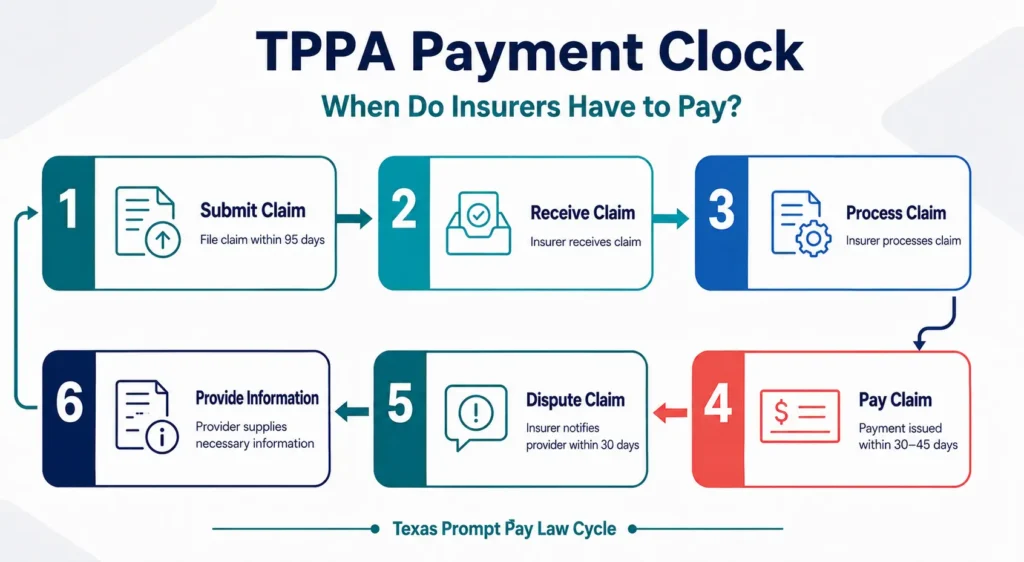
When it comes to getting paid, timing is everything, and the Texas Prompt Pay Law ensures it. Once a healthcare provider submits a clean claim, the clock starts ticking for insurance companies. If the claim is submitted electronically, insurers have 30 days to pay. For paper claims, they get 45 days.
You must be wondering what a “clean claim” is, right? A clean claim is your ticket to getting paid on time. It must be error-free, fully completed, and follow every payer guideline to the letter.
In simple terms, a clean claim is one that’s submitted in the correct format, either the CMS-1500 form (also known as the HCFA-1500, used for professional services) or the UB-04 form for institutional claims. Filing every required field accurately before submitting a claim ensures your submission has everything the insurer needs to process it without delay.
However, even a clean claim can hit a pause if the insurer needs extra information. Oh yes, it does happen! Sometimes they request details, such as verification of secondary insurance, before they can proceed with payment.
In such cases, the insurer can pause the TPPA payment clock, but only if they request the missing details promptly (usually within 30 days). Once the information is provided, the clock restarts.
| Type of Claim | Submission Requirement | Payment Deadline |
|---|---|---|
| Electronic Claim (EDI) | Must be filed within 95 days of the date of service. | 30 days after the insurer receives a clean claim. |
| Paper Claim | Must be filed within 95 days of the date of service. | 45 days after the insurer receives a clean claim. |
| Disputed Claim | The insurer must notify the provider of the dispute within 30 days of receiving the claim. | Payment is due upon resolution of the dispute. |
| Quick Tip! TPPA filing deadlines apply only to commercial plans regulated by the Texas Department of Insurance. Self-funded ERISA plans are exempt from TPPA timing and penalty rules. |
Who is Not Covered By The Texas Prompt Pay Law?
To avoid legal misunderstandings, it must be stated clearly: TPPA does not apply to all health plans in Texas.
TPPA does not apply to:
- Self-funded ERISA plans
- Federal employee plans (FEHB)
- Medicare
- Medicaid
- Tricare
- Workers’ compensation programs
- Veterans Affairs programs
TPPA only applies to:
- Fully insured PPO plans regulated by TDI
- HMOs regulated by TDI
This clarification is essential because applying TPPA incorrectly can lead to compliance mistakes and denied appeals.
Clean Claim Requirements Under Texas Law
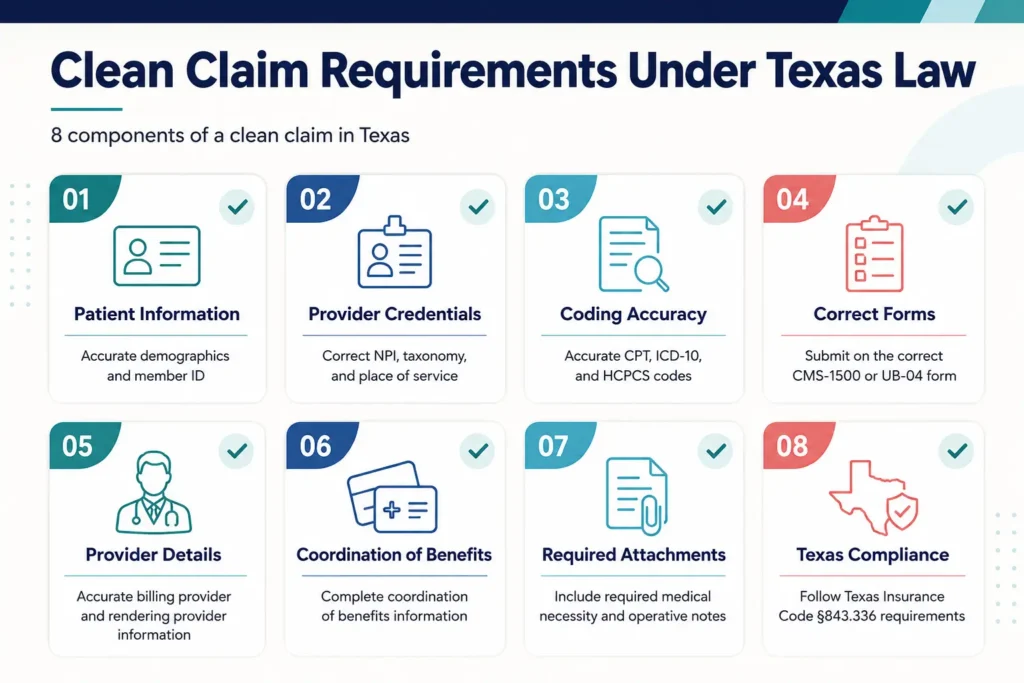
A clean claim must include:
- Accurate patient demographics
- Subscriber/member ID
- Correct provider NPI & taxonomy
- Place of service details
- Accurate CPT/ICD-10/HCPCS codes
- Valid modifiers
- Coordination of benefits information (if applicable)
- Required attachments (medical necessity notes, op notes, etc.)
- Accurate billing provider & rendering provider information
- Compliance with Texas Insurance Code 843.336
Missing any of these allows payers to delay, question, or reject payment.
Late Payments Aren’t Free – Penalty Structure
Who foots the bill when claims run late, the provider or the insurer? The answer is that both can feel the impact one way or another.
For insurers, failing to pay clean claims on time can trigger steep financial penalties, sometimes reaching hundreds of thousands of dollars, plus interest for extreme delays.
For providers, submitting claims late or with missing information can result in denied or delayed payments and in losing out on the timely reimbursements TPPA is intended to guarantee.
Here’s the breakdown of Deadlines & Penalties for Texas :
Penalties Table
| Time Past Statutory Deadline | Penalty Calculation | Maximum Penalty | Additional Details |
|---|---|---|---|
| Within 45 days | 50% of the difference between the contracted and billed rate. | Lesser of $100,000 | __ |
| 46 to 91 days | 100% of the difference between the contracted and billed rate. | Lesser of $200,000 | __ |
| 91 to 270 days | 100% of the difference between the contracted and billed rate. | Lesser of $200,000 | +18% annual interest on the penalty, accruing from the original payment due date |
Important Clarification (Required)
Penalties apply only to health plans regulated under the Texas Insurance Code. ERISA plans are exempt.
Stress-Free TPPA Compliance Starts with a Trusted Billing Team
Managing claims, deadlines, and insurer rules is time-consuming, stressful, and downright confusing.
One small mistake on a claim can lead to delayed payments, lost revenue, or even penalties under the Texas Prompt Pay Law (TPPA). That’s where a trusted medical billing service in Texas becomes your secret weapon. With the right experts handling your claims, you can:
- Submit 100% clean claims that meet every Texas Prompt Pay Law requirement.
- Track payment timelines to ensure no reimbursements slip through the cracks.
- Handle late-payment penalties efficiently and ensure insurers remain accountable.
- Focus on patient care, not paperwork, without worrying about compliance risks.
Conclusion
The Texas Prompt Pay Law protects providers and clinics by ensuring timely reimbursements. Here’s the quick takeaway:
Payment Timeline:
Electronic claims must be paid within 30 days, paper claims within 45 days.
Penalties for Late Payments:
- Within 45 days: Lesser of $100,000 or 50% of the difference between contracted and billed rate.
- 46–91 days: Lesser of $200,000 or 100% of the difference.
- 91–270 days: Lesser of $200,000 or 100% of the difference plus 18% annual interest from the due date.
Submit clean claims, track deadlines, and know your rights; it’s your best way to get paid on time and keep cash flow steady. Start working with the right medical billing company to get a higher reimbursement rate for your practice.
Want to know how much delayed or underpaid TPPA revenue your clinic is owed?
Request a full Texas Prompt Pay Law compliance audit today and recover the reimbursements you’re entitled to.
Legal Disclaimer
This article is not legal advice. Always consult a healthcare attorney for case-specific interpretation of the Texas Prompt Pay Law, ERISA applicability, appeals, or enforcement.