

Mental health billing is not only about submitting claims and obtaining reimbursement. It also involves remaining compliant in one of the most closely monitored areas of healthcare. A single mistake could result in denied services, lost revenue, or penalties that result in steep legal fines.
Government audits of behavioral health claims state nearly 30% of behavioral health claims they reviewed had documentation or coding errors that could lead to overpayments or penalties. Moreover, the Centers for Medicare & Medicaid Services (CMS) also states that not following the standards for billing or documentation creates the risk of claim recoupments, payment suspensions, and even civil monetary penalties.
This guide simplifies the basic requirements for mental health billing compliance that every provider should understand, including critical concepts like incident-to billing, direct supervision, and the use of important billing modifiers. We’ll also cover how parity enforcement and financial documentation rules can impact your practice and provide best practices for avoiding common pitfalls.
What is Mental Health Billing Compliance?
In simple terms, Mental health billing compliance means ensuring that a claim is properly submitted under all federal, state, and insurance-specific rules. This includes:
- Using the correct CPT and ICD-10 codes
- Maintaining thorough and timely documentation
- Protecting patient data in line with HIPAA
- Adhering to payer-specific billing rules (e.g., Medicare, Medicaid)
Failure to comply with these regulations can lead to serious consequences, such as audit triggers, claim denials, and recoupments, where providers are asked to pay back funds for incorrectly billed services.
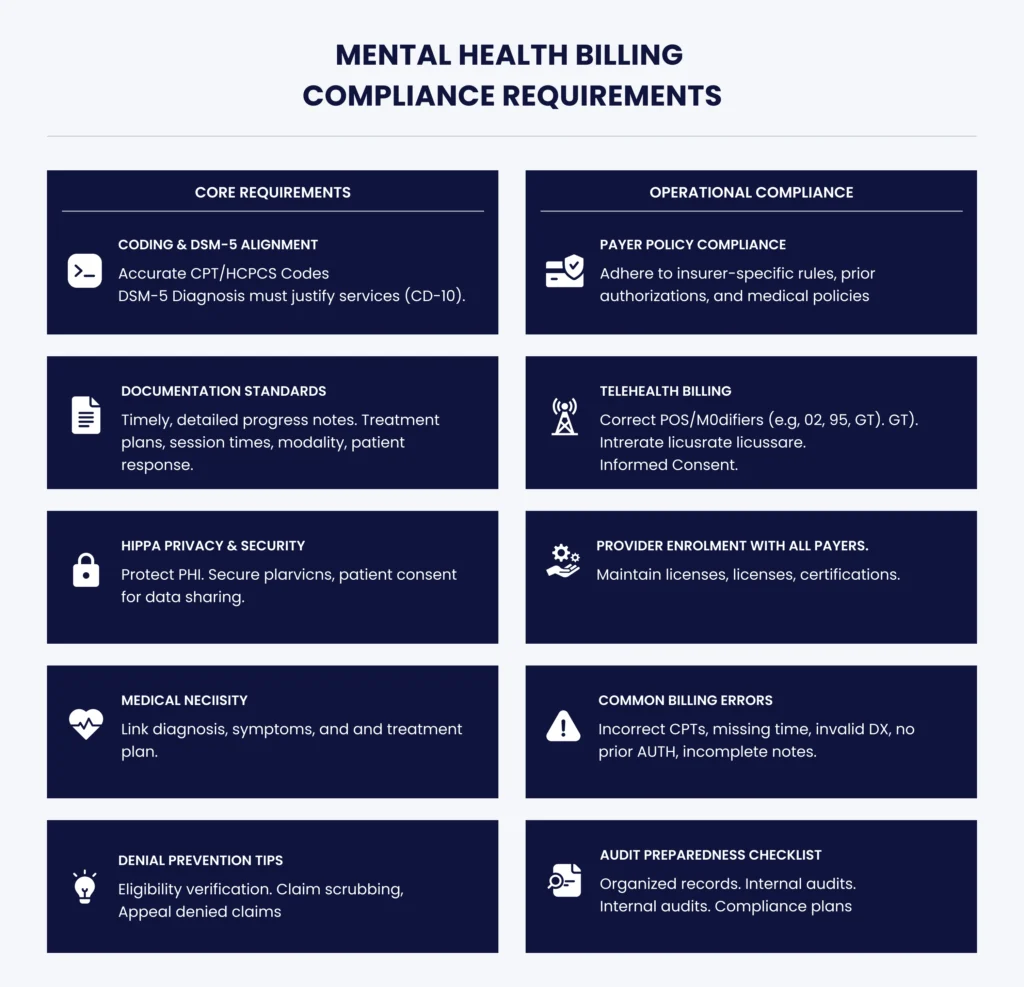
The Pillars of Billing Compliance for Mental Health Providers
Billing compliance is built on several key foundations that providers must master to ensure smooth operations. Below are the core pillars that guide mental health billing practices:
1.1 Health Insurance Portability and Accountability Act (HIPAA)
The Health Insurance Portability and Accountability Act (HIPAA) establishes national standards for the Protected Health Information (PHI). For mental health billing, compliance with HIPAA means:
- Using secure, encrypted systems for electronic claims and documentation.
- Limiting access to PHI to only authorized staff.
- Maintaining audit trails for all billing data.
- Ensuring telehealth platforms meet HIPAA privacy and security requirements.
A 2023 report by the Office for Civil Rights (OCR) found that 63% of healthcare data breaches involved failures with regard to HIPAA administrative safeguards, further emphasizing the importance of compliance in behavioral health billing.
1.2 Centers for Medicare & Medicaid Services (CMS) Billing Requirements
The Centers for Medicare & Medicaid Services (CMS) establishes the standards mental health providers must follow when billing federally funded programs. These include:
- Documentation supports medical necessity
- CPT and ICD-10 codes accurately reflect the service
- Ensuring rigorous mental health credentialing and enrollment so providers are authorized to bill specific payers.
- Claims are submitted within CMS deadlines
- Coverage policies are followed
CMS audits consistently identify documentation and coding discrepancies as leading causes of overpayment recoupments and claim denials.
1.3 High-Impact Modifiers for Mental Health Billing
Modifiers are essential in ensuring accurate billing, particularly in telemedicine and combined E/M services. The following modifiers should be applied carefully to avoid claim denials:
| Modifier | Description | Use Case |
|---|---|---|
| -95 | Synchronous Telemedicine | For real-time telehealth sessions |
| -GT | General Telemedicine | For general telehealth services that aren’t synchronous |
| -25 | Significant, Separately Identifiable E/M Service | When billing E/M code (e.g., 99214) with therapy (e.g., 90833) |
These modifiers are critical for proper telehealth billing and E/M code therapy combinations, and missing them can lead to denied claims.
1.4 Behavioral Health Billing Laws and Parity Requirements
The Mental Health Parity and Addiction Equity Act (MHPAEA) ensures that mental and behavioral health benefits cannot be more restrictive than medical or surgical benefits. This means that payers must apply the same criteria for treatment limits, coverage approvals, and co-payments for mental health services as they do for medical care.
Providers must carefully review payer policies to ensure billing parity compliance, especially when appealing denials or negotiating network contracts.
Enforcement of Parity Laws:
If a claim is denied due to restrictions that are more limiting than medical benefits (such as session caps), providers have the right to appeal. The Department of Labor (DOL) and CMS oversee enforcement of parity laws. Knowing how and when to appeal denials based on these restrictions is crucial to ensure payment for services rendered.
1.4 State Regulations and Payer-Specific Rules
Every state has its own set of rules for mental health billing, and you can’t afford to ignore them. For example:
- Some states require documentation updates every 90 days for Medicaid claims.
- Others mandate live supervision for certain therapy codes or enforce specific telehealth modifiers.
Understanding payer-specific contracts and state Medicaid guidelines is just as crucial as federal laws because many denials stem from regional rule variations (Medicaid.gov, 2024).
Why Compliance Isn’t Optional: The Risks and Costs
Ignoring compliance isn’t just risky; it can be costly. Here’s a look at the impact of non-compliance:
| Compliance Gap | Risk/Consequence | Estimated Impact (2024 Data) |
|---|---|---|
| No medical necessity proof | Denials or fraud probes | 25% of CERT errors |
| Coding/documentation slips | Audit triggers, penalties | $31.7B in Medicare improper payments |
| HIPAA lapses in billing | Fines, trust erosion | 100M+ records breached |
| Ignoring modifiers/supervision | Payment delays | 18% denial spike in telehealth |
In 2023, improper documentation and missing medical necessity contributed to over $3.4 billion in overpayments across outpatient mental health claims, according to CMS’s Comprehensive Error Rate Testing (CERT) program.
Struggling with audits? Dastify Solutions delivers up to 99% error reduction while ensuring compliance with CMS and HIPPA regulations,

CMS Billing Pathways: Incident-to, Direct Supervision, and Split/Shared
CMS billing for mental health requires clear understanding of three key billing methods used by practices with non-physician providers. Incident-to, direct supervision, and split/shared billing each have specific rules and compliance issues. Properly selecting and documenting the correct method is critical to ensure full reimbursement and prevent costly claim denials or repayments. This information is especially relevant for clinics using nurse practitioners, physician assistants, or licensed clinical social workers.
2.1 Incident-to Billing vs. Direct Supervision in Mental Health
Understanding how non-physician providers can bill under a physician’s National Provider Identifier (NPI) is key to CMS compliance in mental health:
Incident-to Billing:
- Non-physician providers (such as NPs, PAs, or LCSWs) deliver services that are billed under the supervising physician’s NPI.
- Strict requirements apply: the physician must be physically present in the office and actively engaged in the patient’s care during each service.
- Lapses in these requirements result in denied claims or recoupments.
Direct Supervision:
- The physician must be immediately available for consultation, but does not have to be physically present in the treatment room.
- This model is more practical for many mental health settings, but still requires careful documentation of physician oversight and availability.
Comparison Table:
| Billing Method | Key Requirements | When It Applies |
|---|---|---|
| Incident-to | Physician onsite, directly involved | NP/PA/LCSW works under MD’s NPI |
| Direct Supervision | MD immediately available (on premises), not in room | Flexibility for supervising off-site, with documentation |
Advanced CMS Rule: Split/Shared vs. Incident-to
| Billing Rule | Who Bills | Supervision/Documentation | Audit Risk | Payment Notes |
|---|---|---|---|---|
| Incident-to | Physician | Direct, onsite, strict documentation | High | MD rate, strictest |
| Split/Shared | Either | Both contribute & document their roles | High | Allowed when physician & other clinician each perform part of E/M |
For psychiatric practices with NPs or LCSWs, another distinction matters:
“Split/shared” billing is permitted when both the physician and a qualified non-physician participate in the same E/M visit and each documents the components they performed. CMS audits this area closely for proper documentation.
Mental Health Billing, Coding, and Documentation Requirements
The process of coding and documenting mental health services is the foundation of compliant billing. Both CPT codes and ICD-10 codes serve as a language that communicates to insurance companies what service was provided and for what condition. Proper documentation substantiates these codes and ensures that the medical necessity of the services is clear.
2.1 Why Accurate Coding Matters
Both CPT codes and ICD-10 codes are essential for submitting claims that are properly reimbursed. Here’s a breakdown of why these codes matter:
- CPT Codes: These codes describe the services provided (e.g., psychotherapy, diagnostic evaluation). The correct code reflects how long the session was and what type of treatment was provided.
- ICD-10 Codes: These codes indicate the patient’s diagnosis (e.g., depression, anxiety, PTSD). Insurance companies use ICD-10 codes to determine medical necessity and whether the treatment provided is covered under the patient’s plan.
Example CPT and ICD-10 Codes:
| CPT Code | Description | ICD-10 Code | Diagnosis |
|---|---|---|---|
| 90791 | Psychiatric diagnostic evaluation (no medical services) | F32.9 | Major depressive disorder |
| 90834 | Individual psychotherapy (45 minutes) | F41.1 | Generalized anxiety disorder |
| 90837 | Individual psychotherapy (60 minutes) | F40.9 | Phobic anxiety disorder |
Modifiers Matter
Modifiers such as -95 (synchronous telemedicine), -GT (general telemedicine), and -25 (significant, separately identifiable E/M service) must be applied when billing combinations like E/M codes with therapy. For example, billing code 99214 with 90833 requires modifier -25. Missing a required modifier commonly results in claim denials.
Is your coding process and documentation up to date? Dastify Solutions ensures every CPT and ICD-10 code is matched correctly, including all necessary modifiers.

2.2 How Documentation Supports Coding
Accurate documentation is required to justify the services rendered and to ensure that the claims are paid. Without detailed and accurate documentation, there is no way to prove that the CPT and ICD-10 codes align with the service provided.
Key Documentation Elements:
- Treatment Plans: Should clearly link the ICD-10 code (diagnosis) with the CPT code (therapy type). For example:
- Diagnosis: F32.9 (Major depressive disorder)
- Treatment: CPT 90834 (45-minute individual psychotherapy)
- Progress Notes: Must support the CPT code by documenting the actual time spent, interventions used, and the patient’s response. For example:
- Session Time: 45 minutes
- Service Provided: Cognitive-behavioral therapy (CBT) for depression
- Patient Response: Patient participated actively, showing slight improvement in coping strategies.
- Medical Necessity: Document why the service was necessary and how it supports the patient’s treatment goals. For example:
- Patient diagnosed with F32.9 (Major depressive disorder), requiring CPT code 90834 for psychotherapy.
Financial Documentation: ABN Waivers
If Medicare is likely to deny a billed service due to lack of medical necessity, you must obtain a signed Advance Beneficiary Notice (ABN) from the patient before delivery. An ABN outlines the reasons coverage may be denied and the patient’s financial responsibility. Without an ABN, you cannot bill the patient for denied services. Practice staff should be trained to recognize when an ABN is needed and secure it before the appointment.
Additional Compliance Documentation
In mental health care, documentation often requires extra notes to meet compliance requirements related to privacy and mandated reporting.
- State law required use” typically refers to protections under the HIPAA Psychotherapy Notes Rule, which mandates separate handling and special privacy standards for psychotherapy notes.
- OSHA required use” usually involves facility safety or incident reporting documentation that must be segregated from standard billing records.
Recognizing and properly managing these documentation types is critical to avoid compliance errors and audit challenges.
2.3 Common Coding and Documentation Mistakes
Billing errors are common, but they can be avoided with careful attention to detail. Here are a few mistakes to watch out for:
| Mistake | Why It’s a Problem | How to Avoid It |
|---|---|---|
| Vague progress notes | Doesn’t support the billed CPT or medical necessity | Ensure specific details like session duration, patient response, and next steps |
| Using the wrong CPT code | Under or over-billing, payer denial | Match the CPT code to exact session length and type of service |
| Missing ICD-10 code details | Claim denial due to mismatch with diagnosis | Ensure the ICD-10 code aligns with the diagnosis and treatment provided |
| Not documenting medical necessity | Risk of claim denial or fraud investigations | Clearly document why the service was necessary for the patient’s treatment |
Avoid costly billing mistakes with Dastify Solutions. We help practices like yours stay compliant and reduce denials.
To Wrap it Up
Mental health billing compliance isn’t just a set of rules to follow; it’s about ensuring your practice runs smoothly, stays financially healthy, and remains focused on what matters most: your patients. By keeping your coding, documentation, and data security on point, you protect both your revenue and your reputation. At Dastify Solutions, we’re here to help you navigate these complex billing processes with ease. Our expertise in mental health billing has already several practices across the US to reduce errors by up to 99%, improve accounts receivable by 40%, and increase clean claims on the first pass to over 95%.