

Technical and professional components
Each study must be billed as global, technical only, or professional only based on who performed the technical portion and who interpreted the results. TC and 26 need to reflect real roles, not system defaults.
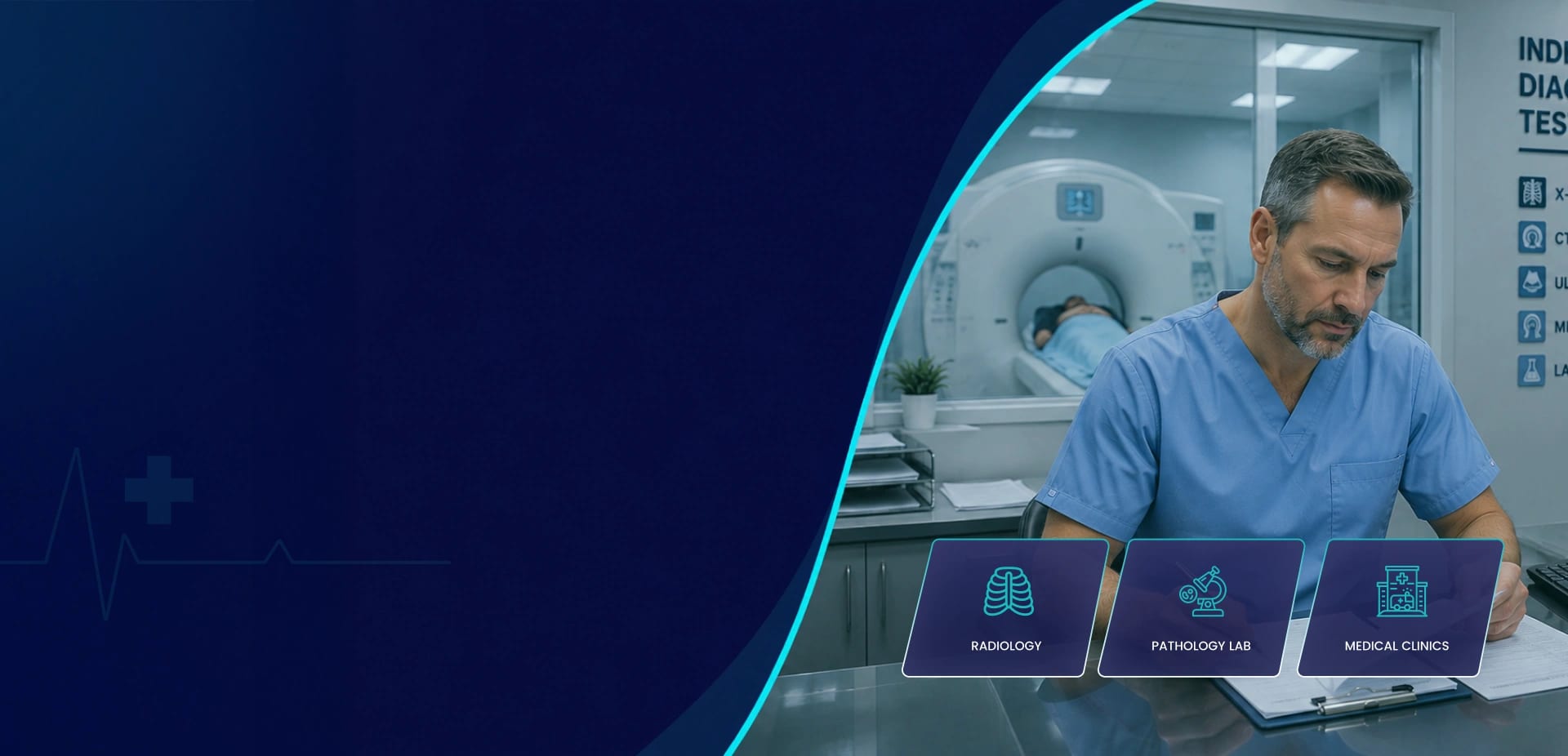
Accurate and Compliant Medical Billing for Independent Diagnostic Testing Facilities (IDTFs)
IDTF revenue depends on three things: precise TC/26 splits, verified ordering provider data, and strict adherence to CMS 855B performance standards. A small gap in an order or a coding choice can turn a completed study into a denied or underpaid claim.
Dastify Solutions is an IDTF medical billing company providing IDTF revenue cycle management services that cover everything from order review and eligibility checks to coding, diagnostic test claims submission, payment posting, and AR follow-up.
Billing for an independent diagnostic testing facility is not just CPT selection. Several structural elements must line up for a claim to pay correctly.
Technical and professional components
Each study must be billed as global, technical only, or professional only based on who performed the technical portion and who interpreted the results. TC and 26 need to reflect real roles, not system defaults.
Ordering provider and medical necessity
Orders must include a clear reason for the test and diagnosis support that meets payer coverage rules. Vague indications often trigger medical necessity denials.
Global vs split billing arrangements
If outside physicians interpret the study, your billing pattern must match the arrangement to avoid duplicate billing exposure and recoupments.
IDTF enrollment and performance standards
Your CMS Form 855B enrollment profile must match what you bill, including sites, modalities, supervision model, and testing locations.
When those pieces are handled deliberately, billing feels predictable. When they are left to chance, denials and audits feel random.
We work with IDTFs that rely on accurate, high volume testing, including:
Cardiac diagnostics
EKGs, Holter monitoring, and echocardiography.
Sleep diagnostic labs
Both home sleep testing and in-lab polysomnography.
Independent imaging centers
Ultrasound, X-ray, CT, and MRI.
Neurodiagnostic testing
EEG and nerve conduction studies.
Mobile diagnostic units
Testing that travels to clinics or employer sites.
We look at the IDTF revenue cycle as a continuous diagnostic test claim lifecycle, not just as separate back office tasks.
Clean billing depends on accurate enrollment and contracts. We help you:
Maintain accurate IDTF enrollment with CMS through Form 855B for each site and modality
Coordinate with Medicare, Medicaid, Medicare Advantage and major commercial plans such as Blue Cross Blue Shield, Aetna, UnitedHealthcare, Cigna and Humana
Configure IDTF fee schedules that match contracted amounts and keep patient responsibility clear
We ensure your claims utilize POS 49 (Independent Clinic) or POS 81 (Independent Lab) correctly. We prevent the common "POS 11 (Office)" error that triggers Medicare recoupments for IDTFs improperly billing as physician offices, a key audit focus for 2026.
Many diagnostic denials start before the patient ever arrives. Our front end IDTF insurance verification and order management work includes:
Real time eligibility verification for diagnostics at scheduling and again close to the date of service
Checking whether specific tests, such as sleep studies or advanced imaging, require prior authorization or meet plan frequency limits
Reviewing orders for required elements such as ordering physician details, signatures, ICD 10 indications and test parameters
Flagging missing or unclear documentation that will cause trouble with Medicare, Medicaid or commercial plans
| Step | What we manage |
|---|---|
| Eligibility | Confirm active coverage and basic benefits |
| Order validation | Check for complete and compliant ordering information |
| Requirements | Identify prior auth and documentation needs |
This reduces the number of tests performed that were never billable in the first place.
Once a test is performed, the next issue is how it is coded and how components are split. Our IDTF medical billing and coding focuses on:
Appropriate assignment of TC and 26 modifiers for technical and professional components
Correct use of CPT codes for EKGs (93000 to 93010), cardiac monitoring (93224 to 93248), echocardiography (93306), myocardial perfusion imaging (78452), sleep studies (95800 to 95811), nerve conduction studies (95907 to 95913), ultrasound (76536), mammography (77067), chest X ray (71045), MRI lumbar spine (72148) and other IDTF services
ICD 10 linkage that supports medical necessity documentation for diagnostic tests, such as I10, R07.9, G47.33, R42, R06.02, M54.5, I49.9, G56.00, Z13.6 and Z01.89
Applying NCCI edits and AMA CPT guidelines so that procedures are not unbundled or combined incorrectly
| Billing Pattern | Modifier Use | Description |
|---|---|---|
| Global diagnostic billing | None | Facility bills both technical and professional |
| Technical only | TC | IDTF bills technical component only |
| Professional only | 26 | Physician bills interpretation only |
For IDTFs that utilize third party interpretations, we manage the Purchased Diagnostic billing requirements to ensure compliance with anti markup regulations and correct identification of the performing provider on the claim.
We then create claims that reflect this structure correctly on the first pass.
When coding is precise, the rest of the IDTF claim management process should be straightforward. Dastify handles:
Timely, accurate diagnostic test claims submission with correct place of service, referring provider and supervision data
Detailed IDTF payment posting that separates technical and professional receipts and matches payments to specific studies
Organized IDTF AR follow up that groups denials by reason and test type so prevention steps can be targeted
| Stage | What happens | What We manage |
|---|---|---|
| Order | Test requested | Check completeness and alignment with rules |
| Test | Diagnostic study performed | Confirm documentation and supervision |
| Claim | Charge built in the system | Code and edit with TC, 26 and correct ICD 10 |
| Submission | Claim sent to payer | Monitor acceptance, rejections and status |
| Decision | Paid, denied or pended | Work denials, resubmit or appeal as needed |
| Posting | Payment applied | Post accurately by component and encounter |
| Follow up | Remaining balance | Tackle unresolved or high value outstanding AR |
This is how our IDTF RCM services move you from reactive denial management to proactive process control.
We built this workflow to catch problems at every stage, from order to payment. Let us show you where your current process is breaking down.
To protect your revenue, we manage the specific regulatory hurdles that most billers miss.
LCD Compliance for Diagnostic Testing
Medicare Local Coverage Determinations (LCD) govern coverage for most IDTF services. For example, LCD L34558 covers cardiac monitoring and LCD L33797 covers sleep testing. We cross-reference every claim against the applicable LCD before submission. This prevents medical necessity denials caused by mismatched diagnosis codes.
Accreditation-Dependent Billing
Several service lines require facility accreditation for Medicare payment. Mammography requires FDA MQSA certification and sleep labs may require AASM accreditation. We verify your accreditation status for each modality before configuring your workflow. This ensures claims are never submitted under a lapsed service line.
Ordering Provider PECOS Verification
Medicare requires that physicians ordering tests from IDTFs be enrolled in PECOS. If the referring provider is not enrolled, Medicare denies the claim with a CO-16 or CO-57 code. We verify PECOS enrollment for every referring provider before the first claim is submitted.
Medicare Advantage vs. Traditional Medicare
Medicare Advantage plans often have different prior authorization requirements and carve-out vendors for cardiac or sleep studies. We identify these arrangements early to manage the separate authorization workflows required by MA plans.
Home Sleep Testing vs. In-Lab Polysomnography
The clinical decision between home testing (95800) and in-lab testing (95810) has huge revenue implications. We validate the physician's clinical indication against payer criteria to ensure the correct modality is authorized and billed.
Mobile IDTF Compliance
Mobile units face unique enrollment needs. Each service location must be reflected in your CMS 855B file. We ensure the supervising physician meets performance standards at the mobile site and that claims reflect the actual testing location to prevent enrollment mismatch denials.
When evaluating a partner, do not settle for generic medical billing. You need a company that meets these four standards:
TC/26 split billing expertise.
CMS 855B enrollment management.
Ordering provider PECOS verification.
LCD-compliant pre-submission validation.
| Denial Code | IDTF-Specific Cause | Resolution |
|---|---|---|
| CO-16 | Missing ordering provider NPI or PECOS non-enrollment | Verify PECOS status and correct claim with enrolled provider |
| CO-50 | Diagnosis code does not meet LCD medical necessity | Cross-reference LCD before submission and obtain amended order |
| CO-97 | TC and 26 both billed globally when split was required | Review arrangement and resubmit with correct modifiers |
| CO-119 | Frequency limit exceeded for repeat test | Track prior test dates and verify eligibility before scheduling |
| CO-4 | Incorrect modifier for supervision level | Verify CMS PFS supervision requirement and correct modifier |
| PR-96 | Non-covered charge due to lapsed accreditation | Verify MQSA or AASM status before billing modality |
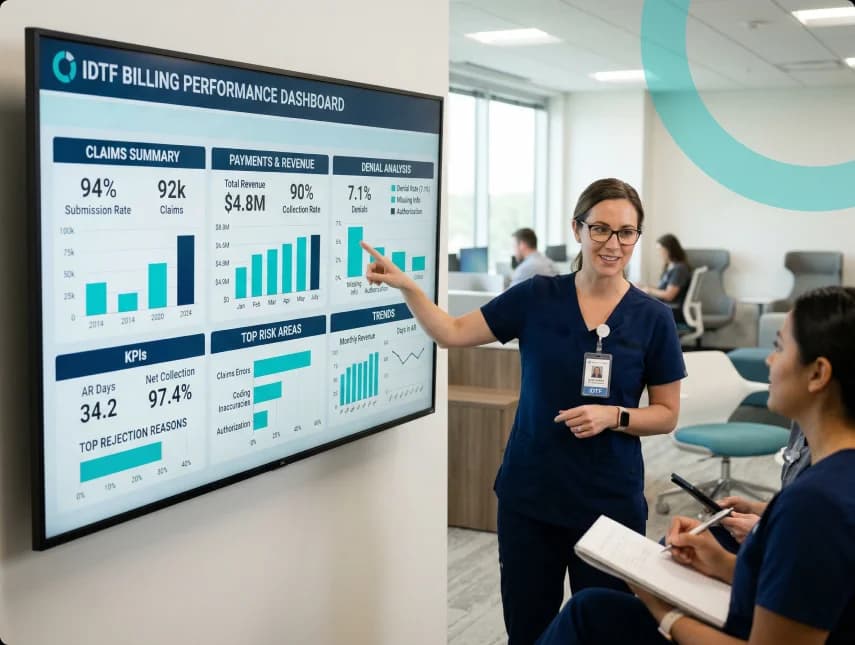
We believe diagnostic billing transparency is essential. Instead of opaque AR totals, we give you visibility into:
Volume of tests performed by modality, location and referring provider
Claims submitted, paid and denied by payer and test type
Average time from date of service to payment
Common denial reasons and where in the front end they can be addressed
This helps you make rational decisions about new equipment, promotional efforts and staffing for your IDTF operations.
If you do not know your average days to payment by payer and test type, you are flying blind. We track every claim from date of service to deposit so you see the full picture.
We believe diagnostic billing transparency is essential. Instead of opaque AR totals, we give you visibility into:
We understand the difference between professional billing for a cardiologist and technical billing for an IDTF, and how they connect
We track IDTF specific regulations such as CMS IDTF Performance Standards and federal IDTF billing regulations
We bring structure to IDTF RCM outsourcing instead of treating your work like generic outpatient visits
Our team of IDTF billing specialists works alongside your staff, helping refine workflows rather than just cleaning up errors after the fact
If your current IDTF billing feels unpredictable, or you find yourself spending more time answering payer questions than managing your diagnostic programs, your facility is under more strain than it should be. We can review a small sample of your IDTF charts, orders, claims and payments and give you a structured assessment of what is working, what is at risk and where you can improve.
Medicare will deny the claim regardless of how accurate your coding is. We verify PECOS status for every referring provider before submission. If we find a non-enrolled provider, we notify your facility immediately so the issue can be fixed before denials accumulate.
We can take responsibility for only your independent diagnostic testing facilities, medical billing services or extend services to your other lines of business, depending on how you are structured.
When the IDTF performs the technical component and an interpreting physician bills the professional component, the claims must be coordinated as technical and professional, not duplicated as global. We manage the component structure, documentation, and anti markup considerations where purchased interpretations apply.
Yes. We assist with initial CMS 855B enrollment for new IDTF locations, add modalities and testing sites to existing profiles, process revalidation requests within CMS timelines, and update supervising physician information when staff changes occur. Outdated 855B profiles are one of the most common causes of IDTF claim denials because billing activity outside the enrolled profile triggers automatic MAC review.
We help ensure locations and equipment are reflected correctly in your enrollment and claims so that mobile diagnostic testing units and additional sites do not create compliance problems.
You will see results in two stages. First, most IDTFs see a drop in denial rates within 30 to 45 days. This happens because we catch PECOS errors and LCD mismatches before they ever leave your office. That stops CO-16 and CO-50 denials in their tracks. Second, it takes about 90 days to fully stabilize your AR. That is the time it takes for our new, clean claim flow to replace your existing backlog.
Yes. We work with your existing EMR and billing software, improving coding accuracy, diagnostic test claims submission, payment posting and IDTF AR follow up inside the environment your staff already knows.