


Introduction: When Claim Denials Drain Your Practice
Claim denials are more than administrative headaches; they’re silent revenue killers. They delay payments, increase staff workload, and hurt cash flow. According to Healthcare Financial Management Association, 22% of healthcare leaders report losing at least $500,000 annually to denials, while 1 in 10 loses over $2 million per year.
For physicians and medical practices, this means:
- Delayed reimbursements
- Increased administrative burden
- Higher operational costs
- Reduced net collection rate
The solution? A structured denial management workflow within your Revenue Cycle Management (RCM) strategy.This workflow can recover lost revenue, reduce repeated errors, and shorten AR cycles by up to 40% when executed correctly. This blog answers your key questions: why denials happen, how to fix them fast, and how to prevent them permanently.
Why Are Medical Claims Denied?
Understanding why claims are denied is the first step toward eliminating revenue loss. While denial trends evolve, historical data provides a useful benchmark to identify recurring issues. According to Change Healthcare (2022), the national average denial rate was 11%, with 80–90% of denials considered preventable.
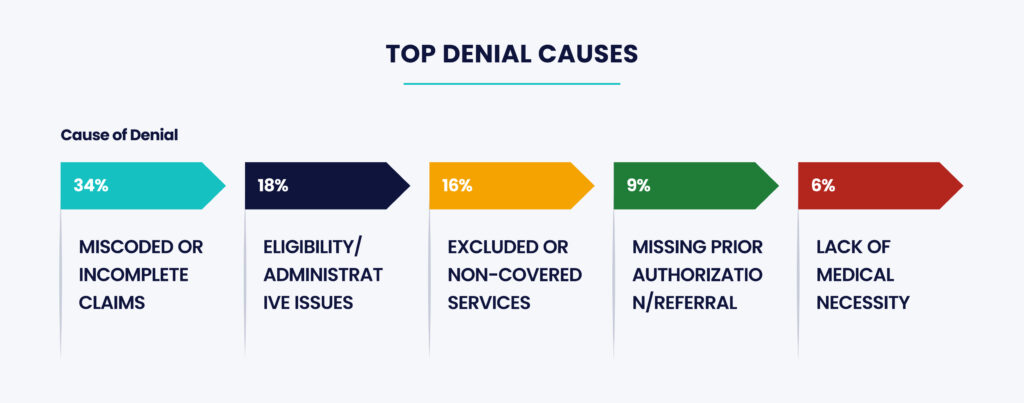
Illustrative Top Denial Causes (2022–2023 benchmark)
| Cause of Denial | Estimated % of Total Denials | Source |
| Miscoded or incomplete claims | 34% | Change Healthcare Denials Index 2022 |
| Eligibility/administrative issues | 18% | Change Healthcare Denials Index 2022 |
| Excluded or non-covered services | 16% | Change Healthcare Denials Index 2022 |
| Missing prior authorization/referral | 9% | HFMA |
| Lack of medical necessity | 6% | AHA |
Note: Denials can be soft (fixable errors) or hard (final rejections requiring appeal). Most are preventable before reaching the payer.
| Key Point: Most denials are preventable before claims even reach the payer. |
Denial Management Workflow: Step by Step
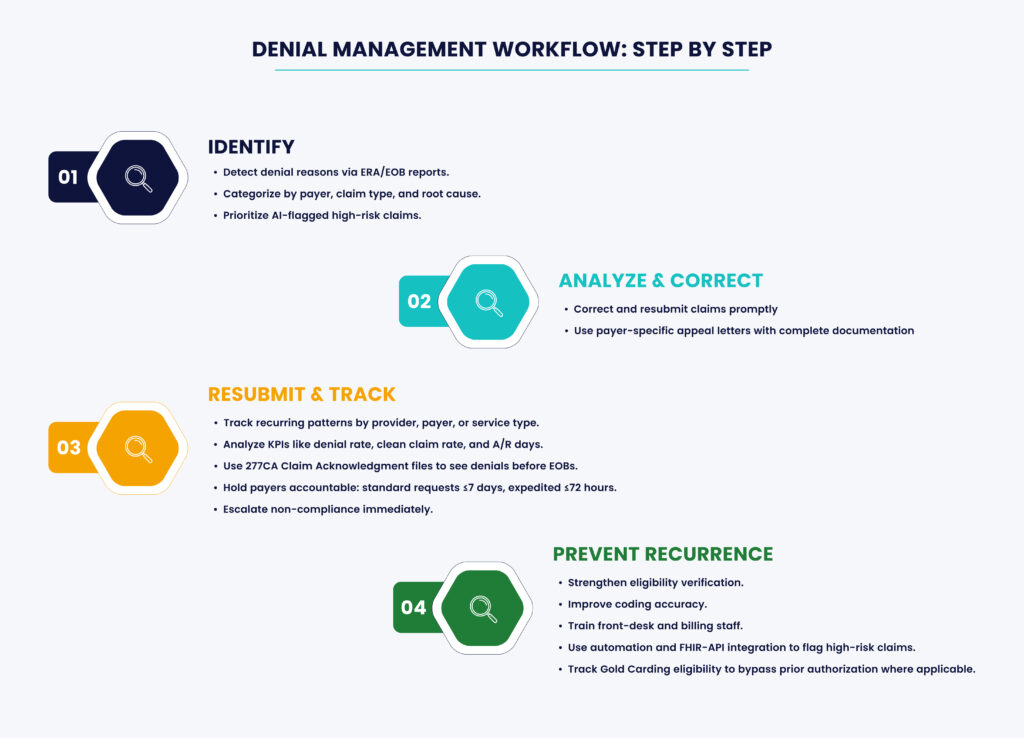
A strong denial management workflow ensures every denied claim is identified, tracked, corrected, and prevented from recurring. Below is a breakdown of an effective workflow that medical billing companies use to minimize denials and improve A/R performance.
Step 1: Identify
- Detect denial reasons via ERA/EOB reports.
- Categorize by payer, claim type, and root cause.
- Prioritize AI-flagged high-risk claims.
Step 2: Analyze & Correct
- Correct and resubmit claims promptly
- Use payer-specific appeal letters with complete documentation
Step 3: Resubmit & Track
- Track recurring patterns by provider, payer, or service type.
- Analyze KPIs like denial rate, clean claim rate, and A/R days.
- Use 277CA Claim Acknowledgment files to see denials before EOBs.
- Hold payers accountable: standard requests ≤7 days, expedited ≤72 hours.
- Escalate non-compliance immediately.
Step 4: Prevent Recurrence
- Strengthen eligibility verification.
- Improve coding accuracy.
- Train front-desk and billing staff.
- Use automation and FHIR-API integration to flag high-risk claims.
- Track Gold Carding eligibility to bypass prior authorization where applicable.
When executed properly, practices can reduce AR days by up to 40%.
The solution? Outsourcing denial management ensures these steps are executed efficiently by experts using automation and analytics.
| Tip: Combining workflow with automation reduces manual errors and accelerates payments. |
Stop leaving money on the table and recover the revenue you already earned
Get Your Denial Recovery Estimate Now
How Denial Management Protects Revenue
Denial management protects revenue in several key ways:
Key benefits of structured denial management:
- Capturing Lost Revenue: Up to 65% of denied claims are never resubmitted due to backlog; structured workflow ensures every claim is corrected.
- Reducing Rework Costs: Denied claims cost $25–$50 each; addressing root causes saves time and money.
- Shortening A/R Cycles: Faster resubmissions mean quicker payments.
- Preventing Recurring Denials: Track patterns in coding, eligibility, or documentation.
- Optimizing Staff Time: Automation allows staff to focus on high-value tasks.
In short: denial management is not reactive work, it’s revenue protection.
2026 Regulatory Update: Denial Transparency & The Federal Clock
As of January 1, 2026, the CMS-0057-F mandate transformed “denial” into a transparency metric, not just a billing error.
- Payers must provide structured denial reasons.
- Vague rejections like “Medical Necessity Not Met” without a clinical citation are compliance violations for Medicare Advantage and Medicaid MCOs.
Practices can leverage this to accelerate appeals and streamline workflow.
AI-Driven Denials: Predictive Logic in 2026
Payers are increasingly using Agentic AI to triage claims:
- Claims matching high-waste patterns (WISeR Pilot) are automatically diverted to forensic audits.
- Workflow automation should integrate predictive AI alerts to prioritize risk claims, enabling faster correction and resubmission.
State-Level Gold Carding Realities (2026)
“Gold Carding” is an active law in several states.
- For example, In Texas, Georgia, and Michigan, a ≥90% clean-claim rate over 6 months can bypass prior authorization entirely.
- RCM teams should track metrics to ensure eligibility for Gold Carding, reducing administrative burden and speeding approvals.
Payer-Specific Strategies
In-Network: Denials due to missing authorization, invalid eligibility, or late filing.
Out-of-Network: Denials when plans exclude benefits or procedures flagged “non-emergent.”
Patient Communication: Upfront communication is critical to avoid disputes.
Proven Strategies to Prevent Denials
According to AHIMA research, leading healthcare organizations focus on prevention and leverage data-driven insights rather than reactive strategies.
Key strategies include:
Front-End Accuracy – Verify demographics, eligibility, and authorizations.
Ongoing Training – Keep billing and coding staff up to date on rules and regulations.
Track KPIs – Monitor denial rates, clean claim rates, and days in A/R.
Leverage Automation – Use RPA or AI to flag high-risk or incomplete claims.
Collaborate with Payers – Maintain clear communication to address recurring denial patterns.
Good Denial Rate Benchmarks (CMS & HFMA)
| KPI | Target | Description |
|---|---|---|
| Claim Denial Rate | ≤ 5% | Measures the frequency of denied claims |
| Net Collection Rate | ≥ 95% | Revenue collected after contractual adjustments |
| Clean Claim Rate | 98% | Claims accepted without edits |
| Days in A/R | ≤ 40 days | Average time to collect payment |
| Denial Resolution Time | ≤ 30 days | Duration to resolve denials |
Why is Outsourcing Denial Management Important
For many practices, managing denials in-house can be time-consuming and resource-heavy. Outsourcing to a medical billing company gives you access to trained RCM experts, advanced tools, and proven workflows.
FAQ: Denial Management in Medical Billing
Q1: What is denial management?
A: Denial management is the process of identifying, correcting, appealing, and preventing denied claims to protect practice revenue.
Q2: How long does denial resolution take?
A: Best-performing practices resolve denials within 30 days.
Q3: How can I prevent denials before claims are submitted?
A: Use front-end automation for eligibility verification, AI tools to flag high-risk claims, and ensure accurate clinical documentation that supports coding. Preventive workflows are trending as the most effective strategy.
Q4: Are certain payers denying more claims than others?
A: Yes. Private payers and Medicare Advantage plans are denied at higher rates than Traditional Medicare or Medicaid. Payer-specific workflows are critical.
Q5: How can I reduce A/R days using denial management?
A: Structured workflows identify, analyze, correct, resubmit, track, and prevent recurrence combined with automation, can reduce A/R by up to 40%.
The Bottom Line
Every denied claim is lost revenue. If your denial rate is above 5% or AR exceeds 40 days, your practice is leaking money. Implementing a structured denial management workflow with automation and expert support can recover lost revenue, improve cash flow, and reduce administrative stress.
Get a complimentary denial analysis and uncover recoverable revenue.
Request Free Analysis