


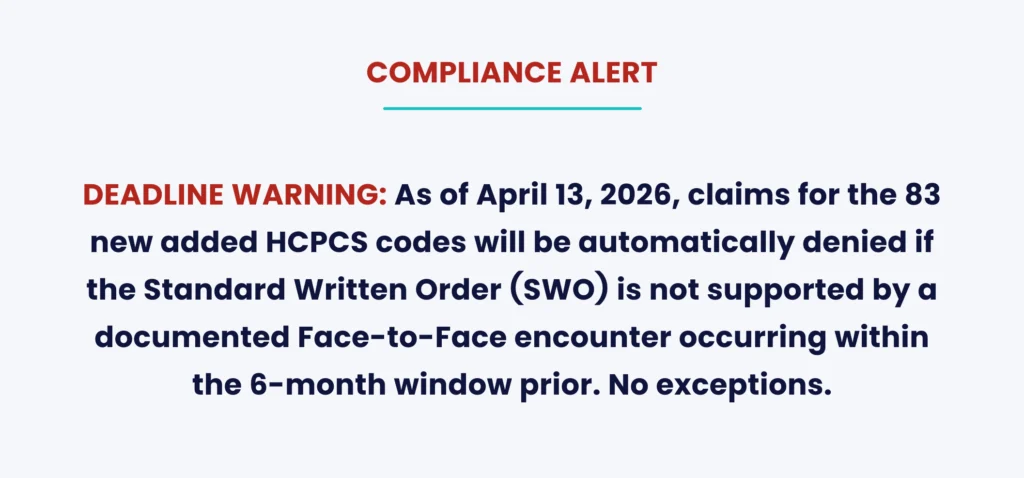
If you are a DME supplier or a referring provider, that is the day the Centers for Medicare & Medicaid Services (CMS) formally expands documentation enforcement under the DMEPOS Required List. We aren’t just talking about a minor administrative tweak. We are looking at a massive expansion of the Master List of DMEPOS Items Potentially Subject to Face-to-Face Encounter and Written Order Prior to Delivery Requirements (the “Required List”).
The update adds 83 new items to the list.
For billing teams, this means 83 new ways to get a claim denied if you don’t have a Face-to-Face (F2F) exam documented before the Standard Written Order (SWO) is signed.
Here is what is changing, why it matters, and how to protect your revenue before these rules are enforced.
The Core Change: Connecting the “Required List” to the F2F
There is often confusion about how these lists work. Let’s cut through the noise.
CMS maintains a “Master List” of items that are high-risk for fraud or overuse. When they move items from the Master List to the Required List, strict documentation rules kick in.
Before this update, you might have been able to supply certain orthotics or supplies with just a standard prescription. That ends for these 83 items on April 13.
The New Mandatory Workflow
If you dispense any of the 83 new items without following this exact sequence, you are working for free.
- The Encounter: The treating practitioner must see the patient (in person or via telehealth) to evaluate the medical need.
- The Documentation: That encounter must be documented in the medical record.
- The SWO: Only after the encounter can the physician sign the Standard Written Order.
- The Delivery: You deliver the item.
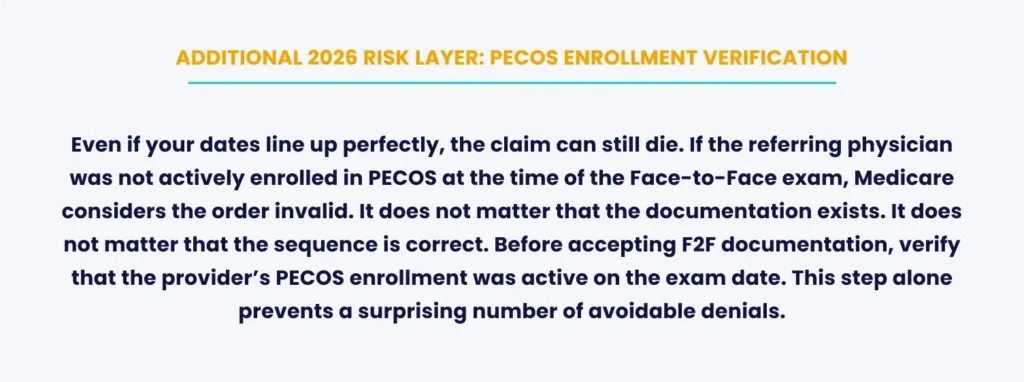
If the SWO is dated before the medical record entry for the exam, the claim fails. It’s that simple.
What Are the 83 New Items?
While we won’t list every single HCPCS code here (you can find the raw data in the Federal Register), the expansion heavily targets high-cost and high-volume categories. CMS is specifically looking at items where they suspect “prescriptive lethargy” where doctors sign orders without actually checking if the patient still needs the device.
Key Categories Impacted:
- Orthotics: Both Off-the-Shelf (OTS) and Custom-Fabricated orthoses are impacted, with heightened scrutiny placed on custom-fabricated devices due to higher reimbursement exposure and audit vulnerability.
- Mobility Assistive Equipment: specific operational parts and accessories.
- Respiratory Equipment: New classes of nebulizers and oxygen supplies.
For urgent respiratory items subject to prior authorization, suppliers should also be mindful of CMS turnaround timelines. Expedited requests must meet documentation requirements at submission, as post-submission corrections may delay medically necessary equipment.
If your inventory relies heavily on off-the-shelf (OTS) orthotics, you need to audit your stock against the new list immediately.
| Feature | Before April 13, 2026 (For These 83 Items) | After April 13, 2026 (Compliance Mandatory) |
|---|---|---|
| Order Type | Verbal Order or simple prescription (Rx) often accepted initially | Standard Written Order (SWO) required prior to delivery |
| Doctor Visit Requirement | Not strictly enforced for claim submission | Mandatory Face-to-Face (F2F) visit within 6 months prior |
| Audit Risk | Moderate | Severe – Automatic CERT reviews likely |
| Prior Authorization | Varies by payer | Required as a Condition of Payment |
The “Written Order Prior to Delivery” (WOPD) Trap
This expansion isn’t just about the face-to-face exam; it triggers the WOPD rule.
For these 83 items, you cannot rely on a dispensation order. You need the full SWO in your hand before the driver leaves the warehouse or the patient leaves the office.
Your SWO Must Contain:
- Beneficiary’s name or MBI
- Order Date
- General description of the item (brand name alone is risky, use the HCPCS description)
- Quantity to be dispensed
- Treating Practitioner Name & NPI
- Practitioner Signature
If any of these fields are missing, or if the date implies the order was signed before the exam, the CMS Program Integrity Manual dictates a denial.
How You Collect the F2F Documentation Matters
Many suppliers still rely on faxed notes or scanned PDFs when collecting Face-to-Face documentation. That approach creates delays and increases the risk of missing pages or incomplete records.
As interoperability standards continue to evolve, more organizations are moving toward secure API-based record exchange between EHR systems. When available, pulling the actual encounter note directly from the referring provider’s system reduces reliance on manual document handling and strengthens audit defensibility.
Date Matching Should Not Rely on Memory
Most denials we see are not because staff do not understand the rule. They happen because someone moved too quickly.
The warehouse ships. The intake team assumes the order date is fine. No one cross-checks the encounter timestamp against the signature date.
That gap is where revenue disappears.
At a minimum, your workflow should force a hard review of the encounter date against the SWO date before delivery. Whether that is done manually with a checklist or through system controls, the verification needs to happen before the claim leaves your system, not after it is denied.
Why Is CMS Doing This Now?
It’s always about money. The Office of Inspector General (OIG) releases reports annually showing billions in improper payments for DME. By moving these 83 items to the Required List, they are essentially putting a “speed bump” in the ordering process.
They want to ensure that a provider actually laid eyes on the patient and verified that the brace, wheelchair part, or oxygen supply is medically necessary, rather than just rubber-stamping a renewal.
Is Your Intake Team Ready for the New List?
Documentation errors are the #1 killer of DME profit margins.
Don’t guess. Let Dastify Solutions audit your current intake workflow. We ensure your documentation is bulletproof before it ever hits the payer.
How to Prepare Your Team (And Your Cash Flow)
April 13, 2026, is the effective date. Suppliers should update their documentation and billing workflows before implementation to help prevent claim denials and reimbursement delays.
Action Plan for Suppliers:
- Update Your PM Software: Ensure the 83 new HCPCS codes are flagged in your system as “WOPD Required.” Your staff shouldn’t have to memorize them; the software should stop them from printing a delivery ticket until the SWO is scanned.
- Scrub the Pipeline: Look at all pending orders for these items scheduled for delivery after April 13. If the SWO is old or the F2F is missing, get it fixed now.
- Audit Your Referring Providers: Identify which doctors send you the most volume for these specific items. Call their office managers. Send them a cheat sheet.
The Bottom Line
The expansion of the Required List is a headache, but it’s also the law. The days of loose documentation for these 83 items are over. The focus is shifting entirely to medical necessity validated by a human encounter.
If you have the documentation, you get paid. If you have a signature but no exam date, you don’t.
This is where expertise wins. You can’t fight the CMS regulations, but you can outsmart the administrative burden with the right partner.