


So, what exactly are back office services in healthcare? They’re the administrative stuff, the financial workflows, and the technical processes that keep things running behind the scenes. The stuff that doesn’t happen right in the exam room, but is super important for patient care.
Your front-office folks are handling patient-facing tasks like scheduling, payments, and whatnot. Meanwhile, the back office handles medical billing, medical coding, compliance, and other behind-the-scenes tasks.
Take a clinic that’s dealing with thousands of claims a month, for example. Without a solid back office operation, they’re going to have cash flow problems, and that’s just a recipe for disaster. And if your back office is running all over the place, it can really mess up patient care.
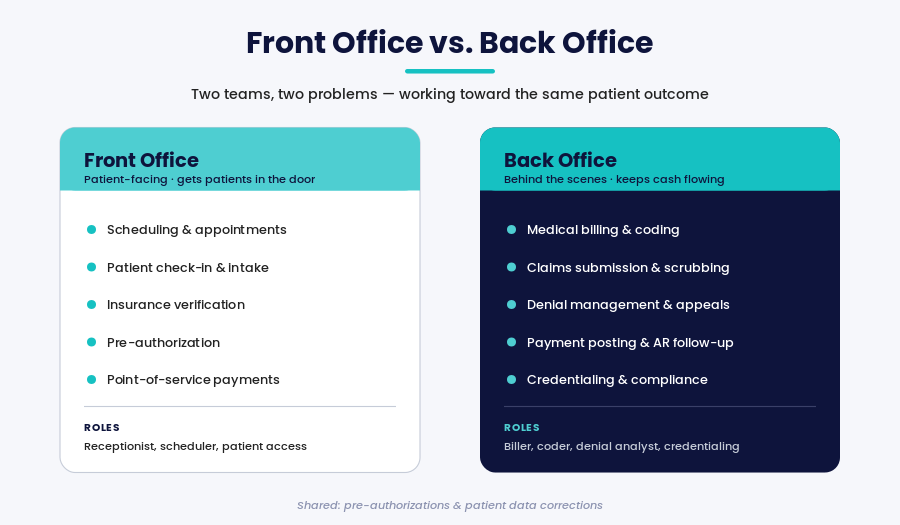
Front Office vs. Back Office Roles in Healthcare
Your front-office and back-office teams might work together, but they’re solving different problems. The front office is all about getting patients in the door and ensuring they receive the care they need. The back office is all about keeping cash flowing, ensuring compliance, and maintaining financial order.
For example, insurance verification is a front office thing, but if it goes wrong, the back office is left dealing with the fallout – denied claims, appeals, and delayed payments.
Here are some typical roles:
- Front office: Receptionist, scheduler, patient access specialist, pre-authorization specialist.
- Back office: Billing specialist, coder, denial management analyst, credentialing specialist.
- Some stuff is shared, like pre-authorizations and patient data corrections.
Core Back Office Functions in Healthcare
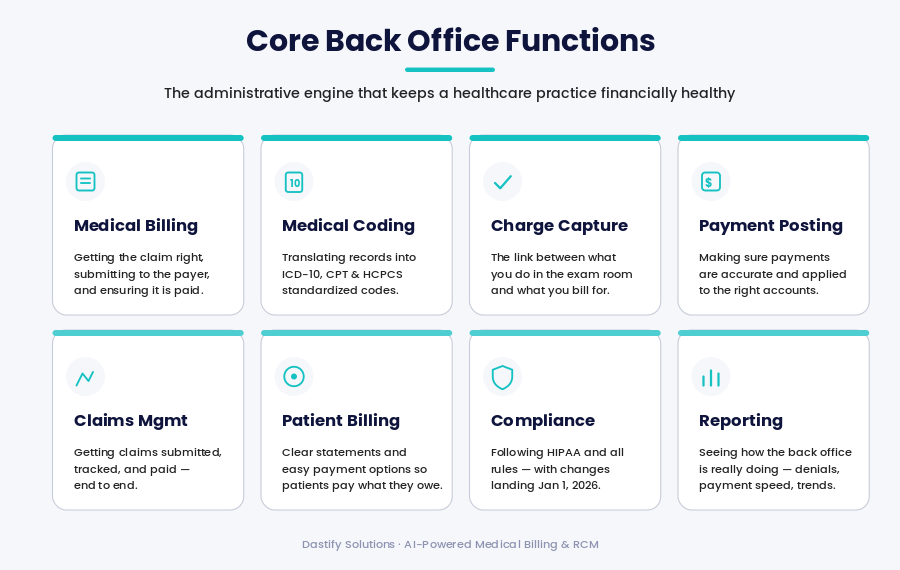
Your back-office services should handle all key administrative and operational tasks that keep your practice running smoothly. That includes medical billing, coding, claims processing, and more.
- Medical Billing: This is all about getting paid by insurance. It includes getting the claim right, submitting it to the payer, and ensuring it is paid.
- Medical Coding: This is how you translate all those patient records into standardized codes that insurance can understand.
- Charge Capture: The connection between what you do in the exam room and what you bill for.
- Payment Posting: Just making sure all those payments are accurate and applied to the right accounts.
- Claims management: This is all about getting those claims submitted and paid.
- Patient Billing: This is all about getting the patient to pay what they owe.
- Compliance: Ensure you’re following all rules and regulations. January 1, 2026, is going to bring some changes, so pay attention!
- Reporting: This is where you get to see how your back office is really doing. Are denials going up? Are payments taking too long?
Detailed Types of Healthcare Back Office Services
Your back office in healthcare is basically all about the day-to-day financial and administrative tasks that keep the place running. That includes medical billing and coding, claims processing, and everything else.
Some of the key stuff your back office should be doing includes customer support, data management, payroll management, insurance verification, and claims processing. All of this stuff is super important for keeping your practice financially healthy.
We provide this kind of back-office support at Dastify Solutions, and we do it across the country.
Medical Billing and Claims Processing
Medical billing is basically the lifeblood of any healthcare practice. Without it, you’re not getting paid. And if you’re not getting paid, you’re in trouble.
A good billing team will ensure every claim is correct, which means verifying charge capture, applying modifiers, and submitting claims via EDI or whatever method. And then they have to deal with all the rejections and get them sorted out.
Automation and workflow optimization tools can really help streamline all this stuff, making it faster and more efficient. And with AI-assisted claim scrubbing and robotic process automation, you can really cut down on manual workload and make things run smoother.
Medical Coding and Documentation Support: Certified Coders Translate Clinical Notes – Why It Matters
Certified coders get to work translating clinical notes into ICD-10-CM, CPT, and HCPCS codes – all while keeping a very close eye on NCCI edits, payer rules, and CMS guidance. And it is a fact that documentation quality plays a HUGE role in getting reimbursed, getting your risk adjustment ticket punched, and avoiding audit nightmares.
A cardiology procedure, an ortho surgery, a behavioral health visit, or a home health episode under PDGM/OASIS all involve different coding rules. That’s why having the right expertise – specialized expertise – is an absolute must.
PCBs and NLP can provide code suggestions or flag missing documentation, but humans will still need to review the complex stuff. That way, you can keep compliance on a tight leash and avoid overcoding, undercoding, or documentation gaps.
Getting Paid – AR, Denial Management, and Collections
Alright, so AR management is all about those aging buckets – 0-30, 31-60, 61-90, and 90+ days. Common denial causes? Missing doc, coding errors, eligibility issues, prior authorization gaps, and insurance company policy changes are all usual suspects.
Dastify Solutions uses AI-driven worklists to prioritize the most valuable and high-risk claims. Teams do root-cause analysis, create appeals, resubmit corrected claims, and track overturn rates.
And of course, patient collections are also a thing. Clear statements, payment plans, and digital options help keep customers satisfied without damaging trust.
Getting Set Up Right – Credentialing and Payer Enrollment
Credentialing is all about verifying provider licenses, insurance network enrollments, and more. CAQH maintenance, NPI management, payer applications, effective date tracking, and revalidations all come into play.
And let me tell you: when a new doc joins the practice, slow credentialing can delay reimbursement for months. Back-office operations need to be on point so the provider can get to billing Medicare, Medicaid, and commercial plans ASAP.
Staying on the Right Side of the Law – Compliance, Audit Support, and Regulatory Administration
Compliance and Risk Management is all about keeping in line with laws and regulations like HIPAA – and avoiding legal penalties and data breaches in the process. It is a real challenge out there in the world of back-office operations, especially with HIPAA to contend with.
You’ve got to manage HIPAA compliance and a host of other regulatory functions, including OIG guidance, payer policies, state laws, modifier use, E/M documentation, and telehealth billing rules.
A good healthcare partner uses governance checklists, audit logs, secure workflows, and role-based access controls to keep patient data safe and ensure data security is rock-solid.
Why Back Office Services Matter for Healthcare Ops
Back-office operations are the backbone of every healthcare provider because they let frontline staff focus on patient care and improve overall service delivery and patient outcomes. When administrative tasks are automated, clinical staff can focus on patients, and patient outcomes improve.
A better patient experience comes from streamlined processes like pre-authorization and billing, resulting in shorter wait times. Back-office efficiency can reduce physician burnout and support better patient outcomes, too.
Here are some KPIs to keep an eye on:
- Days in AR – lower is better for cash flow.
- Denial rate – fewer denials mean fewer write-offs.
- Net collection rate – shows how financially healthy you are.
- Clean claim rate – measures billing accuracy.
Why Outsourcing Back Office Functions is a Good Idea
Healthcare orgs face it: back-office operations are a real challenge when you’ve got staffing shortages, which can lead to a real admin headache for existing staff. Outsourcing can help alleviate that burden and let you focus on patient care.
By outsourcing non-clinical tasks, healthcare providers can focus on patient care while someone else handles the administrative work. It lets you streamline complex workflows, reduce burdens, and improve operational efficiency.
Cost Savings and Operational Efficiency
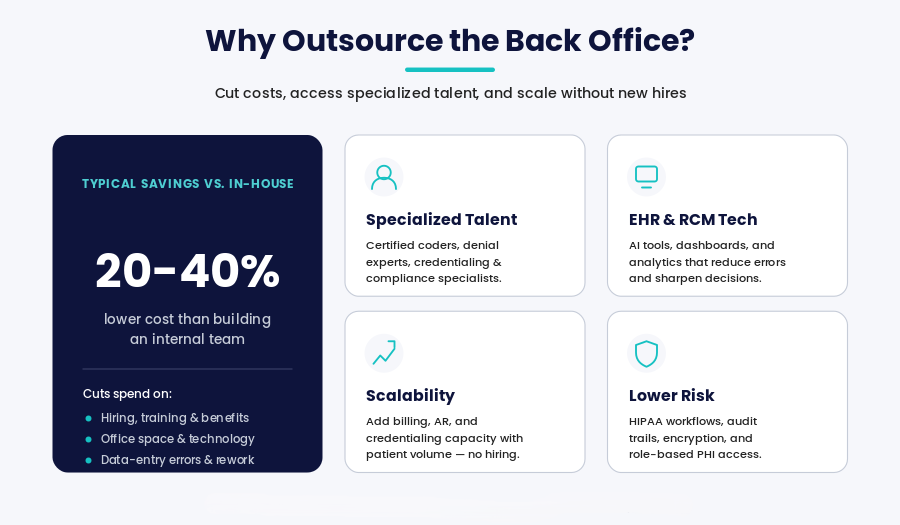
Outsourcing your back-office functions can save a healthcare organization a pretty penny by reducing labor costs associated with hiring, training, and maintaining an internal team for admin tasks. Outsourcing also cuts employee benefits, office space, technology, and training costs. You can often save between 20-40% by outsourcing compared to an in-house team.
And operational efficiency improves with digital workflows that reduce manual data errors and operational bottlenecks.
Access to Specialized Talent and Tech
A good outsourcing partner gets you access to certified coders, denial experts, credentialing teams, and compliance specialists. And let’s not forget about those electronic health record (EHR) and revenue cycle management (RCM) systems that can digitize and streamline back-office functions, making it all more efficient and reducing data errors.
Data analytics and business intelligence tools let you visualize and analyze data, leading to better decision-making and operational efficiency.
Scalability and Flexibility
Outsourced back office services can scale with patient volume. So if you add a few clinicians to your group practice, you can quickly add billing, credentialing, payer enrollment, and AR capacity without hiring anyone. Healthcare facilities might be tempted to outsource one single task like coding, or they may choose to go all in with end-to-end back office outsourcing for billing, AR, credentialing, reporting, transcription services – you name it – and compliance.
Improved Compliance and Reduced Risk – A Must-Have
The experienced back-office service providers – and I mean the real pros – know a thing or two about structured workflows, audit trails, encrypted systems, secure data exchange, and role-based access when it comes to handling super-sensitive PHI (that’s Protected Health Information, to you and me).
Take a medical group that’s been getting its documentation repeatedly denied – outsourcing billing and coding reviews to a seasoned office service provider can be a real game-changer, and can reduce those pesky audit findings.
How AI and Automation Are Taking Over Healthcare Back Office Operations – in a Good Way
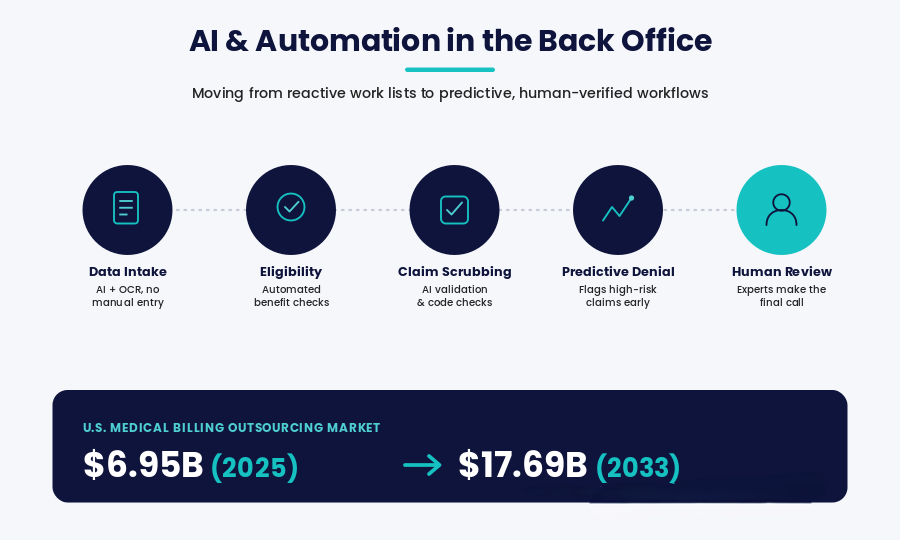
How’s this for some good news? AI is turning healthcare operations on their head and moving them from reactive work lists to actually predictive workflows. Research says the US medical billing outsourcing market was a whoppin’ $6.95 billion in 2025 and is projected to hit $17.69 billion by 2033 (Grand View Research). That’s a whole lotta demand for outsourced support.
AI can lend a hand with all sorts of tasks:
- Claim scrubbing and validation
- Coding suggestions
- Denial prediction
- Eligibility checks
- Payment posting
- Reporting dashboards
AI-Enabled Data Intake and Eligibility Verification – No More Manual Entry
With AI and OCR (that’s Optical Character Recognition, for those who don’t know) extracting demographics, insurance details, and procedure information from PDFs, faxes, EHR exports, and patient records, you can forget about all that tedious manual data entry.
And once you’ve got that verified, automated eligibility checks come in handy to make sure benefits are in place before the patient even shows up. Many practices find that eligibility-related denials can be cut by 30-50% just by improving data quality.
Intelligent Routing, Prioritization, and Predictive Denial Management – AI is a Real Game-Changer Here
AI routes high-value claims, aging AR, and payer-specific issues to the right specialist. And with predictive models flagging high-risk claims before submission, teams can get in there and correct any missing documentation or coding problems.
This is great for first-pass acceptance, reduces the number of appeals, and gives CFOs a much more predictable cash flow.
Augmenting Human Expertise, Not Replacing It
Let’s be clear – AI isn’t going to replace healthcare professionals anytime soon. What it’ll do is help billers and coders work faster by providing suggestions, exceptions, and payer patterns for review.
But in the end, it’s humans who make the tough calls on compliance-sensitive cases, payer disputes, nuanced coding, and value-based documentation.
Choosing the Right Back Office Service Provider – Not All Are Created Equal
When picking a service provider, you want to make sure they improve service delivery, ensure compliance, and make results visible. Look for:
- Real industry expertise in the healthcare game, ICD-10, CPT, HIPAA, and payer rules.
- Service scope that goes beyond just staffing – and I mean, coding, credentialing, denial management, and reporting.
- Technology that works seamlessly with EHR/EMR systems, cloud portals, AI, and dashboards.
- Compliance and security controls, including HIPAA, SOC 2, and secure PHI handling.
- Performance metrics and SLAs for denials, days in AR, response times, and clean claims.
Key Evaluation Criteria for a Back Office Service Provider
When choosing a provider, you want one that’s really familiar with your specialty, payer mix, and business operations. Ask how they handle medical groups, hospitals, home health, and specialty clinics differently.
And don’t be shy about asking about pricing – percentage-of-collections, per-claim, or flat-fee pricing all have their place, but only if scope and accountability are crystal clear.
Questions to Ask Potential Partners
- How will their team integrate with our EHR and RCM systems?
- What kind of onboarding timeline should we expect over the first 60-90 days?
- Which KPIs will we review every month?
- How do they protect patient data and maintain HIPAA compliance?
- Can they show you some real-life examples of cost savings or denial reduction?
- Will we have a dedicated account manager?
- What happens if service levels are missed?
How Dastify Solutions Supports Healthcare Back Office Operations
Dastify Solutions is a full-service B2B company providing AI-powered medical billing, revenue cycle management, coding, credentialing, payer enrollment, AR, denial management, reporting, and compliance support across all 50 states.
We help healthcare providers streamline operations, improve cash flow, reduce administrative burden, and deliver top-notch customer service to patients and providers.
Our AI-Powered Back Office Platform – No More Manual Entry, Please
Our cloud-based platform automates routine office tasks like eligibility checks, claim scrubbing, payment posting, and worklist routing.
Our AI models learn from claim outcomes and denial patterns to improve accuracy over time. Real-time dashboards show practice owners and CFOs KPIs, trends, and revenue risks in a way that’s super easy to understand.
RCM and Back Office Services – We’ve Got It All Covered
We support coding, charge capture, claim submission, AR follow-up, patient statements, credentialing, payer enrollment, monthly reporting, and compliance workflows.
Take this anonymized specialty clinic – they were able to reduce preventable denials when we brought in our expertise with coding review, claim edits, and payer-specific AR follow-up.
Who We Serve – Solo Docs to Big Medical Groups
We have clients across the United States, including solo physicians, specialty clinics, group practices, home health agencies, medical groups, and hospitals. We work hard to customize administrative processes for each specialty mix, payer profile, and payment model – from fee-for-service to bundled payments and value-based care.
Measuring the Impact of Back Office Improvements – Let’s Get Down to Business
So, just how do you measure the impact of these back-office improvements?
Financial Sustainability in Healthcare: Getting it Right with Efficient Billing and RCM
Financial sustainability in the healthcare industry can be achieved when you get your billing and Revenue Cycle Management processes working together in harmony – and that means minimizing claim denials right from the get-go. To make a fair judgment, set a 6- to 12-month baseline, then, as the dust settles, see how things stack up on the other side.
Financial and Operational Key Performance Indicators (KPIs)
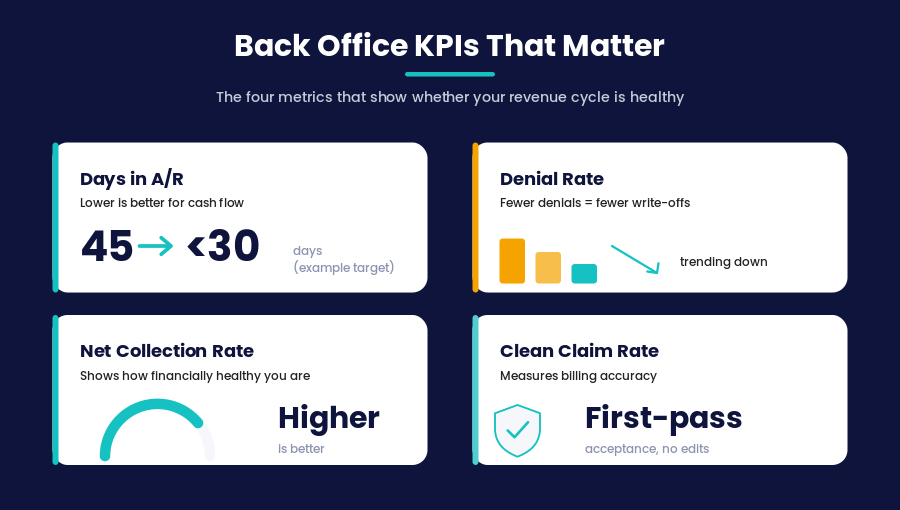
- Days in AR: A big reduction – from 45 days to under 30 – can really make a difference to your cash flow.
- Denial and rejection rates: keep an eye on the percentages and identify the most common reasons.
- Cost to collect: work out all the costs involved – staff, software, vendor fees, and write-offs, too.
- Productivity per Full Time Equivalent (FTE): track the number of claims processed, charges entered, and dollars recovered.
Patient and Provider Experience Metrics
- Billing-related patient satisfaction: ask patients what they think about how they’ve been billed – is it clear and timely?
- Call response time: How fast do you respond to patient billing queries?
- Provider admin time: measure how much time your providers spend dealing with follow-ups.
- Keeping a focus on frontline care: the more back-office admin you outsource, the more you can focus on patient care – and that really does improve patient outcomes and satisfaction.
Conclusion
The back office is the lifeblood of modern healthcare – and it includes everything from billing and coding to claims, credentialing, compliance, data management, reporting, and all the financial workflows that keep healthcare delivery ticking over.
For many healthcare organizations, outsourcing their back-office functions is now a sensible way to cut costs, improve compliance, increase efficiency, and maintain high-quality patient care.
If you’re looking for a back-office expert to get on top of your revenue cycle with AI-powered tools, a skilled team, and measurable results, Dastify Solutions can certainly help.
FAQs
Which back office functions should a small practice outsource first?
For small practices, start with the high-impact areas that will make the biggest difference – like medical billing, coding, claims follow-up, and denial management. These areas will free up cash flow.
But small practices might want to keep simple scheduling in-house while outsourcing the more complex billing, accounts receivable, and compliance-heavy work.
How long does it take to transition to outsourced back office services?
The time required to make a smooth transition usually depends on the size of the practice, the complexity of the EHR system, the mix of payers, and whether you need to clean up any legacy AR accounts. On average, it takes between 2 and 4 months.
A good transition plan should cover all the key stages: discovery, system access, data review, parallel testing, and the full go-live.
Will outsourcing the back office affect patients?
Yes, but in a good way – if you manage it properly. Patients will probably see clearer statements, faster answers to their billing queries, and more convenient payment options.
The trick is to choose a partner that knows a thing or two about patient communication and customer satisfaction.
Is AI in back office operations HIPAA-compliant?
Yes, AI can be HIPAA-compliant – but only if used in an environment that’s encrypted, access-controlled, and comes with proper agreements, monitoring, and governance in place.
Always check the security standards, data security controls, and how the vendor will protect patient data before signing on the dotted line.
Disclaimer & Editorial Standards
This guide is for informational purposes only and is not legal, billing, coding, or compliance advice. Healthcare regulations, CPT/ICD-10 codes, CMS rules, and payer policies change often – always confirm current requirements with CMS.gov, HHS.gov, and your payer contracts before acting. How this article was researched: Content is based on current CMS guidance, HIPAA rules, AMA coding standards, and publicly available industry research. Statistics are cited from their original publishers; please verify figures at the source before reuse. Examples are anonymized and illustrative individual results vary by specialty, payer mix, and implementation.