


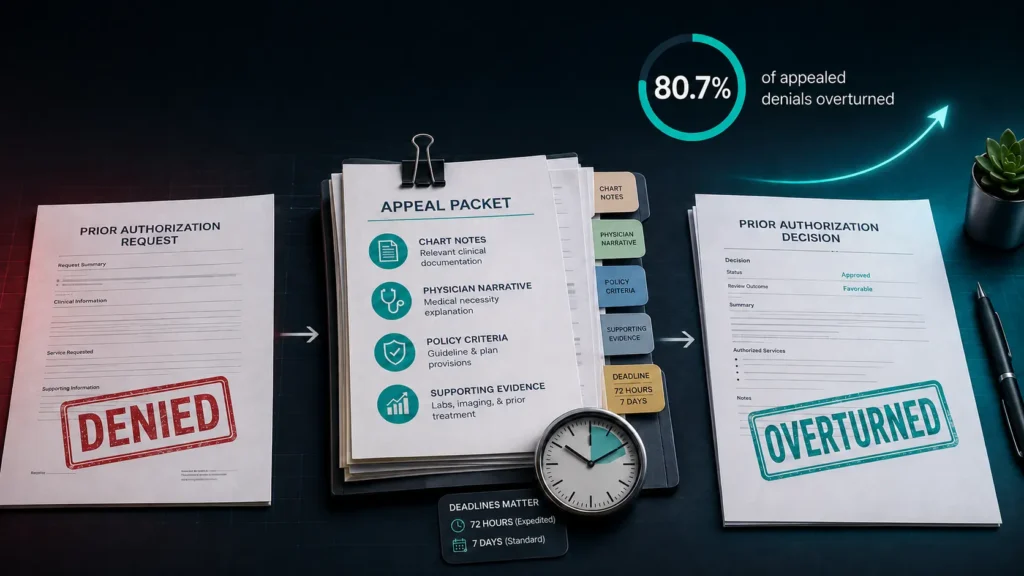
Medicare Advantage insurers made nearly 53 million prior authorization determinations in 2024 and denied approximately 4.1 million requests, or 7.7%. Only 11.5% of those denials were appealed. Among the denials appealed, plans partially or fully overturned 80.7%.
These figures show why healthcare organizations should carefully evaluate Medicare Advantage denials instead of automatically writing them off. This guide explains the five appeal levels, key filing deadlines, the requirements introduced by CMS-0057-F, and practical considerations for deciding whether to appeal.
It focuses on appeals arising from standard Medicare Advantage organization determinations. It does not cover service-termination notices, including the Notice of Medicare Non-Coverage, which follow a separate fast-track appeals process.
The Five Medicare Advantage Appeal Levels
Medicare Advantage has five successive appeal levels, beginning with reconsideration by the health plan and ending with review by a Federal District Court. The process is governed by 42 CFR Part 422, Subpart M.
The MA Appeal Levels
Level 1: Reconsideration by the MA plan.
The plan reviews its initial determination. Standard reconsiderations involving services or items must generally be completed within 30 calendar days. Payment reconsiderations must generally be completed within 60 calendar days. An approved expedited reconsideration must be completed within 72 hours.
Level 2: Independent Review Entity (IRE)
If the plan upholds all or part of its denial, or fails to issue a decision within the required timeframe, it must automatically forward the case to the CMS-contracted Independent Review Entity.
Level 3: Office of Medicare Hearings and Appeals (OMHA) Administrative Law Judge
There’s a special threshold for the amount in controversy that CMS publishes every year.
Level 4: Medicare Appeals Council
If the ALJ decision remains unfavorable, the appeal may be submitted to the Medicare Appeals Council, generally within 60 days. The Council reviews the case and may uphold, modify, reverse, or return the decision to the ALJ for further review.
Level 5: Federal District Court
The final appeal level is judicial review by a Federal District Court. A case may proceed to this level after an unfavorable Medicare Appeals Council decision, provided the amount in controversy meets the threshold established annually by CMS. A civil action generally must be filed within 60 days of receiving the Council’s decision.
How This Affects What You Do Operationally
Original Medicare uses a Qualified Independent Contractor at the second appeal level. In Medicare Advantage, the plan conducts the first-level reconsideration. If the plan upholds its denial, it must automatically forward the case to the CMS-contracted Independent Review Entity.
Build the Level 1 appeal packet with the external review in mind. Address the exact denial reason, include the applicable coverage criteria, provide relevant medical-record documentation, and explain why the requested service meets those criteria. If the plan upholds the denial, the IRE will receive a record that is already organized for review.
What CMS-0057-F Now Means in a Denial Letter
MA plans (along with Medicaid and CHIP managed care, and QHPs on the FFEs) have to:
- Get back to the provider on prior authorization decisions inside of 72 hours for expedited (urgent) requests and 7 calendar days for standard (non-urgent) requests.
- Give a specific reason for denial, no matter how they send it.
- Report certain prior authorization metrics out in the open.
Beginning in 2026, affected payers must provide a specific reason when denying a prior authorization request. Medicare Advantage organizations and certain Medicaid and CHIP payers must also issue decisions within 72 hours for expedited requests and seven calendar days for standard requests. The decision timeframes do not apply to QHP issuers on the Federally Facilitated Exchanges.
When reviewing a denial, compare the stated reason with the documentation submitted. If the denial does not clearly explain the basis for the decision, request the applicable clinical criterion, coverage policy, or documentation requirement. Do not automatically describe a denial as noncompliant solely because it does not cite an LCD or plan policy.
Coverage and Payment Denials: Different Appeal Timelines
MA denials break into two categories, and the timing rules are different.
Coverage Denial (Pre-Service)
A coverage denial occurs when the plan declines to authorize a service before it is provided. Examples include a denied SNF admission, IRF transfer, or elective procedure. Standard reconsiderations involving services or items must generally be completed within 30 calendar days. Expedited review is available when applying the standard timeframe could seriously jeopardize the enrollee’s life, health, or ability to regain maximum function.
Payment Denial (Post-Service)
The service was already delivered and the claim got denied. Standard reconsideration decision within 60 days. There’s no expedited pathway – the service is already provided.
Two operational guidelines follow from this distinction. First, request expedited review when the enrollee’s clinical condition meets the applicable standard. Explain the patient-specific risk of waiting for a standard reconsideration. Second, when a claim is denied after prior authorization was granted, compare the authorization with the submitted claim. Review the authorization number, dates of service, place of service, procedure codes, units, and approved provider before preparing the appeal.
Filing Windows and How to Set Up an Expedited Review
According to 42 CFR Part 422 Subpart M, an enrollee (or a provider acting on behalf of the enrollee with a valid representative form) needs to file a standard reconsideration request within 60 calendar days of the plan’s initial determination notice. A reconsideration request must generally be filed within 60 calendar days after receipt of the written organization determination. A late request must explain the good cause for missing the deadline. A physician may provide oral or written support for expedited reconsideration. The support should explain the patient-specific clinical risk of applying the standard timeframe.
Peer-to-Peer Script for SNF, IRF and LTCH Escalations
Post-acute care denials require close review by hospital and post-acute revenue cycle teams. An OIG review of 19 Medicare Advantage organizations found that they collectively denied 65% of LTCH requests and 54% of IRF requests during the period studied. The three largest organizations denied these requests at higher rates than most of their peers. These findings apply to the organizations and period studied and should not be presented as industry-wide denial rates. The companion OIG report on skilled nursing facility (SNF) admissions found a denial rate of around 12% but a 95% overturn rate for appeals. The OIG findings identify post-acute care as an important area for denial monitoring, but denial rates vary by service type, plan, contractor, and patient circumstances.
In the OIG review, Medicare Advantage organizations overturned 95% of appealed SNF denials. OIG concluded that the high overturn rate indicated that some enrollees were initially denied medically necessary care.
So, in practice: Promptly evaluate every clinically supportable SNF denial for appeal. Confirm that the medical record addresses the applicable coverage criteria and that the request can be submitted within the required deadline. Don’t make it a habit to just write them off.
Peer-to-Peer Opening Script
Use this format with the plan medical director on the phone. Adapt it for IRF and LTCH by swapping in the relevant requirements.
The denial states [exact reason]. The medical record documents [criterion one], [criterion two], and [criterion three]. Please explain which coverage criterion has not been met and whether the determination can be reconsidered based on this documentation. If the denial is upheld, please provide the specific clinical and coverage basis so it can be addressed in the appeal. The denial letter says [exact reason]. The medical record shows [specific criterion 1], [specific criterion 2], and [specific criterion 3] all check out. Given the OIG findings on how MA plans overturn SNF admissions. We expect the IRE to overturn it as well. Can the plan reconsider this determination based on the documented criteria?
What happens in that call is either the plan person overturns it, or you’ve got a document ready to support the appeal request.
The Break-Even Calculation: Appeal vs. Write-Off
Appeals cost staff time, and if you rely on volume to make it work, you need a rule of thumb.
For illustration, assume a Level 1 appeal requires 90 minutes and the fully loaded labor cost is $65 per hour. The estimated labor cost would be $97.50. Replace these assumptions with your organization’s actual time and labor costs.
The math is:
Expected Value = (probability of overturn) x (net recoverable) – (cost of appeal)
KFF reported that 80.7% of appealed Medicare Advantage prior authorization denials were partially or fully overturned in 2024. However, this overall rate should not be treated as the expected success rate for an individual denial. Appeal outcomes vary by service, plan, documentation, denial reason, and the strength of the case:
Net recoverable > cost of appeal/probability of overturn
At 80.7% and a $97 cost, break-even is around $120. The calculation can provide an internal screening point, but it should not be the only basis for an appeal decision. Organizations should also consider the strength of the documentation, contractual requirements, filing deadlines, patient impact, and whether the denial indicates a recurring process problem. Post-acute appeal decisions should use the organization’s service-specific recovery data, documentation strength, filing requirements, and patient-impact considerations.
Each organization should establish its own appeal threshold using its actual labor costs, historical overturn rates, recoverable amounts, contractual obligations, and patient impact. A universal $120 write-off threshold cannot be supported by the national overturn data alone.
Building an Appeal Packet for IRE Review
Level 2 is the first review outside the plan. Write to that reader. A clearly organized packet helps the IRE identify the denial reason, supporting documentation, and applicable coverage criteria. It does not guarantee an overturn. In the packet you should include:
Have a cover letter that specifically calls out the exact reason for the denial and addresses each point the plan cited in the exact order they mentioned it.
- Update relevant chart notes only – don’t go overboard and copy the whole chart.
- Get a copy of the plan’s own coverage policy, LCD, or LCA that led to the denial. Make sure that’s the one they invoked.
- Get the physician to write up a narrative and sign it off with a date.
- Gather any peer-to-peer conversations, including the times when the [plan name] outright refused to budge.
- Be sure to have proof that the submission was timely filed.
For more on handling denials for related coding workflows, For related guidance, read why medical claim denial rates are rising and how RCM teams can reduce preventable denials.
FAQs
How long does an MA plan have to decide a prior authorization request?
You know how it works under CMS-0057-F – by January 1, 2026, MA plans have to decide expedited PA requests within 72 hours and standard PA requests within 7 days.
How often were appealed MA prior authorization denials overturned in 2024?
KFF reported that plans partially or fully overturned 80.7% of appealed denials in 2024. This overall figure does not predict the outcome of an individual appeal.
How long do you have to make a Level 1 MA reconsideration filing?
A standard reconsideration request must generally be filed within 60 calendar days after receipt of the written organization determination.
What did OIG find about appealed SNF denials?
OIG found that Medicare Advantage organizations overturned 95% of appealed SNF denials. OIG concluded that the high overturn rate indicated that some enrollees were initially denied medically necessary care.
Can a provider appeal on behalf of an enrollee?
A treating physician may request a standard reconsideration on an enrollee’s behalf after notifying the enrollee. An enrollee may also formally appoint another person to act on their behalf using the Appointment of Representative form. For a denied payment, a noncontracted provider may request reconsideration but generally must submit a signed Waiver of Liability. Follow the instructions in the plan’s denial notice for the specific appeal.
Disclaimer: This article provides general operational information and is not legal or clinical advice. Appeal requirements may vary by plan, service, provider status, and case circumstances. Review the applicable denial notice, plan policy, current CMS guidance, and medical record before filing an appeal.