




Introduction
A claim gets delayed and another comes back denied. Payments arrive below the expected amount, while older accounts receivable (A/R) continue piling up. Before long, your billing team is spending more time chasing payments than keeping new claims moving.
Sound familiar? For ambulatory surgery centers (ASCs), managing billing is about more than submitting claims and waiting for reimbursements. It requires specialized knowledge of facility billing, payer requirements, coding guidelines and payment policies. And as claim volumes grow, maintaining an efficient in-house billing operation can become increasingly challenging.
That's where ASC billing outsourcing comes into the picture.
But outsourcing isn't simply about handing your billing operations to another company. You need to know what services you're paying for, how much they cost, what performance standards to expect and how to hold your billing partner accountable.
In this guide, we'll break down ASC billing outsourcing costs, services, pricing models, vendor selection and the KPIs that help you determine whether an outsourcing partner is delivering real value.
How Is ASC Billing Different From Physician Practice Billing?
ASC billing involves facility charges associated with performing a procedure. Physician professional billing covers the surgeon's or other provider's professional services. Anesthesia billing is another distinct component and may be handled by a separate anesthesia group.
These claims have different billing requirements and may be submitted by different entities. Before choosing a vendor, clarify whether its services cover:
ASC Facility Billing | Physician Professional Billing | Anesthesia Billing |
|---|---|---|
Operating room, recovery area, equipment, supplies and eligible facility services. | Professional services provided by the surgeon or other healthcare provider. | Anesthesia services provided by the anesthesia team. |
How Medicare Pays ASCs
Medicare pays eligible ASC facility services under a separate payment system. CMS maintains an ASC Covered Procedures List (CPL) that identifies procedures eligible for payment under the ASC system. Coverage and payment depend on the procedure code, applicable payment rules and other Medicare requirements.
Many services and items provided during an ASC procedure are packaged into the facility payment rather than reimbursed separately. These may include routine medical and surgical supplies, certain drugs and biologicals, nursing and technical services, and other facility-related items. Some qualifying ancillary services or items may receive separate payment under specific CMS rules.
For implants and higher-cost supplies, the billing team should verify documentation, invoices, applicable HCPCS codes and payer-specific reporting requirements. Not every implant or supply is separately reimbursable. The vendor must understand which items are packaged and which may qualify for separate payment.
Review the current CMS ASC payment system guidance and Medicare Claims Processing Manual, Chapter 14 before finalizing billing workflows. CMS updates its covered procedures and payment policies, so older code lists should not be treated as current.

What Does ASC Billing Outsourcing Include?
ASC medical billing outsourcing involves assigning some or all revenue cycle management activities to an external company. The exact scope depends on your center's needs and the agreement you establish with the vendor.
A comprehensive arrangement may include:
- 01. Eligibility Verification
Coverage, benefits and patient responsibility. - 02. Prior Authorization
Requirements, approvals and follow-ups. - 03. Coding Review
CPT, HCPCS, ICD-10-CM and modifiers. - 04. Claims Submission
Claim preparation and rejection handling. - 05. Payment Posting
ERA, EOB and payment reconciliation. - 06. Denial Management and A/R Follow-Up
Denials, appeals and outstanding insurance and patient balances.
A qualified ASC billing company should clearly define these responsibilities before onboarding. Ask which services are included in the quoted fee and which require additional charges.
How Much Does ASC Billing Outsourcing Cost?
The ASC billing company cost depends on several factors, including the services included, claim volume, payer mix, specialty mix, existing A/R workload and revenue cycle complexity.
There is no single price that applies to every surgery center. Vendors generally use one of three pricing structures. See our medical billing costs guide for how each model works.
1. Percentage of Collections
Under this arrangement, the vendor charges an agreed percentage of the collections defined in the contract.
This structure connects the vendor's compensation to collections. However, the contract must explain exactly which payments count, how refunds and adjustments are handled and whether the fee applies to all collections or only accounts managed by the vendor.
A 2019 HealthCare Appraisers survey reported by Becker's ASC Review provides some context. Among 26 respondents (ASC management companies, investment bankers and business brokers), third-party billing fees were:
Billing Fee as a Percentage of Net Revenue | Share of Respondents |
|---|---|
3%–3.99% | 38% |
4%–4.99% | 24% |
5%–5.99% | 21% |
These figures are historical survey findings, not current market quotes or guaranteed pricing ranges. Use them as context rather than assuming they represent today's rates.
2. Per-Claim Pricing
Some vendors charge a fixed amount for each claim processed. This can make costs easier to estimate when claim volume is predictable.
However, the contract should clarify what counts as a billable claim. Ask whether corrected claims, secondary claims, resubmissions and appeals are included or charged separately.
3. Flat Monthly Fees
A fixed monthly fee provides predictable billing expenses. It may suit centers with stable workloads and clearly defined service requirements.
However, confirm whether the fee changes when claim volume increases or when the vendor takes on additional responsibilities such as old A/R cleanup or denial appeals.
What should you compare?
- Do not select a vendor based on the percentage or monthly fee alone. Compare the full service scope, staffing model, technology, reporting, implementation support and additional charges.
- A lower quote may not be the better value if it excludes important activities or leaves your staff responsible for unresolved claims.
Illustrative ASC Billing Cost Example
Suppose an ASC generates $500,000 in eligible monthly collections and receives a vendor quote of 4% of those collections.
- Monthly collections: $500,000
- Illustrative billing fee: 4%
- Monthly outsourcing cost: $20,000
- Annual outsourcing cost: $240,000
This is a simplified example to show how percentage-based pricing works. Actual costs depend on the contract's definition of eligible collections and included services.
In-House vs. Outsourced ASC Billing: Which Model Makes More Sense?
The right approach depends on your center's size and ability to manage revenue cycle performance.
Evaluation Factor | In-House Billing | Outsourced Billing |
|---|---|---|
Staffing costs | Salaries, benefits, recruitment and training | Contracted service fees |
Management control | Direct supervision of employees | May provide access to broader RCM experience |
Reporting | Depends on internal systems and resources | Depends on vendor dashboards and reporting capabilities |
Staff continuity | Can be affected by turnover and absences | Depends on vendor coverage and backup arrangements |
Oversight | Direct day-to-day management | Requires vendor monitoring and clear reporting |
Process control | Internal team manages workflows | Responsibilities are shared under the contract |
Outsourcing does not automatically reduce expenses or improve collections. Its value depends on whether the provider can deliver the agreed services consistently and whether the total cost compares favorably with maintaining internal resources.
How Common Is ASC Billing Outsourcing?
20% Full Outsourcing | 17% Partial Outsourcing |
|---|---|
Surgical facilities reportedly outsource all RCM. | Use partial outsourcing arrangements |
Outsourcing is not an all-or-nothing decision for surgery centers. According to estimates from Surgical Information Systems (SIS), reported by Outpatient Surgery Magazine, approximately 20% of surgical facilities outsource all their revenue cycle management, while another 17% use partial outsourcing arrangements.
A hybrid model allows ASCs to retain internal oversight while outsourcing tasks such as coding, denial management and A/R follow-up.
When Should an ASC Consider Outsourcing?
An ASC doesn't necessarily need to outsource because its billing team is struggling. The more important question is whether the current setup can keep claims moving, resolve payment issues and manage A/R without putting additional pressure on staff.
Outsourcing may be worth evaluating when:
- Growing accounts receivable: More claims remain unpaid beyond expected payer timelines.
- Increasing denials: Repeated eligibility, authorization, coding or documentation issues are creating rework.
- Delayed claim submission: Charges are not being reviewed and submitted promptly after procedures.
- Staffing instability: Vacancies, turnover or absences interrupt billing workflows.
- Limited reporting: Administrators cannot easily identify denial trends, aging balances or payer-specific problems.
- Inconsistent follow-up: Older claims are not receiving timely attention or escalation.
Authorization management also deserves attention. HST Pathways' 2024 State of the Industry Report, based on 590 ASCs across 47 states, reported that only 24% of cases requiring preauthorization completed the process in 2024.
An established in-house team may remain the better option when your ASC has sufficient staffing, specialized expertise and reliable internal processes. You may also choose a hybrid model that keeps financial oversight in-house while outsourcing selected functions.
Ultimately, the decision should come down to whether your current billing model can meet your financial and operational requirements without creating unnecessary administrative pressure.

How Do Commercial Claims and Underpayments Affect ASC Revenue?
Commercial payer contracts and out-of-network claims can involve different reimbursement terms, authorization rules and payment requirements. These differences can lead to missed revenue if payments are not reviewed carefully.
An ASC billing partner should have a process for:
- Payment verification: Compare payments against contracted or expected rates.
- Underpayment detection: Identify short payments, incorrect adjustments and unexplained reductions.
- Remittance review: Investigate payment discrepancies using payer explanations and remittance details.
- Appeals and corrections: Submit supported corrected claims, reconsiderations or appeals.
- Follow-up tracking: Monitor deadlines, payer responses and recovered amounts.
Why does this matter? A claim can be processed and paid but still reimbursed incorrectly. Regular payment variance reviews help identify underpayments that denial reports alone may miss.
Which KPIs Should You Use to Evaluate an ASC Billing Vendor?
Start with a consistent set of key performance indicators (KPIs). Becker’s ASC Review article from 2019 identifies several revenue cycle measures ASC administrators should monitor, including days in A/R, A/R over 90 days, clean claim percentage, denial rate, days to bill and days to pay. Its published benchmarks offer useful historical reference points, but they should not be treated as guaranteed results or universal targets.
Key ASC Billing KPIs and Published Benchmarks
KPI | Published Benchmark | What It Tells You |
|---|---|---|
Days in A/R | 35 days | How long payments and outstanding balances remain in accounts receivable |
A/R over 90 days | Below 15% | How much of your outstanding A/R is aging beyond 90 days |
Clean claim percentage | 98% | How consistently claims are submitted without payer rejection |
Denial rate | Below 5% | How frequently submitted claims are denied |
Days to bill | Less than 2 days | How quickly claims are submitted after procedures |
Days to pay | 45 days overall | How long it takes to receive primary insurance payment; the article also cites 18 days for Medicare and up to 55 days for workers' compensation |
What Are the Red Flags When Choosing an ASC Billing Vendor?
A vendor's service list may look comprehensive, but the way it handles claims and communicates with your team matters just as much.
Watch for these potential warning signs:
- Unreviewed down-coding: Poor documentation should trigger clarification, not automatic down-coding.
- Missed low-dollar claims: Smaller balances still affect collections. Ask about follow-up policies.
- Limited software access: Your team should be able to view claim status, A/R details and reports.
- Slow issue resolution: Look for clear escalation channels and response timelines.
What Does the Transition to an Outsourced ASC Billing Partner Look Like?
Switching billing providers requires coordination across billing operations, payer workflows, system access and outstanding accounts. Without clearly assigned responsibilities, claims may be overlooked during the transition.
A structured implementation process can reduce that risk.
Transition Stage | Key Activities |
|---|---|
Initial assessment | Review billing workflows, payer mix, claim volume and existing A/R |
Scope and agreement | Define services, responsibilities, pricing and KPIs |
System setup | Arrange EHR/PMS access, integrations and secure data transfer |
Workflow validation | Test claim submission, payment posting and reporting processes |
Go-live | Begin agreed billing operations and monitor open claims |
Performance review | Evaluate KPIs, identify workflow gaps and establish corrective actions |
The transition timeline depends on system access, data availability, payer requirements and operational complexity.
Before switching, establish who will manage previously submitted claims, pending denials, unpaid balances, pending authorizations and payments received during the handover. Also agree on how unbilled procedures and incomplete documentation will be handled.
Clear ownership helps prevent claims from being overlooked while responsibilities move from one team to another.
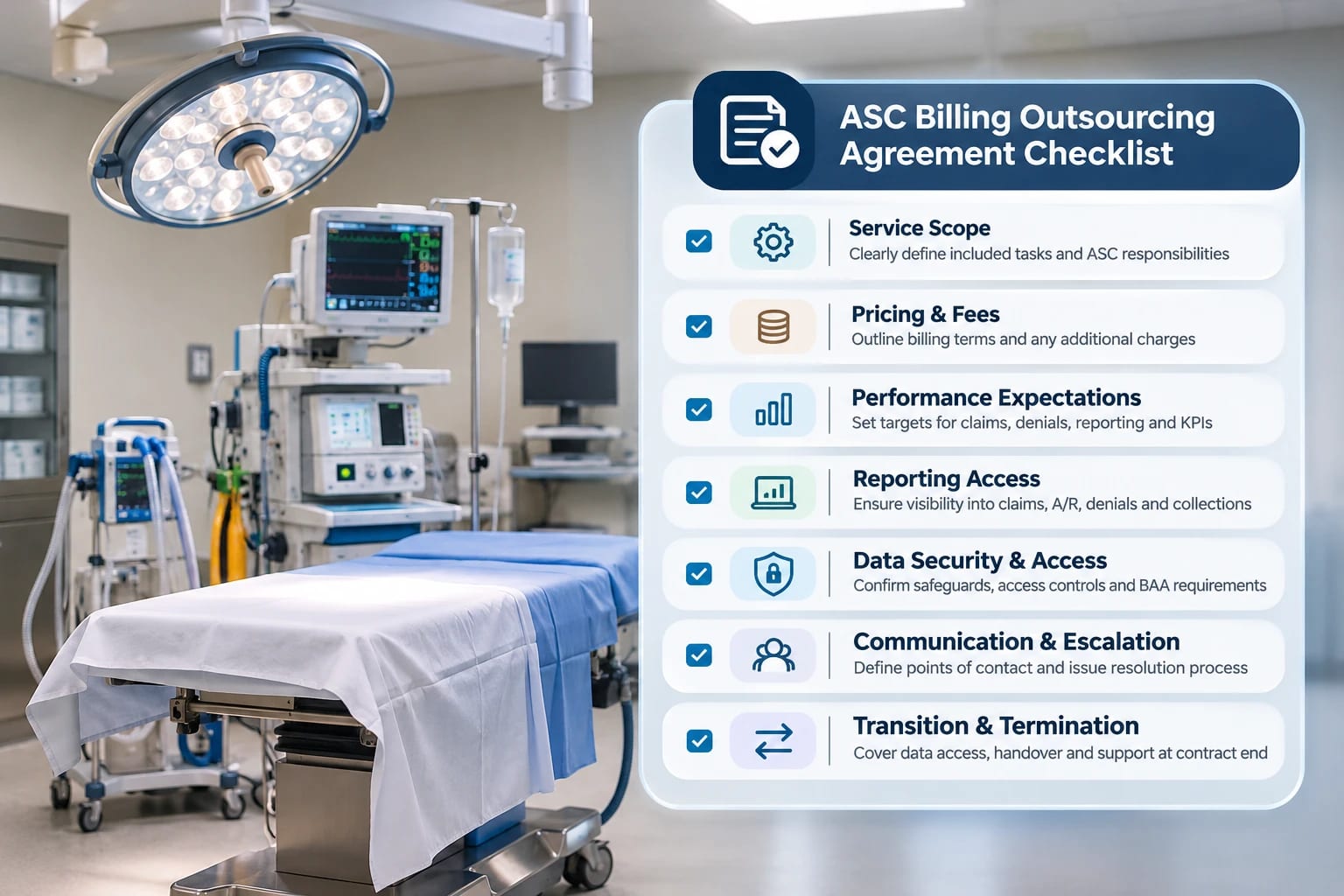
What Should an ASC Billing Outsourcing Agreement Include?
A clear contract protects both the surgery center and the billing vendor. It should explain exactly what the vendor will manage and how performance will be evaluated.
Before signing, confirm that the agreement covers:
- Service scope: List every included activity, from eligibility verification to A/R follow-up. Identify tasks that remain with the ASC.
- Pricing and additional fees: Define the billing calculation, payment schedule and charges for services outside the agreed scope.
- Performance expectations: Set targets for claim submission, denial follow-up, reporting frequency and other relevant KPIs.
- Reporting access: Confirm that administrators can review claim status, aging A/R, denials, collections and outstanding work.
- Data security and access: Establish appropriate safeguards, access controls, confidentiality requirements and business associate agreement responsibilities where applicable.
- Communication and escalation: Identify the points of contact and the process for resolving urgent billing issues.
- Transition and termination: Document data access, outstanding accounts, handover responsibilities and support if the agreement ends.
Who Owns the Data and A/R When the Contract Ends?
Your agreement should state that the ASC retains ownership of its business and patient billing records, subject to applicable law and contractual requirements. It should also explain how the vendor will provide access to records and return or transfer data when the relationship ends.
Before signing, confirm:
- Whether your team has direct access to the billing platform or portal.
- Whether you can export claims, payment records, denial notes, correspondence and A/R reports.
- Who is responsible for following up on claims submitted before termination.
- How open appeals, unpaid balances, unbilled procedures and pending authorizations will be transferred.
- How quickly the vendor must return records and cooperate with the transition.
- How access will be handled after termination and how retained data will be managed.
Where a business associate relationship applies, the business associate agreement must address protected health information appropriately. HHS explains that return or destruction of PHI at termination is generally required where feasible; when it is not feasible, continuing protections and limits on use apply. Your privacy and legal teams should review the arrangement. Source: HHS
Is ASC Billing Outsourcing the Right Move for Your Center?
If your ASC is struggling with billing backlogs, denials or delayed collections, outsourcing may be worth considering. Compare vendors based on service scope, cost, reporting and accountability before making a decision.
Dastify Solutions provides ASC medical billing services covering eligibility verification, authorization management, coding review, claims submission, payment posting, denial management and A/R follow-up.
Talk to Dastify Solutions about your ASC billing requirements and explore how our team can support your revenue cycle operations.