


Introduction: When Claim Denials Drain Your Practice
Claim denials are more than administrative headaches; they’re silent revenue killers. They delay payments, increase staff workload, and hurt cash flow. According to Healthcare Financial Management Association, 22% of healthcare leaders report losing at least $500,000 annually to denials, while 1 in 10 loses over $2 million per year.
For physicians and medical practices, this means:
- Delayed reimbursements
- Increased administrative burden
- Higher operational costs
- Reduced net collection rate
The solution? A structured denial management workflow within your Revenue Cycle Management (RCM) strategy.This workflow can recover lost revenue, reduce repeated errors, and shorten AR cycles by up to 40% when executed correctly. This blog answers your key questions: why denials happen, how to fix them fast, and how to prevent them permanently.
Why Are Medical Claims Denied?
Understanding why claims are denied is the first step toward eliminating revenue loss. While denial trends evolve, historical data provides a useful benchmark to identify recurring issues. The Change Healthcare 2022 Revenue Cycle Denials Index reported that the average denial rate reached 12% of claims denied upon initial submission. The Optum 2024 Revenue Cycle Denials Index also reported national denial rates around 12%, showing that denials remain a persistent revenue cycle problem.
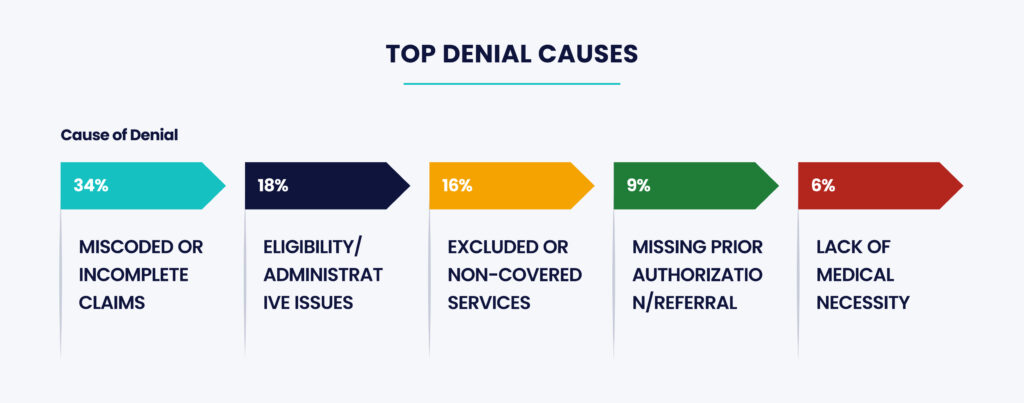
Common Claim Denial Categories to Track
Instead of treating every denial the same, practices should group denials by root cause. This makes it easier to fix the process that created the denial, not just the individual claim.
Common denial categories include: Source
| Denial category | What to check first | Prevention action |
|---|---|---|
| Coding or claim errors | CPT, ICD-10, modifiers, NPI, place of service, units, and diagnosis linkage | Add claim-scrubbing edits and coder review for high-risk services |
| Eligibility or demographic issues | Active coverage, patient name, date of birth, subscriber ID, payer selection, and coordination of benefits | Verify eligibility before the visit and again before submission when needed |
| Prior authorization or referral issues | Authorization number, approved service, approved date range, rendering provider, and payer rules | Track authorization status before the service date |
| Medical necessity denials | Diagnosis support, clinical documentation, payer policy, LCD/NCD when applicable | Add documentation checks before claim submission |
| Timely filing denials | Date of service, payer filing limit, original submission proof, clearinghouse acceptance | Track unsubmitted and rejected claims weekly |
Note: Denials can be soft (fixable errors) or hard (final rejections requiring appeal). Most are preventable before reaching the payer.
| Key Point: Most denials are preventable before claims even reach the payer. |
Denial Management Workflow: Step by Step
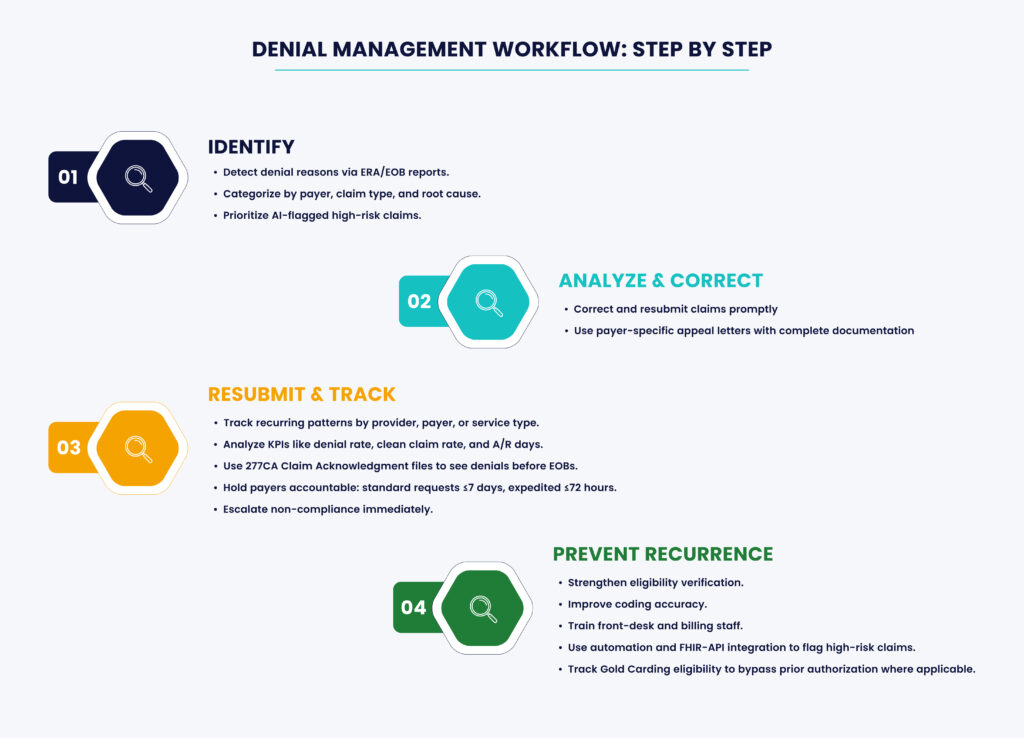
A strong denial management workflow ensures every denied claim is identified, tracked, corrected, and prevented from recurring. Below is a breakdown of an effective workflow that medical billing companies use to minimize denials and improve A/R performance.
Denial Management Workflow Checklist
Use this checklist to make the workflow operational:
- Capture the denial
Record the payer, claim number, patient account, date of service, denial date, CARC/RARC code, denial reason, dollar amount, and filing deadline. - Classify the denial
Group the denial into one of these categories: eligibility, demographic error, coding, modifier, authorization, referral, medical necessity, documentation, timely filing, credentialing, coordination of benefits, or payer processing issue. - Assign ownership
Route the denial to the correct team member: front desk for demographics, eligibility team for coverage issues, coding team for CPT/ICD/modifier issues, clinical team for documentation, or AR team for payer follow-up. - Correct and appeal
Correct the claim when allowed. If the denial requires appeal, include the corrected claim, medical records, authorization proof, payer policy reference, and a short appeal explanation. - Track the deadline
Set appeal and timely filing deadlines in the billing system. Denials should not sit in an unworked queue. - Prevent recurrence
Review denial trends weekly by payer, provider, location, service line, and denial category. Update front-end checks, coding edits, documentation templates, or payer-specific billing rules based on recurring patterns.
When executed consistently, this workflow can help practices reduce avoidable delays in payment by correcting denials faster, tracking payer patterns, and preventing repeat errors before claims are submitted.
The solution? Outsourcing denial management ensures these steps are executed efficiently by experts using automation and analytics.
| Tip: Combining workflow with automation reduces manual errors and accelerates payments. |
Stop leaving money on the table and recover the revenue you already earned
Get Your Denial Recovery Estimate Now
How Denial Management Protects Revenue
Denial management protects revenue in several key ways:
Key benefits of structured denial management:
- Capturing Lost Revenue: Up to 65% of denied claims are never resubmitted due to backlog; structured workflow ensures every claim is corrected.
- Reducing Rework Costs: Denied claims cost $25–$50 each; addressing root causes saves time and money.
- Shortening A/R Cycles: Faster resubmissions mean quicker payments.
- Preventing Recurring Denials: Track patterns in coding, eligibility, or documentation.
- Optimizing Staff Time: Automation allows staff to focus on high-value tasks.
In short: denial management is not reactive work, it’s revenue protection.
2026 Regulatory Update: Prior Authorization Denial Transparency
CMS-0057-F affects prior authorization workflows for impacted payers, including Medicare Advantage organizations, state Medicaid and CHIP fee-for-service programs, Medicaid managed care plans, CHIP managed care entities, and Qualified Health Plan issuers on federally facilitated exchanges.
Beginning in 2026, impacted payers must provide a specific reason when they deny a prior authorization request. CMS also requires prior authorization decisions within 72 hours for expedited requests and seven calendar days for standard requests.
For billing teams, this means prior authorization denials should be tracked more carefully. When a payer denies authorization, the denial reason should be captured, matched against the documentation, and used to improve future authorization submissions.
Practices can leverage this to accelerate appeals and streamline workflow.
Technology-Assisted Review: CMS WISeR Model
CMS launched the Wasteful and Inappropriate Service Reduction (WISeR) Model to test technology-supported prior authorization and pre-payment medical review for selected services in Original Medicare.
This does not mean every claim is subject to WISeR. It does mean practices should pay closer attention to documentation quality, payer rules, medical necessity support, and service-specific review requirements when billing services that may face additional review. Source
State-Level Gold Carding Realities (2026)
State-Level Gold Carding: Track Prior Authorization Approval Rates
Gold carding rules vary by state and payer. In Texas, physicians may qualify for prior authorization exemptions for certain services when they meet approval-rate requirements over an evaluation period. This is based on prior authorization approval history, not general clean-claim rate.
RCM teams should track prior authorization approvals, denials, service type, payer, and provider-level patterns so the practice can identify when it may qualify for payer or state gold carding programs.
Payer-Specific Strategies
In-Network: Denials due to missing authorization, invalid eligibility, or late filing.
Out-of-Network: Denials when plans exclude benefits or procedures flagged “non-emergent.”
Patient Communication: Upfront communication is critical to avoid disputes.
Proven Strategies to Prevent Denials
According to AHIMA research, leading healthcare organizations focus on prevention and leverage data-driven insights rather than reactive strategies.
Key strategies include:
Front-End Accuracy – Verify demographics, eligibility, and authorizations.
Ongoing Training – Keep billing and coding staff up to date on rules and regulations.
Track KPIs – Monitor denial rates, clean claim rates, and days in A/R.
Leverage Automation – Use RPA or AI to flag high-risk or incomplete claims.
Collaborate with Payers – Maintain clear communication to address recurring denial patterns.
Denial Management KPIs to Track
A denial workflow is only useful if the practice measures it consistently. Track these KPIs monthly and review them by payer, provider, location, and service line. Source
| KPI | Formula or meaning | Why it matters |
|---|---|---|
| Initial denial rate | Initial denied claims divided by total submitted claims | Shows how often claims are denied on first submission |
| Denial overturn rate | Successfully appealed denials divided by appealed denials | Shows whether appeals are supported and effective |
| Days in A/R | Total accounts receivable divided by average daily charges | Shows how long it takes to collect payment |
| A/R over 90 days | A/R older than 90 days divided by total A/R | Shows aging risk and slow follow-up |
| Denial resolution time | Average days from denial receipt to correction, appeal, payment, or write-off | Shows whether denials are being worked quickly |
| Top denial category | Highest-volume denial reason by payer or service line | Shows where prevention work should start |
Why is Outsourcing Denial Management Important
For many practices, managing denials in-house can be time-consuming and resource-heavy. Outsourcing to a medical billing company gives you access to trained RCM experts, advanced tools, and proven workflows.
FAQ: Denial Management in Medical Billing
Q1: What is denial management?
A: Denial management is the process of identifying, correcting, appealing, and preventing denied claims to protect practice revenue.
Q2: How long does denial resolution take?
A: Best-performing practices resolve denials within 30 days.
Q3: How can I prevent denials before claims are submitted?
A: Use front-end automation for eligibility verification, AI tools to flag high-risk claims, and ensure accurate clinical documentation that supports coding. Preventive workflows are trending as the most effective strategy.
Q4: Are certain payers denying more claims than others?
A: Yes. Private payers and Medicare Advantage plans are denied at higher rates than Traditional Medicare or Medicaid. Payer-specific workflows are critical.
Q5: How can denial management reduce A/R days?
A: Denial management can reduce A/R days by shortening the time between denial receipt, correction, appeal, and payer follow-up. The biggest improvements usually come from faster denial routing, cleaner documentation, timely appeals, payer-specific tracking, and fixing recurring front-end errors before claims are submitted.
The Bottom Line
Every denied claim is lost revenue. If your denial rate is above 5% or AR exceeds 40 days, your practice is leaking money. Implementing a structured denial management workflow with automation and expert support can recover lost revenue, improve cash flow, and reduce administrative stress.
Get a complimentary denial analysis and uncover recoverable revenue.
Request Free Analysis