




Introduction
When a pregnancy starts in mid-2026 and ends with a delivery in early 2027, billing teams cannot use one legacy global maternity code for the entire episode when delivery occurs in 2027.
The American Medical Association (AMA) will delete the legacy global package codes 59400, 59510, 59610, and 59618 effective January 1, 2027. Deleted codes are invalid for dates of service on or after January 1, 2027. The AMA states that claims systems and clearinghouses should reject them.
Do not hold 2026 prenatal visits for inclusion in a global code reported on a 2027 delivery date. This guide explains the mechanics of splitting cross-year claims, setting dates of service, and clearing out practice management holding buckets before the transition date.
If you want to find out more about the wider unbundled framework, see our 2027 OB/GYN billing and coding guide.
The Date-of-Service Split Rule
For CPT reporting, use the code set in effect on the date the service was provided.
- Services provided on or before December 31, 2026: Billed under 2026 CPT coding rules and fee schedules.
- Services provided on or after January 1, 2027: Billed under the 2027 phase-specific CPT framework, including encounter-level E/M reporting and the new labor and delivery codes.
A practice cannot combine pre-2027 and post-2027 care into a single global package. Every pregnancy active on December 31, 2026, must be split into two distinct billing periods.
Coding Prenatal Care Provided in 2026
For any patients who set up their care in 2026 but give birth in 2027, the prenatal visits completed by December 31, 2026, must be billed using the AMA transition guidance.
Do not hold these visits until delivery. Close and submit these charges at the end of December 2026, subject to the payer’s claim-format and timely-filing requirements.
Completed Visits in 2026 | Code to Submit | Date of Service on Claim | Billing Action |
|---|---|---|---|
1 to 3 visits | Outpatient E/M codes (99202–99215) | Date of each individual encounter | Bill each 2026 visit on its own claim line with its specific date of service. |
4 to 6 visits | 59425 (Antepartum care only; 4–6 visits) | Date of the final prenatal visit in 2026 | Bill 59425 once to cover the included 2026 prenatal care. |
7 or more visits | 59426 (Antepartum care only; 7 or more visits) | Date of the final prenatal visit in 2026 | Bill 59426 once to cover the included 2026 prenatal care. |
Example: March 2027 Expected Delivery
The patient had her prenatal office visits completed over the period from July 1, 2026, to December 20, 2026, and her delivery is set for March 10, 2027.
- 2026 Prenatal Care: Bill code 59426 with a date of service of December 20, 2026 (the final 2026 visit). Submit the claim according to the payer’s filing requirements.
- 2027 Prenatal Care: Bill each 2027 prenatal visit individually using the E/M service appropriate to the patient status and setting on its actual date of service.
- 2027 Delivery and Inpatient Care: Bill the applicable labor management, delivery, hospital rounding, and discharge services separately under 2027 rules. See our 2027 labor and delivery coding guide.
Coding Care Provided on or After January 1, 2027
When the calendar reaches January 1, 2027, the practice will cease to use 59425 and 59426 for any new cases. The care given in 2027 will be reported on a per-encounter basis:
- 2027 Prenatal Visits: Bill the E/M service appropriate to the patient status and setting. Office services may use 99202–99205 for new patients or 99211–99215 for established patients when the requirements are met. Level of service is determined by Medical Decision Making (MDM) or total clinician time on that date.
- Labor Management: Bill active labor management codes 59080 through 59083 based on straightforward or complex criteria and dates of hospital care.
- Delivery Procedure: Bill the delivery code that matches the documented service. Examples include 59431 for vaginal delivery, 59432 for vaginal delivery after a previous cesarean, 59502 for primary cesarean, and 59503 for repeat cesarean.
- Hospital and Office Postpartum: Bill daily inpatient rounding (99231 through 99233), discharge management (99238 or 99239), and post-discharge office visits (99212 through 99215) on their actual dates of service.

Late December 2026 Deliveries with 2027 Postpartum Care
Another problem that arises across years is when a patient gives birth in late December 2026 and then comes in during January or February 2027 for regular postpartum appointments.
How you handle the 2027 postpartum visits depends on how the delivery was billed in 2026 and on the payer’s transition policy.
Scenario A: Delivery Was Billed Under a 2026 Global Code (59400 / 59510)
Under the 2026 code structure, routine postpartum care is included in the global package. However, the AMA’s transition FAQ says that postpartum services performed on or after January 1, 2027, may be reported with the appropriate E/M code even when the 2026 delivery was reported with a global code.
Rule: Report qualifying 2027 postpartum services with the E/M code appropriate to the date, setting, patient status, and documentation. Confirm the payer’s transition edits before submission.
Complications: Report the service supported by the documented care. Do not use modifier 24 solely because the calendar year changed. Apply a modifier only when the circumstances and the payer’s current policy support it.
Scenario B: Delivery Was Billed as Delivery-Only (59409 / 59514)
If your practice split the 2026 claim and billed delivery-only (59409 or 59514) with antepartum codes (59425/59426):
Rule: Postpartum care was not included in the 2026 delivery-only service. Bill each qualifying 2027 postpartum encounter as an outpatient E/M service on its date of service. Verify the payer’s transition policy before submission.
Prevent Transition Claim Rejections with Dastify Solutions
Spanning claims between 2026 and 2027 requires manual review of practice management hold ledgers and fee schedules. Dastify Solutions provides specialized OB/GYN medical billing, helping practices reconcile active maternity episodes and reduce avoidable transition errors.
Practice Management System Updates: The Global "Hold Bucket" Trap
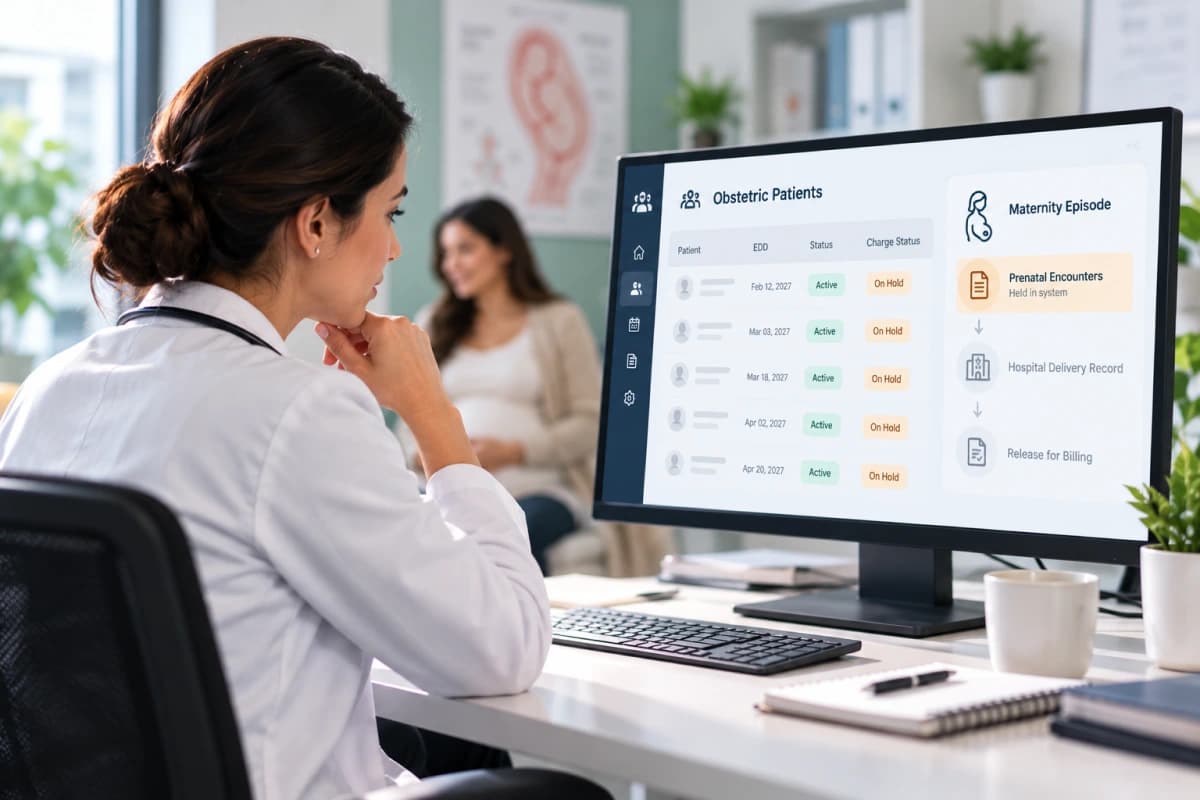
Some OB/GYN practice management (PM) systems are configured to place prenatal encounter charges into a temporary holding account (often called a "global maternity episode" or "dummy ledger"). These charges sit unbilled until a hospital delivery record triggers their release under a global CPT code.
If your billing staff does not manually intervene before January 1, 2027, the PM system may attempt to drop a deleted global code (59400 or 59510) upon 2027 delivery, creating an invalid-code rejection risk.
Three Recommended PM System Actions
- Extract Spanning Episodes by December 15, 2026: Generate a report of all active obstetric patients whose estimated delivery date (EDD) falls on or after January 1, 2027. Treat December 15 as an internal planning target, not a national billing deadline.
- Manually Release 2026 Antepartum Charges: On or before December 31, 2026, convert the held prenatal visits into 59425, 59426, or individual E/M charges based on the exact visit count. Submit these claims with 2026 dates of service and follow the payer’s filing instructions.
- Disable Global Auto-Bundling for 2027: Configure the PM system so that encounters occurring on or after January 1, 2027, generate live, per-encounter E/M claims rather than being moved to a holding bucket.
Payer Policy and Contract Divergence
While the AMA CPT manual defines codes nationally, individual health plans update their claims engines and payment policies on varying schedules.
Payer Category | Transition Consideration | Billing Action Required |
|---|---|---|
Commercial plans | The 2027 CPT changes take effect January 1, 2027. Payment, modifiers, edits, and transition instructions may still vary by payer, product, state, and contract. | Verify the official policy for the patient’s exact product. Confirm code acceptance, modifiers, fee schedules, and contract changes. |
State Medicaid programs | Some state programs or managed-care plans may publish state- or product-specific transition rules. | Verify the state Medicaid bulletin and the applicable managed-care plan instructions. |
Medicare (CMS proposed rule) | CMS-1848-P considered and sought comment on 15 potential maternity G-codes that would preserve a global-style Medicare pathway. This was proposed, not final, as of October 14, 2026. | Check the CY 2027 Physician Fee Schedule final rule before applying Medicare-specific instructions. |
Action Plan for OB/GYN Billing Teams
Follow this workflow to process cross-year pregnancies without unnecessary payment delays. The dates below are internal planning targets and do not replace payer deadlines.
Step 1: Census Review (December 1 to 15, 2026)
Pull a report of all active obstetric patients with delivery dates in 2027. Calculate the exact number of prenatal visits completed by December 31, 2026.
Step 2: Submit 2026 Antepartum Claims (December 31, 2026 to January 10, 2027)
Submit 2026 prenatal claims using 99202–99215 (for 1–3 visits), 59425 (for 4–6 visits), or 59426 (for 7+ visits). Use the date of the final 2026 visit as the date of service for 59425/59426. Follow the payer’s claim-format and timely-filing requirements.
Step 3: Update EHR Charge Templates (January 1, 2027)
Remove deleted global codes from active clinician charge picklists. Ensure all 2027 prenatal and postpartum office visits route directly to the appropriate outpatient E/M codes.
Step 4: Audit Hospital Discharge Slips (January 2027 onward)
Confirm that hospital rounding and delivery encounters are documented and coded under the new 2027 framework rather than global delivery bundles.
Step 5: Monitor Clearinghouse Scrub Logs (Weekly in Q1 2027)
Inspect front-end clearinghouse rejection logs weekly to identify any lingering global codes or mismatched date-of-service edits. Track clearinghouse rejections separately from payer denials. See our OB/GYN billing denial guide for a broader prevention workflow.
Ensure Clean Maternity Claim Billing in 2027
Managing the shift from global maternity packaging to unbundled per-encounter claims requires tight coordination between your clinical providers, billing staff, and practice management software.
Dastify Solutions specializes in OB/GYN coding, payer contract analysis, and revenue cycle management. Our team can help identify configuration, coding, and payer-readiness risks before go-live. Results still depend on documentation, payer policy, contracts, and claim adjudication.
Regulatory & Coding Disclaimers
CPT is a registered trademark of the American Medical Association. Copyright American Medical Association. All rights reserved. Mention of CPT codes in this publication is for educational and informational purposes only and does not constitute official coding advice. CPT coding alone does not guarantee payer coverage or claim reimbursement. Coverage and payment policies vary by health plan and are subject to specific provider contracts. CMS CY 2027 payment policies reference proposed federal rules and remain subject to change until the issuance of the final rule. Practices should consult their contracted health plans and professional coding compliance officers for specific guidance.