Mental health billing is notoriously unforgiving. Unlike general medicine, where a physical procedure often leaves a tangible trail, behavioral health relies almost entirely on the quality of your clinical documentation and the precision of your time-tracking. If your therapy notes do not perfectly align with the CPT codes you submit, you are not just looking at a denied claim. You are looking at a potential recoupment during a retrospective audit.
The National Institute of Mental Health reports that nearly one in five U.S. adults lives with a mental illness. This massive volume of care creates an equally massive paper trail. Small, systemic errors in how you bill these sessions can lead to significant financial losses over time. In fact, according to MGMA, behavioral health practices consistently show higher-than-average claim denial rates compared to other specialties.
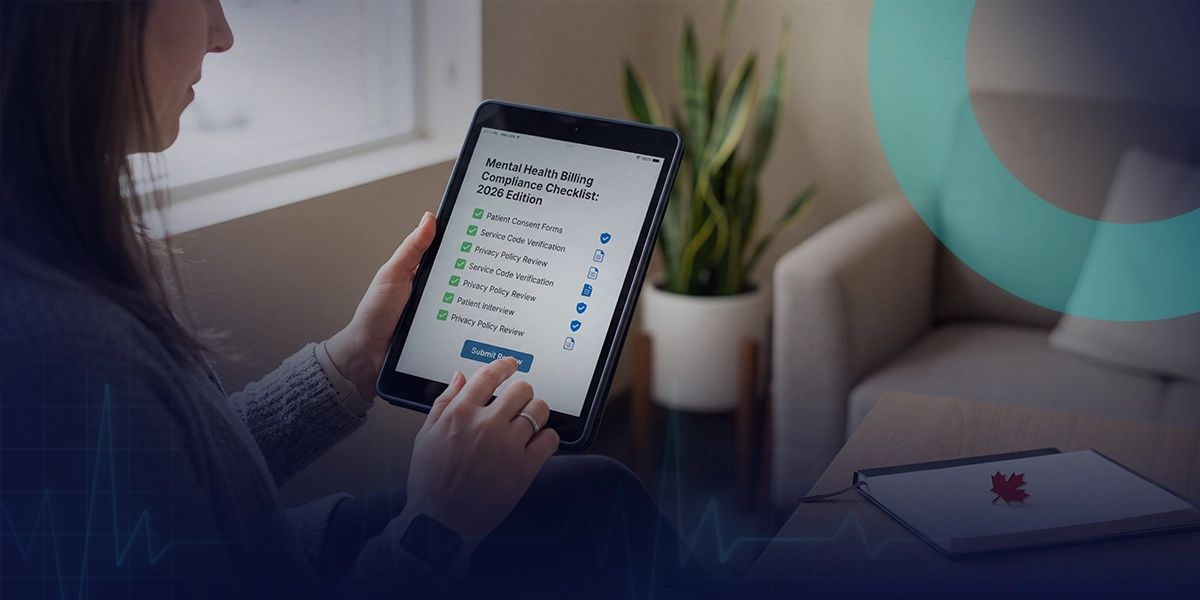
This 2026 mental health billing compliance checklist covers the regulatory changes, plus the operational details that keep your practice defensible during audits.
What Changed in 2025-2026 That Affects Your Mental Health Billing Compliance
Before we get into the full checklist, here’s what actually changed recently. If you’re still billing based on 2022 guidance, you’re already behind.
Medicare Telehealth Policy Is Still in Flux
The temporary telehealth flexibilities that allowed audio-only behavioral health visits and removed geographic restrictions were extended multiple times, but they expire at the end of 2025 unless Congress acts again. If you’re reading this in early 2026 and still billing audio-only psychotherapy to Medicare, verify the current extension status on the CMS telehealth page before you submit another claim. Many commercial payers mirror Medicare policy, so if Medicare rolls back coverage, expect your commercial contracts to follow within months.
Mental Health Parity Enforcement Is Aggressive Now
Health plans are now required to conduct and provide comparative analyses proving their mental health utilization management is not more restrictive than medical/surgical processes. For your billing team, this means you can push back harder on arbitrary session limits and prior authorization denials. When you appeal, cite the parity rule and demand the plan’s comparative analysis. Most plans are still scrambling to comply and will often reverse denials rather than produce documentation they don’t have.
Good Faith Estimates Are Not Optional Anymore
If you see self-pay or uninsured patients, you must provide a written Good Faith Estimate before services begin under the No Surprises Act. This applies even if you’re a solo therapist who doesn’t accept insurance. Civil monetary penalties start at $10,000 per violation. If you’re not doing this yet, start today.
42 CFR Part 2 Consent Rules Changed
SUD programs can now use a single general consent for treatment, payment, and healthcare operations instead of requiring separate written authorization for every single disclosure. This aligns SUD records more closely with standard HIPAA consent processes. But the consent requirements are still stricter than HIPAA, so if you treat substance use disorder patients, make sure your intake forms reflect the updated rule and your billing team knows which consent covers which type of disclosure.
State Telehealth Parity Laws Keep Expanding
More states pass telehealth parity laws every year requiring commercial payers to reimburse telehealth at the same rate as in-person for behavioral health. But coverage for audio-only varies wildly by state. Some states mandate it, some explicitly exclude it, and some leave it to individual payer discretion. Don’t assume. Check your state’s current telehealth law and verify each payer’s policy separately.
The Mental Health Billing Compliance Protocol
This framework is designed to protect your practice from audits and ensure that your revenue is defensible. You should treat these sections as the standard operating procedure for your administrative and clinical staff.
1. Verify Provider Enrollment, Eligibility, and Scope
Billing compliance starts long before a claim is sent. Every clinician whose services are billed must be correctly credentialed and operating within scope.
Taxonomy Alignment: Your National Provider Identifier (NPI) must match your specific provider type. A common error involves billing under a generic taxonomy when a more specific one (like Clinical Social Worker or Psychologist) is required.
Provider Scope: Verify that the services billed are within the provider’s legal state scope. For instance, billing for “psychological testing” when performed by a Master’s level clinician without specific state-allowed supervision can trigger a total recoupment of those funds.
Active Enrollment: Check the CMS PECOS database quarterly to ensure no provider has been de-activated or excluded.
2. Confirm Patient Coverage and Behavioral Health Benefits
Even with parity rules, benefit designs still vary. A fast eligibility check is not enough for mental health billing.
Coverage and Benefits Checklist:
- Verify active coverage for the exact date of service.
- Identify whether behavioral health benefits are carved out to a separate administrator.
- Confirm whether the specific provider and site are in a network for behavioral health.
- Check if prior authorization is needed for:
- Outpatient psychotherapy
- Psychiatry medication management
- Psychological or neuropsychological testing
- IOP, PHP, or residential treatment
- Note any visit limits, session caps, or authorization periods for mental health services.
- Determine patient financial responsibility: copay, coinsurance, remaining deductible.
- Communicate any out of pocket estimates to the patient as early as possible.
- Identify primary vs. secondary payer at every eligibility check. For Medicaid as secondary payer, follow state-specific crossover claim rules. Document coordination of benefits order in the patient record and update it at every authorization renewal.
- For self-pay and uninsured patients, provide a Good Faith Estimate under the No Surprises Act before services begin. Failure to comply can result in civil monetary penalties.
Parity laws restrict plans from imposing stricter limits on behavioral health than on medical benefits, but utilization management tools still exist. CMS provides parity guidance and resources for plans and providers on its mental health parity page.
3. Use the Right CPT Codes for Psychotherapy and Psychiatry
Coding is the core of behavioral health billing. Most common services in mental health revolve around psychotherapy and psychiatric visits.
Typical Psychotherapy and Psychiatry CPT Codes:
| Service type | Common codes | Typical time or structure | Notes for compliance |
|---|---|---|---|
| Psychiatric diagnostic evaluation | 90791, 90792 | Evaluation, no set time in code | Requires history, mental status, and diagnostic work |
| Individual psychotherapy | 90832, 90834, 90837 | 30, 45, 60 minutes | Documentation must support time and complexity |
| Psychotherapy with E/M (psychiatry) | 90833, 90836, 90838 | Add-on to E/M codes | Must document both psychotherapy and E/M components |
| Crisis psychotherapy | 90839, 90840 | First 60 minutes plus add-on | Intended for high intensity, urgent situations |
| Group psychotherapy | 90853 | By session | Document group composition, goals, interventions |
| Family psychotherapy | 90846, 90847 | With or without patient present | Focus on family dynamics and treatment goals |
Psychotherapy and Psychiatry Coding Checklist:
- Match the code to the actual service type and time spent, not the scheduled time.
- For time based psychotherapy, document start and stop times or clear duration.
- Avoid routinely billing the longest psychotherapy code (such as 90837) without strong documentation support.
- When billing E/M plus psychotherapy for psychiatry, document:
- History, exam, and medical decision making, or
- Time dedicated to medication management and associated work, plus
- Distinct psychotherapy interventions and goals.
- Review each payer’s policy on which provider types may bill each code set.
- For IOP, PHP, and testing, follow payer unit rules and minimum service requirements exactly.
The American Medical Association maintains the CPT code set, and Medicare and commercial payers incorporate CPT principles into their policies. Misuse of time based psychotherapy codes is a frequent focus in fraud and abuse investigations reported by the HHS OIG.
4. Assign Accurate ICD-10-CM Mental Health Diagnoses
Diagnosis codes drive medical necessity decisions and shape how plans view your practice patterns.
ICD-10-CM Diagnosis Checklist:
- Select the diagnosis that reflects the condition treated in the visit, not only historical conditions.
- Use the most specific code that the documentation supports.
- Make sure the primary diagnosis reflects the main reason for the encounter.
- When multiple mental health conditions are present, order them by impact on the treatment plan.
- Include relevant medical comorbidities when they influence risk, medication decisions, or therapy focus.
- Keep problem lists updated so they match current diagnoses and active treatment.
Accurate ICD-10-CM usage supports both claims decisions and quality measurement initiatives led by agencies like the National Institute of Mental Health and the Substance Abuse and Mental Health Services Administration.
5. Document Sessions to Support Billing and Medical Necessity
In the eyes of an auditor, if something is not documented, it did not occur. Clinical documentation is the foundation of mental health billing compliance.
Documentation Checklist for Psychotherapy:
Each therapy note should typically include:
- Date of service, location, and type of session
- Start and stop time or total duration
- Participants (individual, couple, family, group)
- Presenting issue or focus for the session
- Diagnoses addressed during the visit
- Interventions used, described in clinical language
- Patient response, progress, and barriers
- Risk assessment when relevant (suicidality, self harm, risk to others)
- Plan for next contact, homework, referrals, or treatment adjustments
- Signature, credentials, and date of entry
Documentation Checklist for Psychiatry and Medication Management:
- Interval history and symptom changes since the last visit
- Mental status examination elements appropriate to the encounter
- Review of medications, adherence, side effects, and changes
- Medical decision making or time spent on evaluation and management
- Diagnosis and clinical reasoning for medication choices
- Safety considerations, including monitoring plans for controlled substances
- Coordination of care with therapists, primary care, or other specialists when relevant
CMS and commercial plans publish documentation guidance that billing teams should review regularly. Aligning notes with these expectations makes it easier to defend services during utilization review or audit. CMS documentation guidance for behavioral health is integrated into various Medicare learning resources.
6. Telehealth Mental Health Billing: 2026 Rules You Must Know
Telehealth exploded during COVID and never fully contracted. But the rules are a moving target, and what worked in 2023 might get you denied in 2026.
1. Originating Site vs. Distant Site
For Medicare billing, the originating site is where the patient is located, and the distant site is where the provider is. Medicare has specific requirements about which originating sites qualify for reimbursement. Many rural health clinics and federally qualified health centers have special originating site rules. If you bill Medicare telehealth, know which site you are and what that means for your claim.
2. Medicare Telehealth Flexibilities Extension Status
The temporary telehealth flexibilities that allowed audio-only visits and removed geographic restrictions were extended through the end of 2025 for behavioral health services. After that? Congress needs to act or the rules revert. If you rely heavily on audio-only psychotherapy, you need a backup plan for 2026.
3. State Telehealth Parity Laws
Many states now require commercial payers to cover telehealth at the same rate as in-person visits for behavioral health. But compliance varies wildly. Some states apply parity only to live video. Some include audio-only. Some exempt certain plan types. Check your state’s telehealth parity law and don’t assume all payers follow it without verifying.
4. Cross-State Licensure Issues
A therapist licensed in Texas treating a patient who moved to Florida is practicing without a license in Florida unless they hold a Florida license or participate in a compact agreement. This may not surface until a payer audits the claim and denies it retroactively because the provider was not properly licensed in the state where the patient received care. Track where patients are located for telehealth visits and confirm that each provider holds an active license in that state.
5. Synchronous Video vs. Audio-Only vs. Asynchronous
Billing requirements differ by modality. Most payers reimburse live video psychotherapy at the same rate as in-person. Audio-only reimbursement is less consistent and often requires specific modifiers or prior approval. Asynchronous services, such as secure messaging or recorded video review, are rarely covered for psychotherapy. Document the modality clearly in every note.
6. Modifiers Commonly Used in Behavioral Health Telehealth
- Telehealth modifiers such as 95 or GT, when required by the payer
- Audio-only related modifiers, for example FQ or FR, for programs that distinguish audio-only from video
- Modifier 59 or related X modifiers for distinct procedural services, when allowed and appropriate
- Modifiers that reflect provider type or supervision, which vary by state and payer, for example HO, HP, HQ
Place of Service Examples:
- 11 Office
- 02 or 10 for telehealth, depending on payer and setting
- 03 School
- 22 Outpatient hospital
- 53 Community mental health center for some programs
7. Telehealth Modifiers and Place of Service Checklist:
- Confirm the right POS for each encounter based on where the patient is located.
- Apply telehealth modifiers consistently for video and audio-only services, following payer policies.
- Document the telehealth modality in the clinical note.
- Validate that your practice management system is mapping POS codes correctly to each location and visit type.
7. Incident-To Billing in Mental Health: When It’s Allowed and When It Creates Audit Risk
Incident-to-billing is when a non-physician provider (like an LCSW, LPC, or MFT) bills under a supervising physician’s NPI instead of their own. This is one of the most common compliance landmines in behavioral health and one of the most frequently audited issues.
When Incident-To Billing Is Allowed
Medicare allows incident-to billing when all of these conditions are met:
- The supervising physician personally performed the initial service and remains actively involved in the patient’s care.
- The non-physician provider is working under the direct supervision of the physician (meaning the physician is immediately available in the office suite).
- The service is part of the patient’s established treatment plan and does not represent a new problem or condition.
- The service is furnished in a non-facility setting (like an office, not a hospital outpatient department).
When Incident-To Creates Audit Risk
Billing incident-to for a new patient or a patient presenting with a new problem is not allowed and will be recouped if audited. Billing incident-to when the supervising physician is not physically present in the office suite is not allowed. Billing incident-to for services provided by a therapist who is not an employee or contractor under the direct control of the practice is not allowed.
Why This Matters Specifically for Group Practices
In a group behavioral health practice where a psychiatrist supervises multiple LCSWs, it is tempting to bill all therapy sessions under the psychiatrist’s NPI to get a higher reimbursement rate. But unless every one of those sessions meets the incident-to criteria above, you are setting yourself up for a massive recoupment during a Medicare audit.
What to Do Instead
Bill under the rendering provider’s own NPI whenever possible. If the therapist is credentialed with the payer, bill under their NPI. If they are not credentialed, get them credentialed. Incident-to should be the exception, not the default billing method.
For Supervised or Incident-To Services:
Check federal, state, and payer-specific rules on when and how these can be billed. Document supervision clearly in the clinical record.
8. Follow Payer-Specific Rules for High-Risk Behavioral Health Services
Some behavioral health services attract more attention from payers and auditors because they are complex and higher cost.
Common examples:
- Psychological and neuropsychological testing
- IOP and PHP programs
- SUD treatment in OTP, residential, and community settings
- Group therapy in various formats
- Community based and wraparound services under Medicaid
High-Risk Services Checklist:
- Maintain a short payer summary for each major high-risk service that includes:
- Covered codes
- Unit limits and timing rules
- Required disciplines and staffing patterns
- Documentation requirements
- Ensure staff who order or deliver these services know the key coverage criteria.
- Require internal reviews of documentation for these programs at regular intervals.
- Monitor denial reasons for these services separately so patterns are visible early.
9. Medicaid-Specific Mental Health Billing: What’s Different
A large percentage of behavioral health patients are on Medicaid, and Medicaid mental health billing has completely different rules than commercial or Medicare.
T-Codes vs. CPT Codes:
Some state Medicaid programs require T-codes (HCPCS Level II temporary codes) for certain behavioral health services instead of standard CPT codes. For example, T1015 for clinic visits or T1016 for case management. Check your state Medicaid fee schedule to see if T-codes apply to your services.
Prior Authorization Requirements:
Medicaid prior authorization thresholds are often lower and more restrictive than commercial plans. Some states require prior authorization after just a few therapy sessions. Know your state’s limits.
FQHC and RHC Billing Rules:
If you operate as a Federally Qualified Health Center or Rural Health Clinic, your Medicaid billing follows encounter-rate rules instead of fee-for-service CPT billing. Make sure your billing team understands which rate applies and how to submit encounters correctly.
State Medicaid Fee Schedule:
Every state publishes its own Medicaid fee schedule. Do not assume that what Medicare covers is what Medicaid covers. Check your state Medicaid website and review the behavioral health billing manual at least annually.
10. Protect Privacy and Manage Consent in Mental Health and SUD Billing
Behavioral health billing must follow all HIPAA rules, plus additional confidentiality rules for SUD services under 42 CFR Part 2.
Privacy and Consent Checklist:
- Maintain a current Notice of Privacy Practices that explains how PHI is used for billing and claim submissions.
- Train billing staff on minimum necessary access to PHI.
- Put clear procedures in place for SUD programs that fall under 42 CFR Part 2, including:
- How consent is obtained
- How billing related disclosures are documented
- How revocation of consent is handled
- Use HIPAA compliant channels for transmitting claims, EOBs, and supporting documents.
- Execute Business Associate Agreements with all vendors that handle PHI, including EHR, clearinghouses, and billing partners.
- Log and monitor disclosures from behavioral health records as required by law and policy
11. Build a Behavioral Health Billing Compliance Program
A checklist is helpful, but regulators expect more than a one-time document. Ongoing monitoring and corrective action are part of a sound behavioral health billing compliance strategy.
The HHS Office of Inspector General recommends formal compliance programs covering written policies, staff training, a reporting mechanism, routine internal audits, and defined corrective actions. For behavioral health specifically, those policies should address time-based code documentation, 42 CFR Part 2 consent requirements, and telehealth modifier accuracy.
Overpayment Identification and Refund Obligations: The 60-Day Rule
When a payer overpays, which happens regularly in behavioral health due to coordination of benefits errors and retroactive eligibility terminations, practices have a legal obligation under the False Claims Act and CMS rules to identify and refund overpayments within 60 days of identification.
This is one of the most overlooked compliance risks in behavioral health billing. If you identify an overpayment and do not return it within 60 days, that overpayment becomes a false claim and exposes you to penalties.
What to do: Conduct quarterly remittance audits to identify overpayments before payers conduct their own audits and demand recovery with interest. Document when the overpayment was identified and when it was refunded.
Concrete Internal Audit Framework
Do not just say you audit. Actually audit.
Here is a realistic framework for small to mid-sized behavioral health practices:
- Frequency: Monthly
- Sample size: 10 to 15 charts per clinician
- Focus areas:
- Time documentation for 90837 claims
- E/M plus psychotherapy add-on code pairs (do both components have separate documentation?)
- Telehealth modifier accuracy
- ICD-10 specificity and alignment with treatment plan
- Red flag trigger: If any provider’s 90837 usage exceeds 80% of their total psychotherapy claims, flag that provider for immediate review. This is a primary OIG audit trigger.
12. Use Technology to Support Mental Health Billing Compliance
The right technology setup makes it easier to follow your checklist consistently.
Technology Checklist:
- Build simple pre-submission edits, such as:
- Blocking claims without a diagnosis
- Flagging psychotherapy claims with missing time data
- Warning on unusual use of 60-minute psychotherapy codes
- Use reporting tools to track:
- Denials by reason and payer
- Coding distributions by provider
- Telehealth vs in-person service mix
Mental Health Billing Compliance Checklist Quick Overview
| Compliance Area | Key Action |
|---|---|
| Provider Enrollment | Verify NPI taxonomy, scope of practice, and active enrollment in PECOS quarterly |
| Patient Coverage | Check eligibility, identify carved-out behavioral health benefits, confirm COB, provide Good Faith Estimates for self-pay |
| CPT Coding | Match psychotherapy codes to documented time; document both E/M and psychotherapy components for add-on codes |
| ICD-10 Diagnosis | Use most specific code; align diagnosis with visit focus and treatment plan |
| Clinical Documentation | Include start/stop time, interventions, patient response, risk assessment, and plan in every note |
| Telehealth Billing | Apply correct modifiers and POS codes; document modality; verify state licensure for patient location |
| Incident-To Billing | Only bill incident-to when supervising physician is on-site, patient is established, and problem is not new |
| High-Risk Services | Maintain payer-specific rules summary for testing, IOP/PHP, SUD treatment; monitor denials by service type |
| Medicaid Services | Check state-specific T-codes, prior auth thresholds, and fee schedules separately from Medicare |
| Privacy & Consent | Follow HIPAA minimum necessary; obtain specific consent for 42 CFR Part 2 SUD disclosures |
| Compliance Program | Conduct monthly audits of 10-15 charts per clinician; refund overpayments within 60 days of identification |
| Technology | Use pre-submission edits for missing time or diagnosis; track denial patterns by payer and reason |
To Sum It Up: Make Compliance a Habit
A compliant mental health practice is built on accurate time-tracking, clear documentation of medical necessity, and an obsession with detail. You should treat your billing process as a clinical extension of your care.
If your current billing system feels fragile or you are seeing an uptick in denials, it may be time to shift your strategy. Reliable billing requires specialized knowledge that general medical billers often do not possess. Make sure your partners understand the behavioral health world as well as you do.