




Introduction
You just billed a radiation oncology procedure the same way you’ve done it for three years. Two weeks later, the claim came back denied. “Incorrect modifier usage,” it says or worse: “Missing required documentation.”
Medi-Cal’s oncology billing rules live in the DHCS provider manual, and the manual pages get revised on their own schedule. Each page carries its own revision date, which is worth checking when a claim starts behaving differently than it used to. The denial codes that come back rarely tell you which specific rule you violated. Split billing with modifiers 26 and TC sounds simple until you hit edge cases. Modifier U7 gets misused constantly, usually because people assume it means the same thing in California that it means somewhere else. And brachytherapy source codes like C2616 or Q3001 have an attachment rule that is easy to miss, which is where a lot of oncology denials start.
The worst part? A lot of these denials are avoidable if you know exactly what Medi-Cal is looking for. This is a practical guide for California oncology and radiation therapy practices billing Medi-Cal for split services, repeat procedures, and radioactive source materials. So let’s cut through the confusion and talk about how to actually get these claims paid.
What Does Modifier U7 Mean in Medi-Cal?
In Medi-Cal, modifier U7 identifies a service rendered by a physician assistant. It is not a repeat-procedure modifier. Modifier 76 identifies a repeat procedure by the same physician, while modifier 77 applies to a repeat procedure by another physician. Always confirm that U7 is allowable with the billed code.
The Global vs Split Decision That Comes Before Modifiers 26 and TC
Before assigning modifier 26 or TC, answer three questions:
- Does your practice own the imaging or treatment equipment, or does a hospital or imaging center own it?
- Is there a written agreement between the professional and technical provider about who bills each component?
- Is the code you are billing actually split-billable under Medi-Cal, and does the manual require the split or merely allow it?
Your practice owns the equipment and the physician does both the supervision and the interpretation on site. Bill the code on its own. On a split-billable claim where you are billing both components, Medi-Cal says a modifier is neither required nor allowed, so adding 26 or TC will work against you.
For a code that Medi-Cal permits to be split billed, modifier 26 generally identifies the separately billed professional component, while modifier TC identifies the separately billed technical component. Confirm which entity performed and may bill each component; location or equipment ownership alone should not determine modifier assignment.
The “no modifier when you bill both components” rule does not apply to MRI, MRA and PET codes. Those have their own billing instructions in the relevant sections of the Part 2 manual, so check there rather than assuming.
This ownership and contractual structure is the decision that comes first. Modifier 26 and TC are just the labels that follow. Service location documentation is what supports a split. Keep the written arrangement on file where you can produce it. Maintain a written record of your billing arrangement that survives a DHCS records request.
What Are Split-Billable Modifiers (And Why Does Medi-Cal Care)?
Most oncology and radiology procedures have two parts:
- the professional component (what the doctor does) and
- the technical component (the equipment, room, staff, and supplies)
When a hospital or imaging center bills for both, they use the base CPT code without modifiers. But when the professional and technical parts happen in different locations or are billed separately, you need modifiers 26 and TC.
Modifier 26 = Professional component only (physician’s interpretation, supervision, report writing)
Modifier TC = Technical component only (equipment use, technician time, supplies)
Pretty straightforward, except Medi-Cal doesn’t always reimburse these the way you’d expect.
Breaking Down the Reimbursement
Modifier | What It Covers | Medi-Cal Rule |
|---|---|---|
Modifier 26 (Professional) | Physician interpretation, report writing, supervision | Append only when billing the professional component on its own |
Modifier TC (Technical) | Equipment depreciation, technician labor, room overhead, contrast materials | Append only when billing the technical component on its own |
No Modifier (Both Components) | Both components billed together by the same provider | Required. On a split-billable claim where both components are billed, a modifier is neither required nor allowed |
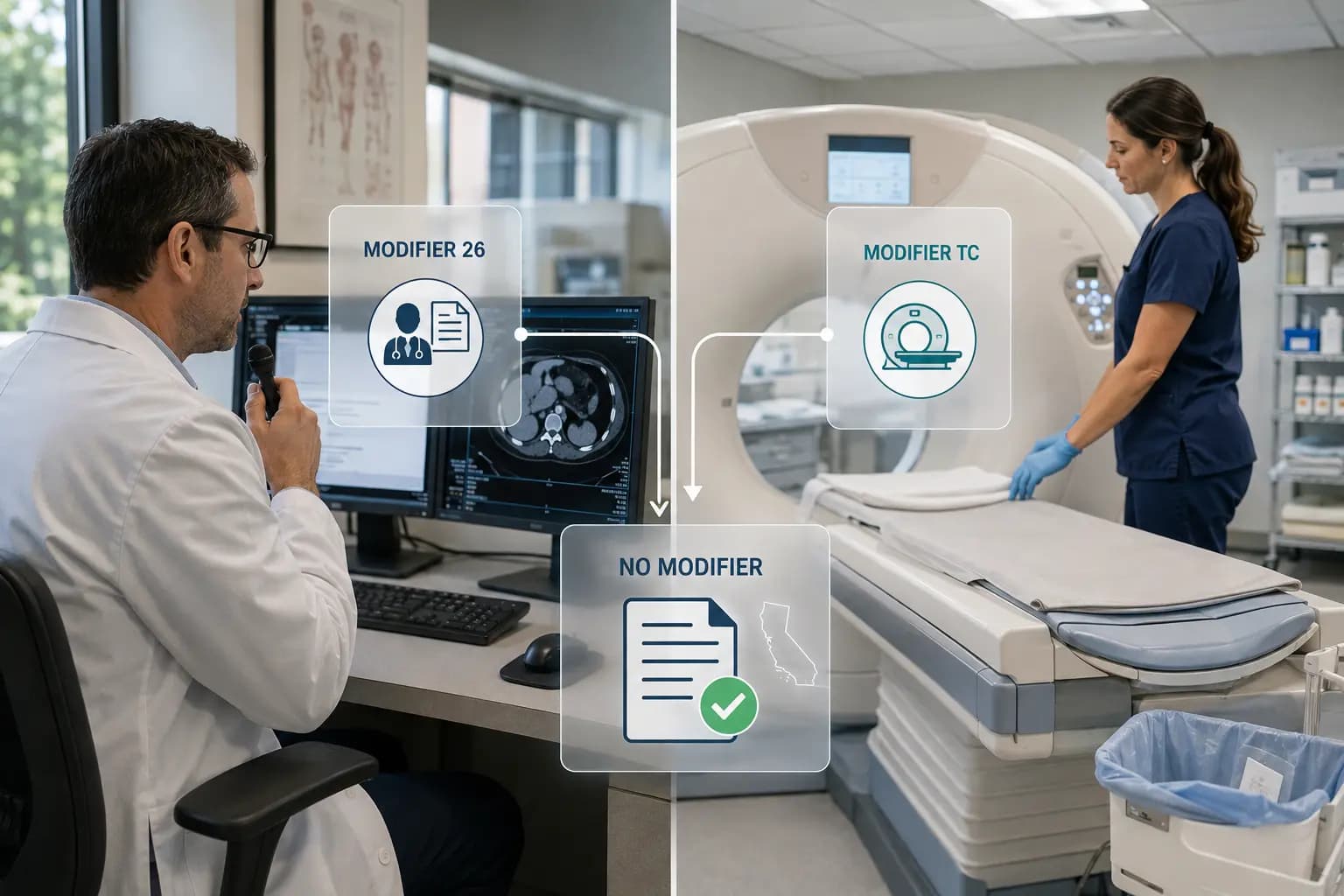
The problem is that a lot of practices bill modifier 26 when they should be billing the bare code, or they double-bill TC when the hospital already submitted it. Medi-Cal sets out which codes are split-billable and which modifiers are allowed on them in the Modifiers Used with Procedure Codes section of the provider manual. Overlapping component billing or documentation that does not support the billed component may result in denial, incorrect payment or additional review.
Before Assigning 26 or TC: Confirm that Medi-Cal permits the specific code to be split billed, identify which entity performed and may bill each component, and review the code-specific instructions. Service location and equipment ownership are relevant, but they do not independently determine whether to bill 26, TC or no modifier.
Which Radiation Oncology Codes Are Actually Split-Billable
Medi-Cal doesn’t leave this to interpretation. The Radiology: Oncology section sorts radiation oncology codes into three groups, and the group decides the modifier.
Must be billed with modifiers 26 and TC
- 77306, 77307 — teletherapy isodose plan, simple and complex
- 77316, 77317, 77318 — brachytherapy isodose plan, simple, intermediate and complex
May be split-billed with 26 and TC
- 77767, 77768, 77770 through 77772
- 77778 — interstitial radiation source application, complex
- 77789 — surface application of low dose rate radionuclide source
- 77338 — MLC device for IMRT
On any of these, if you’re billing both components, a modifier is neither required nor allowed. Bill the bare code.
Not split-billable — must not carry 26 or TC
- 77371, 77372, 77373 — stereotactic treatment delivery
- 77402, 77407, 77412 — radiation treatment delivery, simple through complex
- 77417 — therapeutic radiology port images
- 77427, 77432, 77435 — treatment management
- 77520 through 77525 — proton treatment delivery
- 77750, 77761, 77762, 77763, 77790, 77799 — clinical brachytherapy and radioelement solution
- All brachytherapy source codes, and the therapeutic radiopharmaceutical agent codes
Three rules that sit alongside this
Never put modifier 99 with 26 or TC. The manual says the claim will be denied. It also says not to bill 99 on a split-billable claim you are submitting without a modifier.
Proton delivery has a diagnosis restriction. CPT 77520 through 77525 are not reimbursable when claimed with ICD-10-CM C61 or D07.5, both prostate.When a radiologist and a surgeon are both involved in clinical brachytherapy, bill with the appropriate modifier so the reimbursement doesn’t overlap. If the radiologist actively participates throughout the surgery, modifier 80 may be appropriate.
What Modifier U7 Actually Means in Medi-Cal
In Medi-Cal, U7 means the service was rendered by a physician assistant. That’s it. It has nothing to do with repeat procedures.
Medi-Cal lists U7 under the generic national description “Medicaid level of care 7, as defined by each state.” Then California adds its own note underneath: used to denote services rendered by a Physician Assistant. It came in as the HIPAA-compliant replacement for modifier AN, which was California’s old PA modifier until it was retired in February 2009.
Here’s why so many billers get this wrong. The U-series modifiers, U1 through UD, are set aside for state Medicaid programs to define however they want. California uses U1 for one thing. Another state uses it for something else. So a U-modifier you picked up in another state doesn’t carry over to Medi-Cal, and a national coding reference won’t tell you what California does with it. You have to read California’s own list.
If what you need is a repeat procedure modifier
Use the national ones. Both are on Medi-Cal’s approved list:
- 76 — repeat procedure or service by the same physician
- 77 — repeat procedure by another physician
A repeat service on a different date does not automatically require or prohibit modifier 76 or 77. Review the code description, clinical circumstances and applicable payer instructions.
Verify Before You Bill
Modifier rules, allowable code combinations and the brachytherapy source list all change through DHCS provider bulletins, and each manual page carries its own revision date. Two habits are worth building.
- Check the section, not a summary. Open the current Modifiers: Approved List and Modifiers Used with Procedure Codes sections for the code you’re billing. Articles age. Manual pages are dated.
- Confirm the delivery system first. If the patient is in a managed care plan, the plan’s own rules govern authorization and can differ from fee-for-service policy.
This guide reflects the Medi-Cal provider manual reviewed on September 2, 2026. When this article and the current manual differ, follow the current manual and applicable payer requirements.
Where U7 Does Show Up in Oncology Billing
Anywhere a physician assistant renders a service that Medi-Cal lets a non-physician practitioner bill. In radiation oncology specifically, the manual says U7 is allowed on CPT 77338 (MLC device for IMRT). The Modifiers Used with Procedure Codes section lists U7 as an allowable modifier across a long run of oncology, chemotherapy and radiology code ranges. Look up the code you’re billing instead of assuming.
Brachytherapy Source Codes and the Invoice Attachment Rule
Medi-Cal names the brachytherapy source codes it will actually pay for. As of the current Radiology: Oncology section, that list is C2616, C2634, C2635, C2637 through C2641, C2644, C2645, C2698, C2699 and Q3001.
If the code you’re about to bill isn’t on that list, stop and check the section before you submit. A source code that is valid under Medicare is not automatically payable by Medi-Cal, and that catches people out more than anything else on this page.
These cover different isotopes. Iodine-125 seeds for prostate cancer, cesium-131 for brain tumors, yttrium-90 microspheres for liver cancer, and so on.
Here’s the thing nobody tells you upfront. Medi-Cal requires you to attach the vendor invoice to every single one of these claims. Not later if they ask. Not a summary you typed up. The actual invoice from the supplier.
Why Medi-Cal Requires This
Brachytherapy sources are separately reimbursable materials. Medi-Cal uses the required invoice to establish the actual cost used for claim pricing.
What Medi-Cal Actually Requires on the Invoice
The rule is short. Brachytherapy source codes must be billed “By Report” with an invoice showing the actual cost of the substance attached. They are not split-billable and must not carry any modifier at all.
Two details do most of the damage when people miss them.
The invoice has to be dated before the date of service
For codes listed without a price on the Medi-Cal website, an invoice is required for pricing, and the manual is blunt about it: the invoice must be dated prior to the date of service or the claim will be denied. An invoice your supplier generates after the implant won’t survive. If they normally bill you after delivery, get the itemized invoice at the point of purchase instead.
C2645 needs more than the invoice
When you bill C2645, the report also has to document the dose used, the size used per square millimeter, and the size of the tumor.
Worth knowing about the not-otherwise-specified codes as well. For C2698 and C2699, Medi-Cal no longer requires you to document the procedure performed. The invoice is still required.
Beyond those rules, use judgment. An invoice that clearly ties the supplier, the HCPCS code, the quantity and the cost to your claim line is easier for a reviewer to accept than one that does not, and matching your billed units to the units actually implanted is basic hygiene. Just don’t treat it as a published checklist, because it isn’t one.
How to Bill Brachytherapy Sources Without Getting Denied
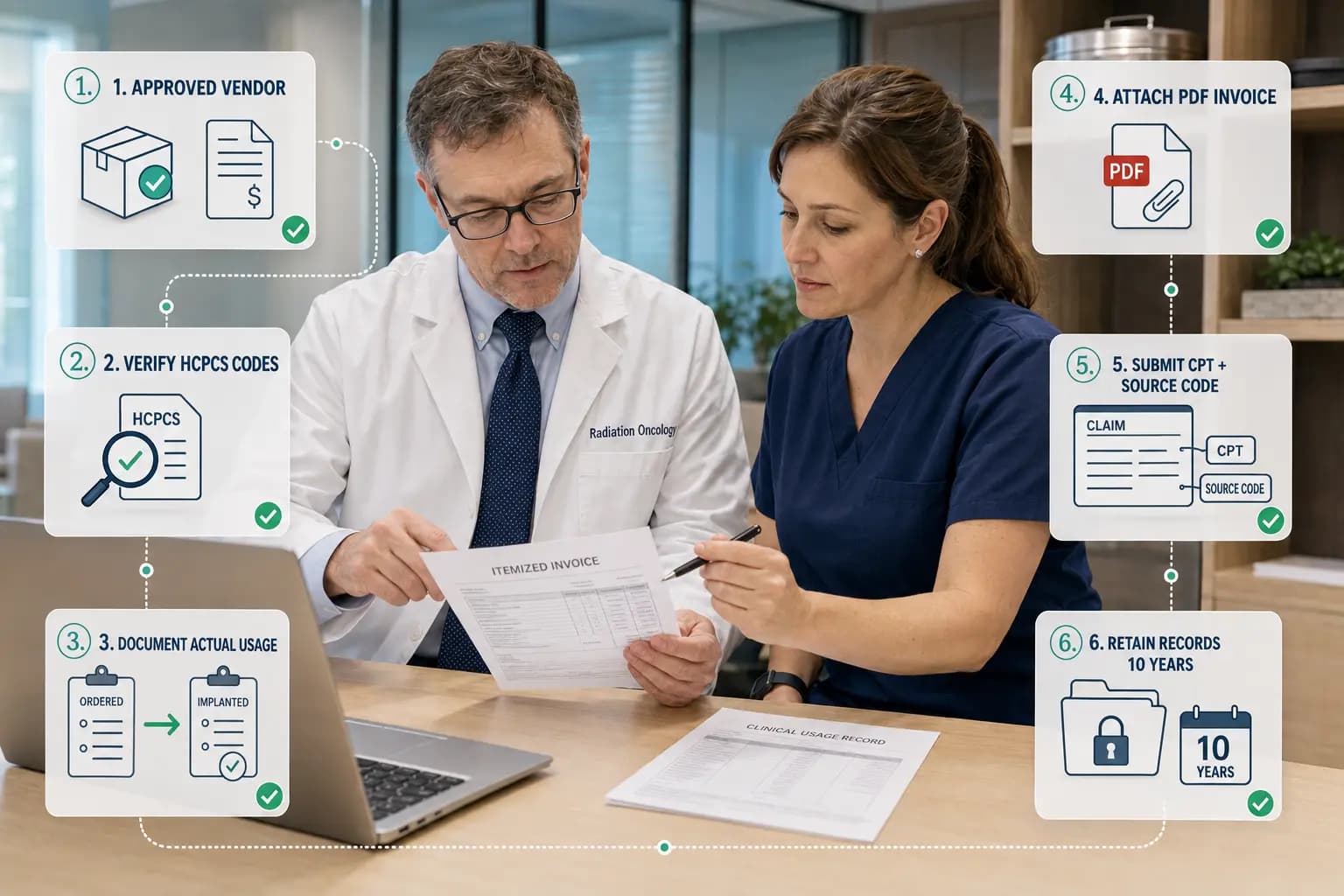
- Purchase the sources from an approved vendor (make sure you get an itemized invoice immediately, not just a packing slip)
- Verify the HCPCS codes on the invoice match what you plan to bill (vendor coding errors happen more than you’d think)
- Document the actual usage in the patient’s chart (if you ordered 50 seeds but only implanted 48, bill for 48)
- Attach a clear, readable copy of the invoice to the electronic claim (PDF format, not a smartphone photo)
- Submit the claim with the appropriate CPT code for the brachytherapy procedure (like 55875 for prostate seed implantation) plus the applicable C-code or Q3001 for the sources
- Keep the records for 10 years. California Welfare and Institutions Code section 14124.1 was amended on 1 January 2018 and now requires Medi-Cal providers to hold these records for 10 years. The clock starts from whichever comes latest: the end of the contract period between the plan and the provider, the completion of any audit, or the date the service was rendered. That lines up with the federal managed care rule at 42 CFR 438.3(u). Any guidance still quoting three years predates the amendment. Check your plan contracts too, because individual plans can set longer terms on top of the statute.
If you’re submitting electronically and the invoice file is too large, split it or compress it. Never skip the attachment thinking you’ll send it “if they ask.” They won’t ask, they’ll just deny.
Source Codes You Will See Most Often
Code | What It Is | Common Use |
|---|---|---|
C2616 | Yttrium-90, non-stranded | Liver cancer microsphere treatments |
C2634 | Iodine-125, non-stranded | Prostate cancer seed implants |
C2638 | Iodine-125, stranded | Gynecological cancers |
C2639 | Iodine-125, non-stranded | Prostate cancer seed implants |
C2698 | Stranded source, not otherwise specified | Uncommon isotopes |
Q3001 | Radioelements, any type | Catch-all when nothing else fits |
Be careful with C2698 and Q3001. These “not otherwise specified” codes get flagged more often because they are easy to misuse when a more specific code actually exists.
For yttrium-90 microsphere claims (C2616), verify whether Medi-Cal requires the National Drug Code on the claim in addition to the HCPCS code. NDC reporting requirements for drug-related brachytherapy codes have expanded and a missing NDC triggers the same denial as a missing invoice for some Medi-Cal plans.
Medi-Cal Managed Care vs Fee-for-Service Brachytherapy

As of December 2024, roughly 94% of Medi-Cal beneficiaries were in managed care and around 6% in fee-for-service, according to DHCS enrollment reporting. For most of your patients, the plan’s rules are the rules that matter. Prior authorization requirements for brachytherapy procedures vary by plan. Anthem Blue Cross Medi-Cal, Health Net Promise and Molina Healthcare each publish their own clinical criteria for brachytherapy coverage that may differ from DHCS fee-for-service rules. Before scheduling a brachytherapy procedure for a Medi-Cal managed care patient, verify authorization requirements with the specific plan. The invoice attachment rule applies to both fee-for-service and managed care claims, but the prior authorization process is plan specific.
What Actually Keeps These Claims From Getting Denied
Based on what actually happens in California oncology practices, here’s what keeps claims moving.
Before you hit submit!
- Confirm if the procedure is even split-billable (check the CPT book for “professional component” language)
- Figure out if you’re billing 26, TC, or global based on service location
- If a physician assistant rendered the service, confirm U7 is allowable on that specific code / Check the invoice is dated before the date of service and the units match your claim line
- Run it through your clearinghouse edits before final submission
After the claim goes out:
- Check claim status within 10 days (don’t wait for denial letters to show up)
- If it gets denied for “missing documentation,” resubmit as a corrected claim with everything attached again (Medi-Cal doesn’t always pull old attachments forward)
- Log every denial reason so you can spot patterns. If the same code and modifier combination keeps rejecting, the problem is upstream of the claim.
Struggling With Modifier Denials?
Dastify’s compliance team reviews your claims before submission to catch these errors.
Appealing Medi-Cal Oncology Denials When They Still Happen
Even correct claims get denied in Medi-Cal. Here is the recovery path for each denial type. Modifier 26/TC denial (CO-4 or CO-97). If denied for incorrect modifier use, review the claim against the service location documentation. If the modifier was correct, appeal with a letter explaining the service arrangement (physician independent from facility, separate ownership) and attach any written agreement between professional and technical providers.
Know which form you are filing
Medi-Cal doesn’t use Medicare’s redetermination process. There are two routes, and picking the wrong one costs you weeks.
If the date of service is still inside the six-month billing limit, you don’t need a form at all. Just submit a corrected original claim. It’s faster than anything else here.
Claims Inquiry Form (CIF). Use this to ask for reconsideration of a denied claim once the RAD arrives after the six-month billing limit. The CIF has to reach the Fiscal Intermediary within six months of the date on the RAD showing the denial. Anything later is subject to automatic denial. Expect an acknowledgment within 15 days and the claim back on a RAD within 45 days of that.
Appeal. Filed within 90 days. Use it if the Fiscal Intermediary never responds to your CIF, or if the Claims Inquiry Response Letter says the claim cannot be located. Attach copies of everything that proves you followed up on time: the acknowledgment, the RAD, the response letter.
Modifier denial on a non-physician practitioner claim. If a claim comes back denied for modifier use on a service rendered by a physician assistant or nurse practitioner, check two things before you appeal. First, that the modifier matches the practitioner type: U7 for a physician assistant, SA for a nurse practitioner working in collaboration with a physician, SB for a nurse midwife. Second, that the modifier is actually allowable on that code. The Modifiers Used with Procedure Codes section lists allowable modifiers code range by code range, and a modifier that is correct for the practitioner but not permitted on the code will still reject.
Brachytherapy source code denial (missing documentation). Resubmit as a corrected claim, not a new claim, with the complete invoice attached. Treat every resubmission as if it has no history. Attach the full invoice package again. If denied for unit mismatch, attach both the invoice and the operative or procedure note documenting actual sources implanted.
DHCS audit response. If you receive a DHCS audit notice for oncology claims, engage a healthcare attorney or compliance consultant before responding. Extrapolation methodology means your response to an audit sample affects repayment calculation for your entire claim history.
What Happens When These Mistakes Become a Pattern
Medi-Cal doesn’t just deny problem claims and move on. If they notice a pattern (like consistently using U7 without documentation, or submitting brachytherapy claims without invoices), they can trigger a full audit.
DHCS runs an audits division that reviews provider claims. When they find systematic errors they can demand repayment, apply extrapolation, and flag your NPI for closer review on future claims. When they find systematic errors, they:
- Extrapolation means findings from a sample can be applied across a wider population of claims, so a small number of errors can produce a much larger repayment figure. Lookback periods and sampling methodology vary by audit.
- Flag your NPI for heightened review on every future claim
That’s not a scare tactic. That’s standard procedure when compliance breaks down.
Let Dastify Solutions handle your oncology billing so you never deal with this again.
To Sum It Up
Oncology billing in Medi-Cal is not something you can wing. Modifier 26 and TC split billing only works when you understand the ownership structure first and document the service location accurately. U7 is a physician assistant modifier, not a repeat-procedure one, and it only works on codes where Medi-Cal allows it. Brachytherapy source codes absolutely require that vendor invoice attached, no exceptions.
Get these right and your claims go through clean. Get them wrong and you are stuck in appeal for months while revenue sits in limbo.