




Introduction
Before you compare prices, test an ophthalmology billing company on four things:
- Real experience with cataract global periods and co-managed surgery
- The ability to manage buy-and-bill injection drugs, from prior authorization through wastage reporting
- Correct billing of medical plans versus vision plans
- Reports and contract terms that let you check its work
Cost matters, but the fee model usually matters more. A percentage fee applied to high-cost retina drugs can take most of a margin that was already thin.
This guide explains what practice administrators and partners should evaluate before signing an agreement, how fee structures actually affect collections, and which warning signs indicate a vendor is not equipped for surgical ophthalmology billing.
Why Ophthalmology Billing Requires Specialized Handling
General medical billing vendors often understand office-based E/M coding (99202–99215) vs Eye Visit Codes (92002–92014) but miss the structural differences that define ophthalmology revenue cycles.
Cataract Surgery and the 90-Day Global Period
Cataract extraction with intraocular lens (IOL) insertion is reported using CPT 66984, or CPT 66982 when the case meets complex surgical criteria. Under Medicare, both codes carry a 90-day global surgical package. Routine postoperative care provided during this window is included in the initial surgical fee.
Four billing scenarios create frequent denials in cataract practices:
- Second-Eye Surgery: When a surgeon operates on the second eye during the first eye's 90-day global period, Medicare expects Modifier 79 (unrelated procedure during the postoperative period) alongside anatomical modifiers (RT or LT). Without Modifier 79, payers may deny the second surgery as falling within the first eye's global period.
- Surgical Co-Management: When an optometrist manages postoperative care, the surgeon appends Modifier 54 (surgical care only) and the co-managing doctor appends Modifier 55 (postoperative management only). Under Medicare Claims Processing Manual, Chapter 12, the surgeon keeps a copy of the written co-management agreement in the patient's record. Both claims must follow your regional Medicare Administrative Contractor (MAC) policies for split dates and transfer codes.
- Premium Refractive Lenses: Under CMS Ruling 05-01 (presbyopia-correcting lenses) and CMS Ruling 1536-R (astigmatism-correcting lenses), practices can collect out-of-pocket payment from patients for the non-covered technology upgrade. The billing team must unbundle the non-covered lens technology from the covered cataract extraction, billing Medicare for the standard package while invoicing the patient separately for the premium upgrade.
- Ambulatory Surgery Center (ASC) Claims: If your practice operates a practice-owned ASC, Medicare ASC facility claims are submitted in the 837P format (or, rarely, on the CMS-1500), and follow ASC payment rules that differ from professional fee claims.

Intravitreal Injections and Buy-and-Bill Drugs
Retina practices bill two distinct code families for every intravitreal injection: the administration procedure (CPT 67028) and the supply J-code for the drug itself.
Under the buy-and-bill model, the practice purchases expensive anti-VEGF agents (such as aflibercept or ranibizumab), stores them in inventory, administers the dose, and submits a claim for reimbursement. Because the practice pays for the drug upfront, coding errors create direct out-of-pocket losses.
Common buy-and-bill errors include:
- Unit Conversion Errors: HCPCS drug codes are billed based on the unit descriptor in the code book, not per vial or per injection. For example, Aflibercept (J0178) is defined as 1 mg per unit. A standard 2 mg dose equals 2 units. Ranibizumab (J2778) is defined as 0.1 mg per unit, meaning a standard 0.5 mg dose equals 5 units. Billed unit errors result in massive underpayments or immediate rejections.
- Wastage Modifier Compliance: For single-dose vials, Medicare requires the JW modifier on a separate line for the discarded amount. When no drug is discarded, the JZ modifier goes directly on the single drug line, per the CMS JW and JZ Modifier Policy.
- National Drug Code (NDC) Format: Under Section 1927 of the Social Security Act, state Medicaid programs and many commercial payers require an 11-digit NDC, with the package size, quantity, and unit of measure on claim lines for physician-administered drugs.
- Step Therapy and Prior Authorization: Commercial health plans and Medicare Advantage plans frequently require step therapy (e.g., trying compounded bevacizumab first) before approving higher-cost branded anti-VEGF agents, consistent with CMS Medicare Advantage Part B Step Therapy Guidance.
Medicare pays most Part B drugs at up to Average Sales Price (ASP) plus 6%. Qualifying biosimilars receive their own ASP plus 8% of the reference product's ASP under CMS ASP Pricing Policy. That add-on is designed to cover administrative handling, inventory risk, and uncollected 20% patient coinsurance; it is not pure profit. When margins are narrow, one unpaid claim can erase the margin on roughly 17 injections.
Diagnostic Imaging Rules
Ophthalmology relies heavily on diagnostic testing, including Optical Coherence Tomography (OCT, CPT 92133 for optic nerve, 92134 for retina), fundus photography (CPT 92250), and visual fields (CPT 92081 through 92083).
Under CPT guidelines, OCT codes (92133 and 92134) are defined as unilateral or bilateral procedures. They are billed once per encounter regardless of whether one or both eyes are scanned. Furthermore, CMS National Correct Coding Initiative (NCCI) edits restrict same-day combination billing of certain imaging modalities (such as OCT and fundus photography) unless clinical documentation supports separate medical necessity.
Local Coverage Determinations (LCDs) maintained by regional Medicare Administrative Contractors (MACs) in the CMS Medicare Coverage Database also enforce strict diagnosis-linking requirements and testing frequency limits.

Medical vs. Vision Plan Routing
Patients frequently present with both medical insurance and routine vision coverage. Routing claims to the wrong payer generates immediate rejections:
- Vision Plans: Cover routine eye examinations, refractions, and glasses or contact lens fittings.
- Medical Insurance: Covers visits for medical eye conditions, including glaucoma checks, macular degeneration, dry eye syndrome, or diabetic eye exams.
Under Section 1862(a)(7) of the Social Security Act, routine eye exams and refractions (CPT 92015) are statutorily excluded from Medicare coverage. Medicare does not require an ABN for excluded services, though many practices issue a voluntary notice. Bill the patient or a supplemental vision plan.
If your practice focuses primarily on optometry rather than surgical eye care, refer to our optometry billing page for specialized vision-plan workflows.
Billing Category | Common Claim Failure Points | What a Qualified Vendor Provides |
|---|---|---|
Cataract Surgery | Omitted Modifier 79 on second eye; mismatched co-management dates; mixed premium lens charges | Automated global tracking; transfer of care verification; unbundled non-covered lens ledgers |
Intravitreal Injections | Incorrect HCPCS unit counts; missing JW/JZ modifiers; lapsed prior authorizations; missing NDCs | Billing unit translation tables; authorization tracking by plan; drug inventory reconciliation |
Diagnostic Imaging | Unilateral/bilateral coding errors; NCCI bundling edits; non-covered ICD-10 linking | Pre-bill NCCI edit scrubbing; MAC LCD diagnosis validation |
Medical vs. Vision | Submitting routine exams to medical plans; billing Medicare for statutory refractions | Front-end benefit verification rules; automated ABN routing |
Outsourcing Eyecare Billing: What to Keep vs. What to Hand Off
Deciding on ophthalmology billing outsourcing requires establishing clear operational boundaries between clinical staff and the billing company. Outsourcing works best when the vendor manages post-encounter processing while the practice maintains control over clinical documentation and patient communication.
Practices with one or two internal billers often experience cash flow volatility when staff take leave or resign.
What Stays In-House
- Premium IOL Financial Counseling: Educating patients on out-of-pocket costs for premium lenses and obtaining signed financial consent.
- Drug Purchasing and Physical Inventory: Ordering anti-VEGF inventory, tracking lot numbers, and managing storage.
- Clinical Charting: Documenting medical necessity, order details, and execution of transfer agreements.
- Front-Desk Check-In: Collecting copays, updating insurance cards, and identifying primary versus vision coverage.
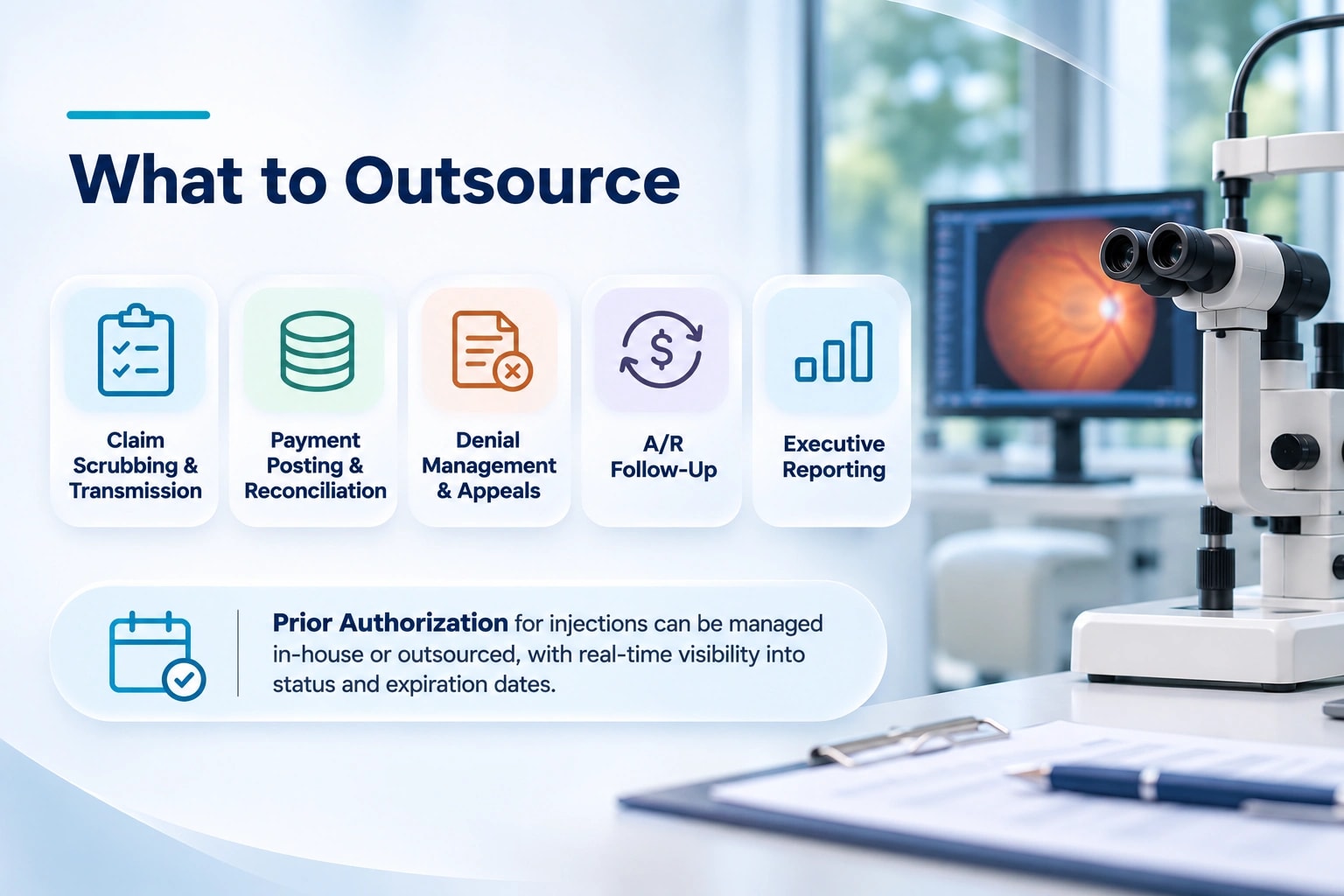
What to Outsource
- Claim Scrubbing and Transmission: Validating NCCI edits, NDCs, units, and modifiers prior to clearinghouse submission.
- Payment Posting and Reconciliation: Posting ERAs, matching line-item drug payments against invoices, and balancing patient payments.
- Denial Management and Appeals: Working rejected claims, filing clinical appeals for authorization or medical necessity denials, and tracking CARC/RARC patterns.
- A/R Follow-Up: Pursuing unpaid insurance balances over 30 days and managing patient statements.
- Executive Reporting: Providing monthly financial analysis broken down by specialty, provider, payer, and service line.
Prior authorization for injections can be managed in-house or outsourced. Whichever model you choose, both teams must share real-time visibility into authorization status and expiration dates.
Ophthalmology Billing Company Scorecard
Use this weighted scorecard to evaluate competing vendors objectively. Require vendors to provide concrete documentation rather than verbal assurances.
Adjust the weights based on your practice mix: retina practices should increase the weight for drug handling, while surgical centers should prioritize global package management.
Evaluation Criterion | Weight | Required Evidence | A Weak Answer Sounds Like |
|---|---|---|---|
Ophthalmology Specialty Depth | 25% | Active eye care client list, sample ophthalmic reports, staff CPC/COPC credentials | "We bill for all medical specialties." |
Buy-and-Bill Drug Management | 20% | Unit conversion logic, JW/JZ workflow documentation, drug invoice reconciliation logs | "The billing software handles J-codes automatically." |
Prior Authorization Tracking | 15% | Staff allocation for PA, step therapy tracking protocols, approval turnaround metrics | "Your front desk is responsible for authorizations." |
Surgical and ASC Experience | 15% | Global period tracking tools, co-management split workflows, ASC facility billing experience | No mention of Modifiers 54, 55, or 79 |
Reporting Transparency | 15% | Sample monthly reporting package with drug A/R isolated from professional A/R | High-level summary totals with no claim detail |
Contract and Data Terms | 10% | Written notice terms, data return formats, explicit business associate agreement terms | Long auto-renewals, exit fees, vague data ownership |
How to Score Vendors
- Grade each vendor from 1 to 5 on each criterion based on submitted proof.
- Multiply each score by the assigned percentage weight.
- Add the totals together.
Eliminate any vendor that scores poorly on specialty depth or drug management. A low price cannot offset the revenue lost to improper J-code billing or unworked surgical denials.
Also ask for two things in writing: the KPIs the vendor reports every month (days in A/R, clean claim rate, denial rate and drug A/R aging, with each formula defined), and how it will take over open claims, pending prior authorizations and unbilled charges during onboarding.
Need an Objective Review of Your Eyecare Billing?
Dastify Solutions provides specialized coding and A/R audits for cataract, retina, and general ophthalmology practices. We review a sample of your recent claims to identify missing modifiers, incorrect drug units, and uncollected global balances.
Request an Ophthalmology Billing Performance Review
Ophthalmology Billing Services Cost: Fee Models and Drug Margin Math
When analyzing ophthalmology billing services cost, look closely at how the fee model applies to high-cost pharmaceuticals. Comparing vendors based on a single percentage rate without reviewing the underlying contract definitions can lead to unexpected billing expenses. For how each pricing model works in general, see our medical billing costs guide.
Fee Structure | How It Functions | Primary Advantage | Major Financial Risks |
|---|---|---|---|
Percentage of Net Collections | Vendor receives a set percentage of total payments collected | Aligns vendor incentives directly with practice revenue | A standard fee applied to pass-through drug payments can erase net profit margins |
Per-Claim Flat Fee | Fixed fee charged per submitted claim regardless of payment amount | Costs are predictable based on patient visit volume | Vendor lacks financial incentive to pursue complex, aged denials |
Flat Monthly Fee | Fixed monthly rate based on provider count or volume tier | Predictable overhead for the practice | Scope disputes regarding appeals, prior auth, or patient A/R |
Hybrid Tiered Pricing | Lower base fee combined with performance incentives or split drug rates | Tailors cost structure to specific service lines | Complex contract terms requiring precise monthly auditing |
Why Drug Revenue Needs a Separate Contract Line
The buy-and-bill model makes standard percentage fees problematic in retina practices.
(Note: This illustrative math assumes drug acquisition cost equals ASP, the patient's 20% coinsurance is collected, no sequestration cuts apply, and no secondary insurance is involved).
- A practice purchases a single-dose anti-VEGF vial for $1,880.
- The Medicare allowed amount (ASP + 6%) pays $1,992.80.
- The net profit margin on the drug supply is $112.80.
- If your billing company charges a 5% fee on total collections, the billing fee for that single claim line is $99.64 ($1,992.80 x 0.05).
- Result: The billing fee consumes 88% of your gross margin on that medication, despite the administrative work being similar to billing a routine office visit.
These figures are illustrative and do not reflect specific vendor quotes, but they demonstrate why retina and multi-specialty practices negotiate custom drug terms:
- Carve-Outs: Excluding J-code drug payments from the percentage calculation entirely, substituting a flat fee per drug claim line.
- Tiered Percentages: Applying a lower rate (e.g., 1% to 1.5%) to drug reimbursement while applying standard rates to professional surgical and E/M services.
- Net Margin Fee Basis: Applying percentage fees strictly to the professional injection procedure (CPT 67028) and net margin over drug acquisition cost.
Comparing Outsourcing Quotes to Internal Overhead
When evaluating vendor proposals against in-house billing costs, include all hidden overhead items in your internal baseline:
- Biller salaries, payroll taxes, and health insurance benefits
- Practice management software user fees and clearinghouse transaction costs
- Ophthalmic coding software, books, and ongoing staff training
- Staff turnover, recruitment fees, and coverage during absences
- Uncollected revenue from unworked denials and timely filing write-offs
Focusing solely on biller hourly wages understates total internal costs.

Red Flags That Should End the Conversation
If a prospective vendor displays any of the following warning signs during discussions, walk away:
- Guarantees of Specific Collection Increases: No billing company can guarantee reimbursement rates because payments depend on payer contracts, patient benefits, and clinical documentation.
- Encouraging Uniform High-Level Coding: Recommending that a practice bill CPT 66982 or high-level E/M codes as a default strategy can create compliance and audit risk, including False Claims Act exposure.
- No Dedicated Eye Care References: The vendor cannot provide references from active cataract or retina practices.
- Refusal to Separate Drug Fee Logic: The vendor insists on charging a full percentage fee on high-cost Part B drug reimbursement without discussing margin impacts.
- Unclear Data Security and Offshore Handling: The vendor cannot provide a clear accounting of who accesses your Practice Management system or hesitates to execute a compliant Business Associate Agreement under HHS Business Associate Guidelines.
- Omitted Global Period Workflows: The vendor has no system for tracking 90-day global windows or managing surgical co-management splits.
Talk to Dastify Solutions Before You Decide
Dastify Solutions offers full-service ophthalmology billing and revenue cycle management designed specifically for eye care practices. We manage cataract global tracking, buy-and-bill drug reconciliation, injection authorizations, and split medical/vision billing while providing complete reporting transparency.
Contact Dastify Solutions Today
Frequently Asked Questions
How do I choose an ophthalmology billing company?
Evaluate vendors using an eyecare-specific scorecard that measures surgical global tracking, buy-and-bill drug management, prior authorization workflows, NCCI imaging edit scrubbing, and medical versus vision plan routing. Require concrete evidence and client references rather than general sales claims.
How much do ophthalmology billing services cost?
Most companies charge a percentage of net collections, a flat fee per claim, or a hybrid rate. Because high-cost Part B drugs carry thin margins (ASP + 6%), practices should negotiate custom rates or carve-outs for J-code reimbursement to prevent billing fees from consuming drug profits.
What is the difference between billing for ophthalmology vs. primary care?
Ophthalmology manages 90-day surgical global periods, expensive physician-administered drugs requiring exact HCPCS unit conversions and JW/JZ modifiers, disease-linked diagnostic imaging, and separate billing channels for medical insurance and routine vision plans.
What services should stay in-house when outsourcing eyecare billing?
Practices should keep premium IOL financial counseling, physical drug inventory purchasing, clinical chart documentation, and front-desk check-in tasks in-house. Claim scrubbing, submission, ERA posting, denial appeals, A/R follow-up, and drug payment reconciliation are ideal for outsourcing.